StemUp: AQA A level physics 3.12.2: Wave particle duality
 Call Kai
 Learn
Learn Practice Test
 Spaced Repetition
 Match
Match Flashcards
 Knowt Play
1/97

There's no tags or description
Looks like no tags are added yet.
Name | Mastery | Learn | Test | Matching | Spaced | Call with Kai |
|---|
No analytics yet
Send a link to your students to track their progress
98 Terms
What did Newton's corpuscular theory of light propose? (1)
Light consists of tiny particles called corpuscles.
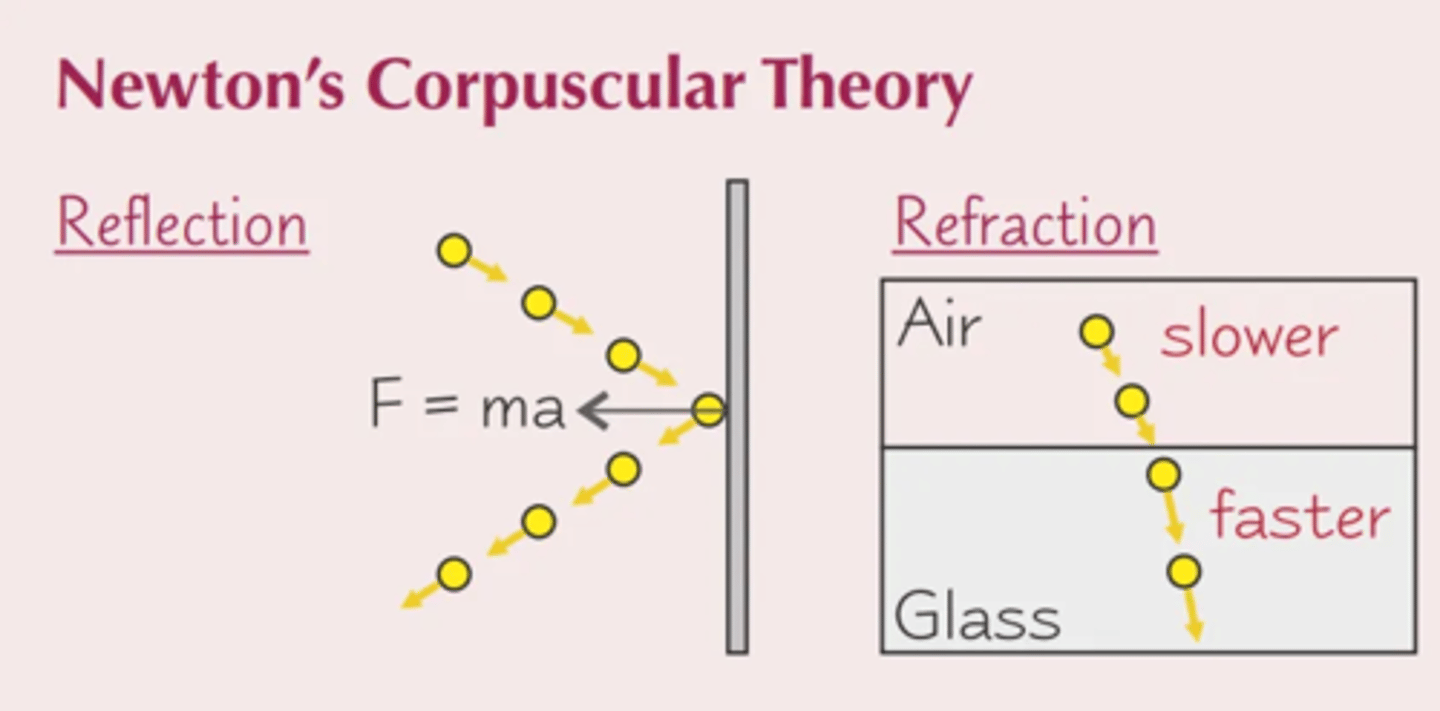
How did Newton's theory explain reflection? (3)
- Corpuscles collide with a surface and are pushed back by a repulsive force.
- This changes their velocity perpendicular to the surface.
- However, the parallel component remains unchanged.
How did Newton's theory explain refraction? (3)
- Corpuscles enter a denser medium.
- Short-range attractive forces increase their perpendicular velocity.
- However, the parallel component remains unchanged.
Why did Newton believe light travels faster in denser media? (3)
- Corpuscles bend towards the normal when entering a denser medium.
- Newton inferred their perpendicular velocity increases.
- This implies a greater overall speed.
What does a labelled diagram showing how Newton's theory describes reflection and refraction look like? (2)
What was a key limitation of Newton's corpuscular theory? (1)
Newton's theory could not explain the diffraction of light.
What was Huygens' wave theory of light? (1)
Huygens proposed that light behaves as a wave.
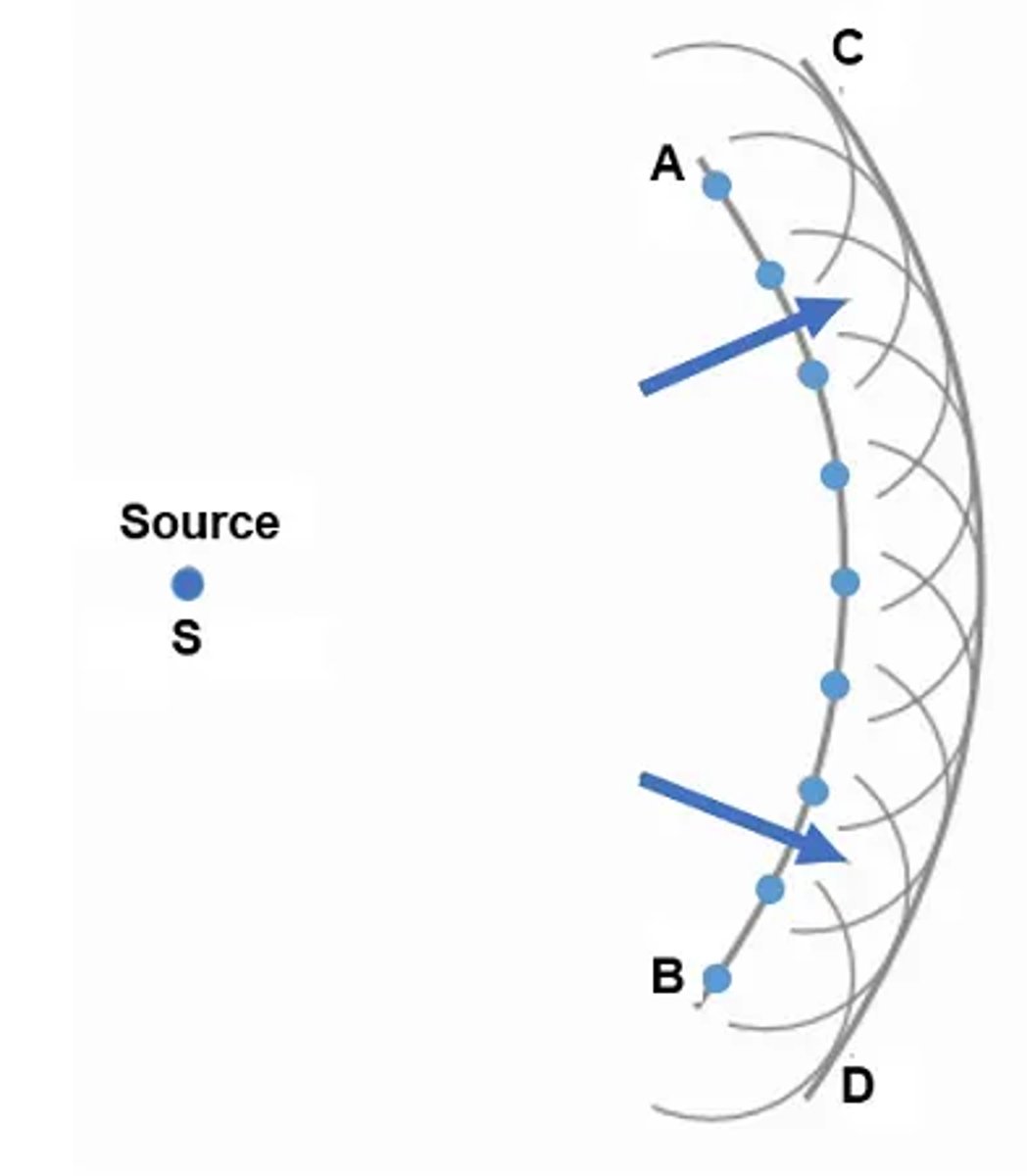
What are secondary wavelets in Huygens' theory? (2)
- Each point on a wavefront acts as a source of small circular wavelets.
- These combine to form the next wavefront.
What is Huygens' principle? (3)
- Every point on a wavefront is a point source of secondary wavelets.
- They spread out in the same direction as the original wave.
- The new wavefront is tangential to all the secondary wavelets.
What does Huygen's principle look like? (2)
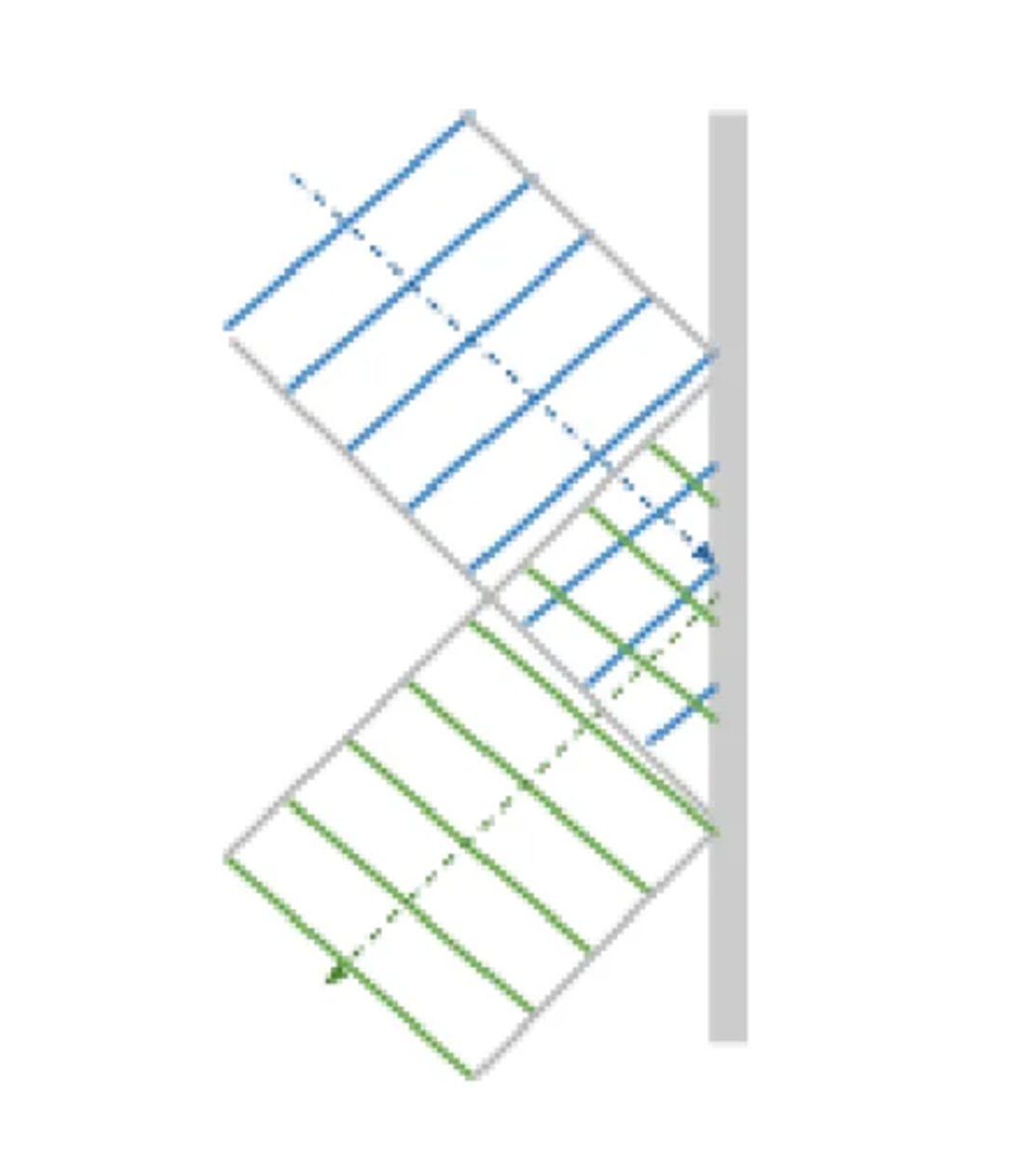
How does Huygens' theory explain reflection? (2)
- Reflected wavelets combine to reform the reflected wavefront.
- This aligns with the law of reflection.
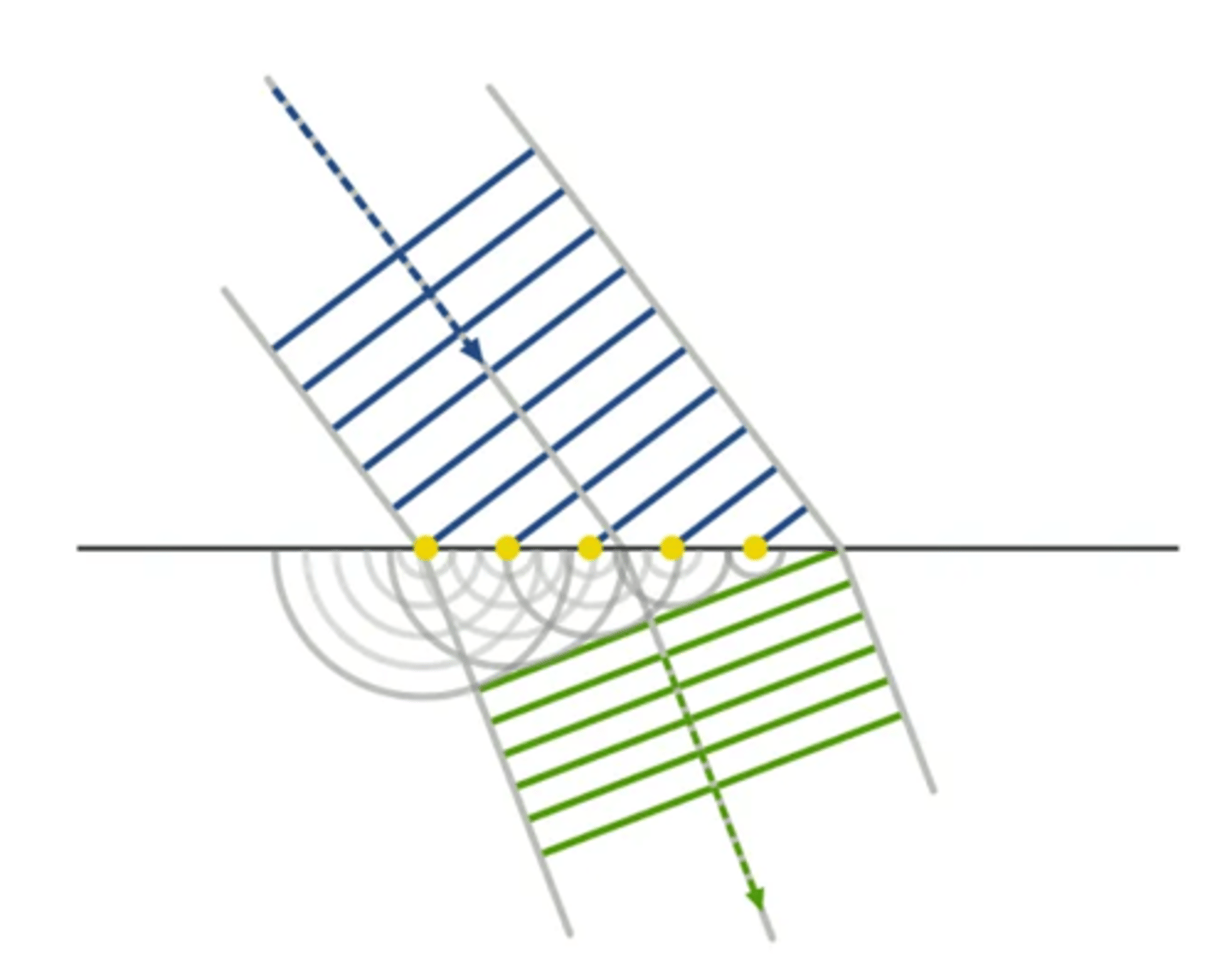
How does Huygens' theory explain refraction? (3)
- Wavelets entering a denser medium spread more slowly.
- The wavefront bends towards the normal.
- This shows that light slows down in denser media.
What does a diagram showing how reflection is explained using Huygens theory look like? (1)
What does a diagram showing how refraction is explained using Huygens theory look like? (1)
Why was Newton's theory accepted despite its flaws? (3)
- Newton's scientific reputation led to wide acceptance of his theory.
- Newton explained double refraction (where light through crystals make two images instead of one) by saying the corpuscles have sides.
- Diffraction hadn't yet been observed, and the speed of light hadn't been accurately measured.
What is observed in Young's double slit experiment with coherent light? (3)
- Coherent light passing through two closely spaced slits diffracts at each slit.
- Each slit acts as a coherent point source and the waves overlap.
- An interference pattern of alternating bright and dark fringes appears on the screen.
How are bright fringes formed in the interference pattern? (3)
- Bright fringes occur where waves arrive in phase and interfere constructively.
- This happens when the path difference is a whole number of wavelengths—path difference = nλ.
- Where n is an integer and λ is the wavelength (m).
How are dark fringes formed in the interference pattern? (3)
- Dark fringes occur where waves arrive completely out of phase and interfere destructively.
- This happens when the path difference is a whole number and a half of wavelengths—path difference = (n + 0.5)λ.
- Where n is an integer and λ is the wavelength (m).
What does the double slit interference pattern look like? (3)
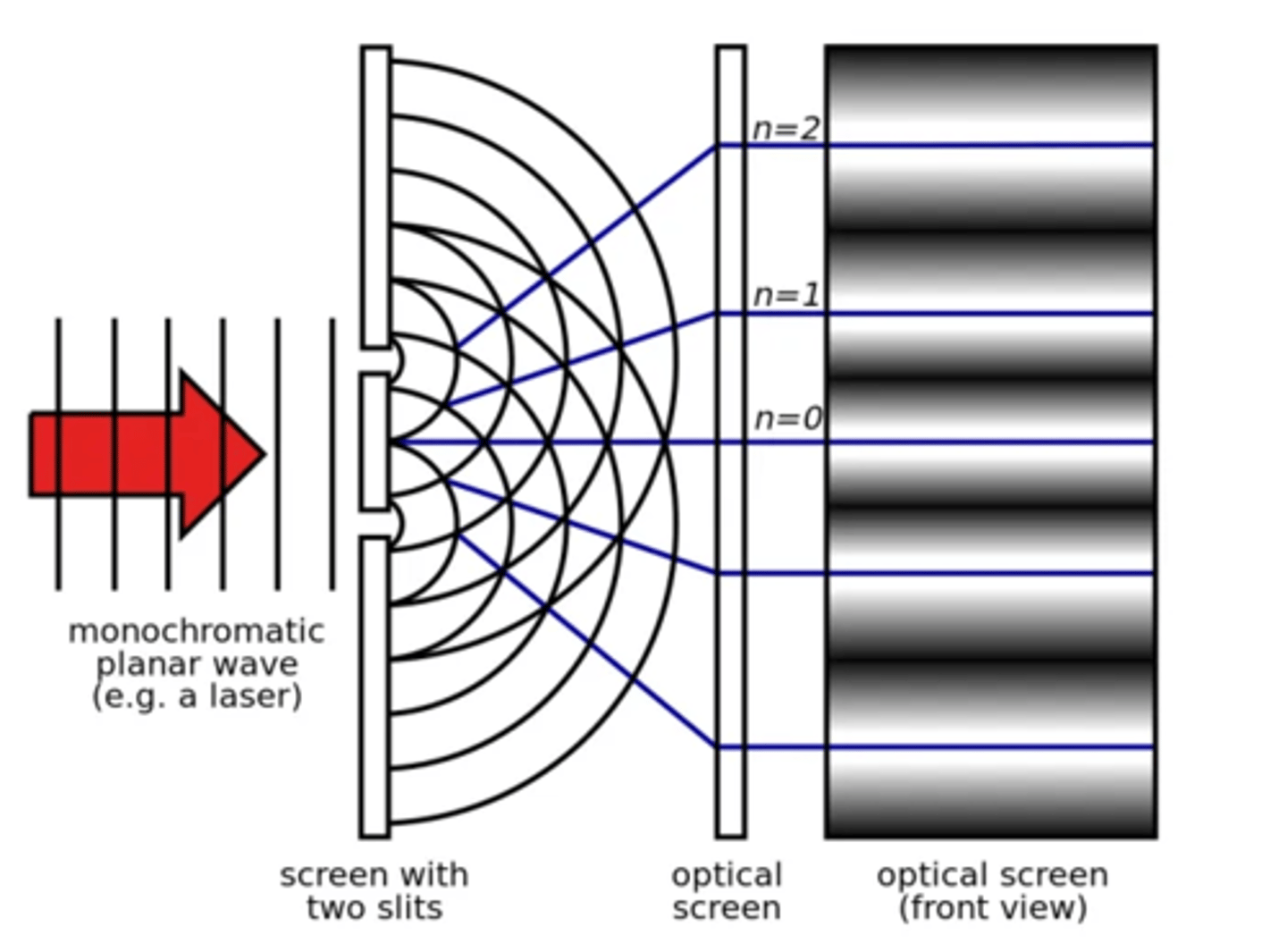
How does Young's experiment disprove Newton's corpuscular theory? (3)
- Newton's theory predicted only two bright spots behind the slits due to particle motion.
- The actual result was a pattern of dark and bright fringes.
- This interference pattern cannot be explained by particles, only by wave behaviour.
How does Young's experiment support Huygen's wave theory? (3)
- Huygen proposed that light is a wave and each point on a wavefront emits secondary wavelets.
- In the experiment, light diffracts at the slits and the waves overlap.
- The resulting interference pattern confirms light's wave-like nature.
Why was Newton's theory still dominant after Young's experiment? (2)
- Newton's strong scientific reputation led to continued support for his theory.
- At the time, diffraction had not been widely observed and light speed in different materials hadn't been measured.
What later discovery contradicted Newton and supported Huygen? (1)
The speed of light was found to be slower in water than in air.
Why does the speed of light in water contradict Newton's corpuscular theory? (2)
- Newton believed light particles would speed up in denser materials due to attractive forces.
- The observed slowing of light in water proved this wrong, supporting wave theory instead.
What are the components of an electromagnetic wave? (2)
- Electromagnetic waves consist of oscillating electric and magnetic fields.
- They are in phase with each other.
What does a polarised electromagnetic field in a vacuum look like? (2)
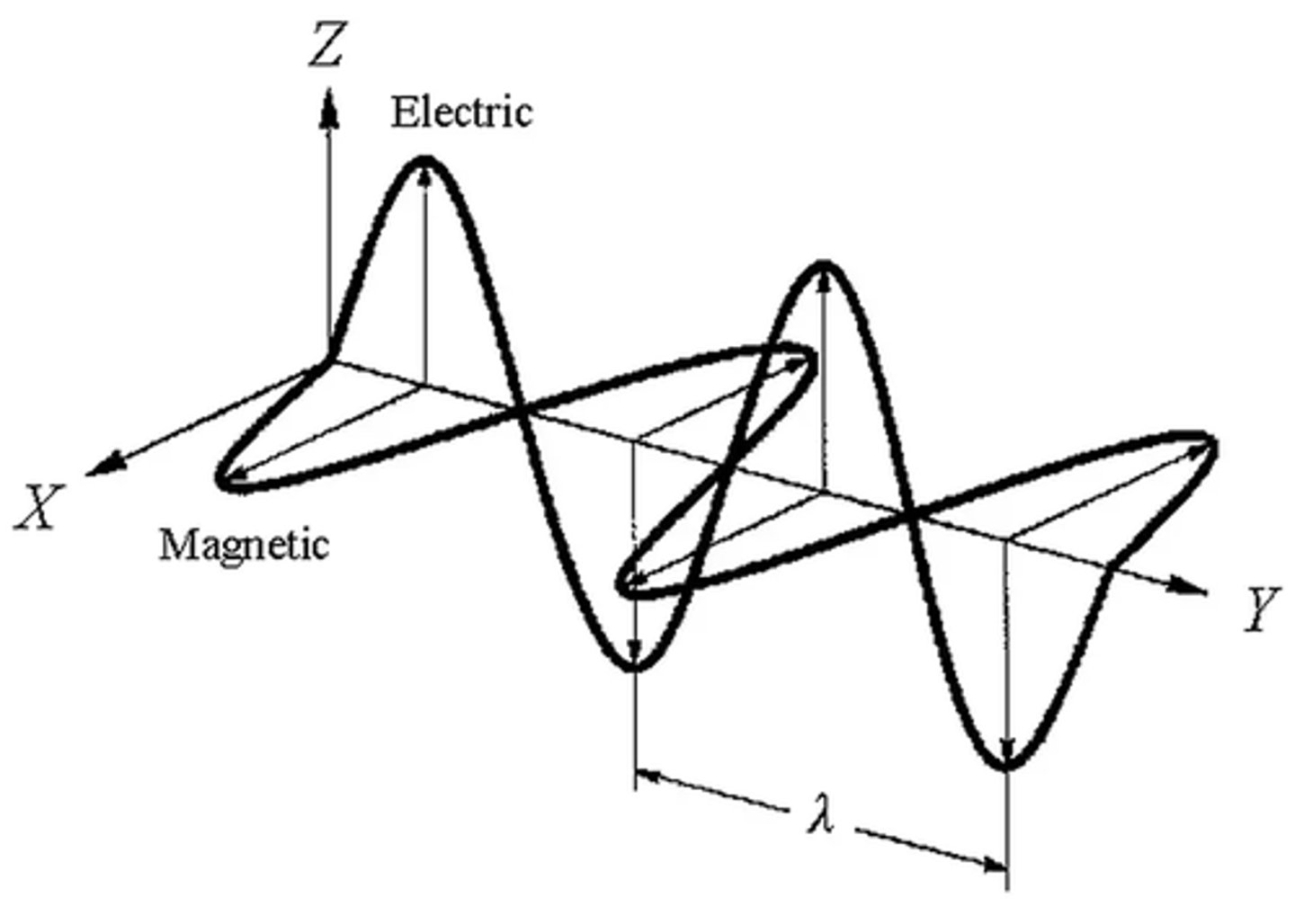
How are the fields oriented in an electromagnetic wave? (2)
- The electric and magnetic fields oscillate at right angles to each other.
- They are perpendicular to the direction of wave propagation.
What is Maxwell's equation for the speed of electromagnetic waves in a vacuum? (2)
- The speed is given by
c = 1 / √(μ₀ε₀).
- Where c is the speed of light in a vacuum (m/s), μ₀ is the permeability of free space (H/m), and ε₀ is the permittivity of free space (F/m).
What does μ₀ represent in Maxwell's equation? (1)
μ₀ is the permeability of free space and relates to the magnetic flux density produced by a current-carrying wire.
What does ε₀ represent in Maxwell's equation? (1)
ε₀ is the permittivity of free space and relates the electric field strength to the electric charge producing the field.
How did Hertz generate radio waves? (1)
Hertz used high voltage sparks across a gap to generate oscillating electric and magnetic fields.
How did Hertz detect the electric field of the radio wave? (1)
Hertz used a dipole receiver with metal plates placed parallel to the spark gap.
How did Hertz detect the magnetic field of the radio wave? (1)
Hertz used a loop of wire with a gap to detect the changing magnetic field via induced current.
How did Hertz confirm radio waves are electromagnetic? (1)
Hertz used a metal sheet to reflect the waves and form a standing wave.
How did Hertz use a standing wave to measure wavelength? (1)
Hertz measured the distance between nodes in the stationary wave pattern.
How did Hertz confirm the wave speed matched Maxwell's prediction? (1)
Hertz used the frequency and measured wavelength to calculate the wave speed.
How did Hertz demonstrate polarisation of radio waves? (2)
- Hertz rotated the receiver around the transmitter axis.
- He observed a change in signal strength.
What did Hertz observe when the receiver was rotated 90°? (2)
- The signal strength dropped to zero.
- This indicated polarisation.
Describe the basic setup of Fizeau's experiment. (3)
- A pulsed light beam passed through a rotating toothed wheel.
- It then reflected off a distant mirror.
- It then returned through the wheel.
What does the basic setup of Fizeau's experiment look like? (3)
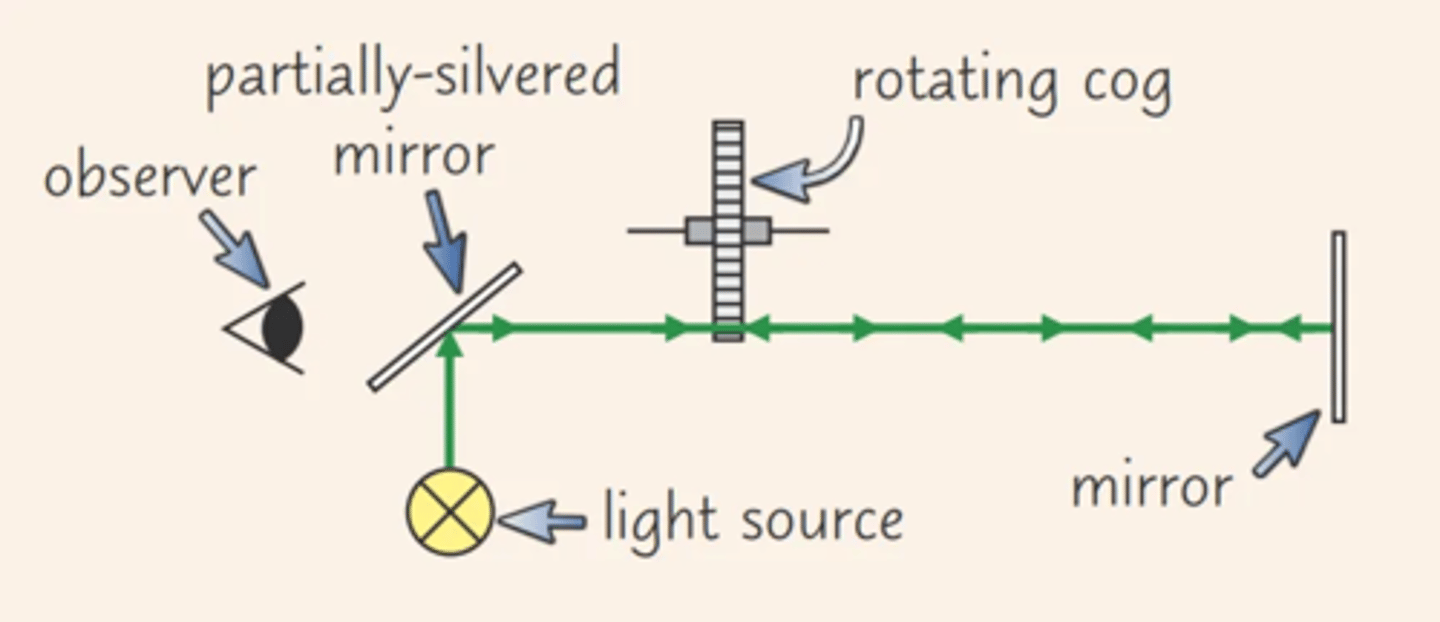
What happened when the wheel rotated at the right speed in Fizeau's experiment? (2)
- The returning light beam was blocked by the next tooth.
- This made it invisible.
What data did Fizeau use to calculate the speed of light? (3)
- The number of teeth on the wheel.
- The wheel's rotation frequency.
- The distance to the mirror.
What equation did Fizeau derive for the speed of light? (2)
- The equation is
c = 4dnf.
- Where c is speed of light (m/s), d is distance to mirror (m), n is number of teeth, and f is frequency (Hz).
Why was Fizeau's result significant? (2)
- Fizeau's result matched Maxwell's predicted speed of light.
- This confirmed that light is an electromagnetic wave.
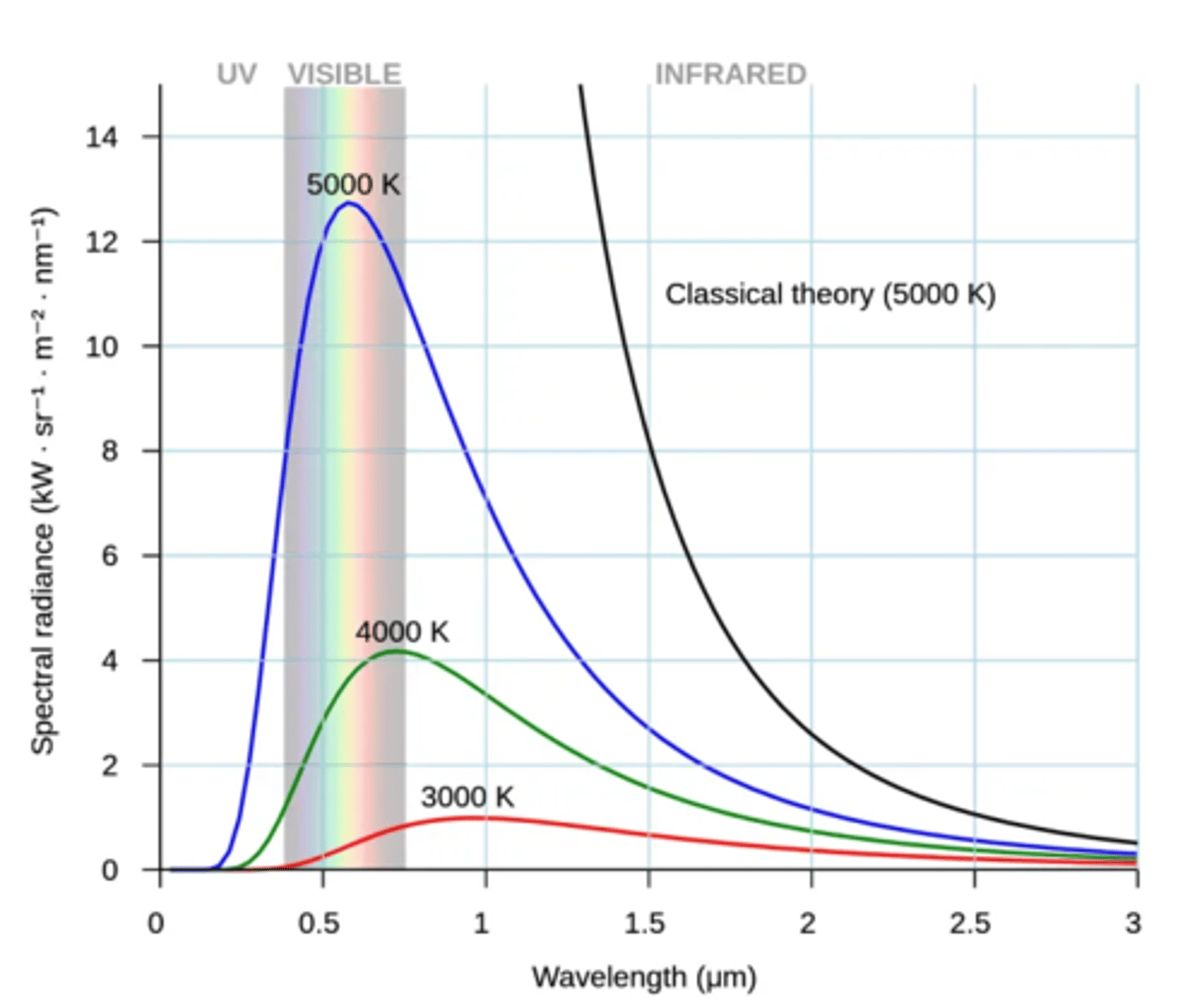
What is meant by a black body? (1)
A black body is a perfect absorber and emitter of all wavelengths of electromagnetic radiation.
What did classical wave theory predict about black body radiation at short wavelengths? (2)
- Classical wave theory predicted that intensity would increase without limit as wavelength decreased.
- This would result in infinite ultraviolet radiation.
What was the name of the failure of classical theory to explain black body radiation? (1)
This failure is known as the ultraviolet catastrophe.
How did Planck resolve the ultraviolet catastrophe? (1)
Planck proposed that electromagnetic waves are emitted in discrete packets of energy called quanta.
What is the equation for the energy of a quantum of radiation? (2)
- The equation is
E = h × f.
- Where E is the energy of the quantum (J), h is Planck's constant (6.63 × 10⁻³⁴ Js), and f is the frequency (Hz).
What does the black body diagram show about classical versus observed radiation curves? (3)
The black line shows what is predicted by classical theory and the coloured lines show what is observed.
Why couldn't wave theory explain the existence of a threshold frequency? (2)
- Wave theory predicted that any frequency of light could cause photoemission given enough time.
- This contradicts experimental results.
Why couldn't wave theory explain the instant emission of electrons? (2)
- Wave theory predicted a time delay before emission.
- Experiments showed electrons were emitted immediately.
Why did increasing light intensity not increase photoelectron energy, as wave theory predicted? (2)
- Experiments showed the number of photoelectrons was increased by intensity.
- It did not affect their individual energy.
Why was the range of photoelectron energies a problem for wave theory? (2)
- Wave theory assumed uniform energy transfer.
- However, photoelectrons were emitted with a range of energies.
What was Einstein's photon model of light? (2)
- Einstein proposed that light is made of discrete photons.
- Each photon carries energy proportional to its frequency.
How does a photon cause electron emission in Einstein's model? (2)
- A single photon transfers all its energy to one electron.
- This is emitted if the energy exceeds the material's work function.
What does a labelled diagram of the photoelectric effect look like? (2)
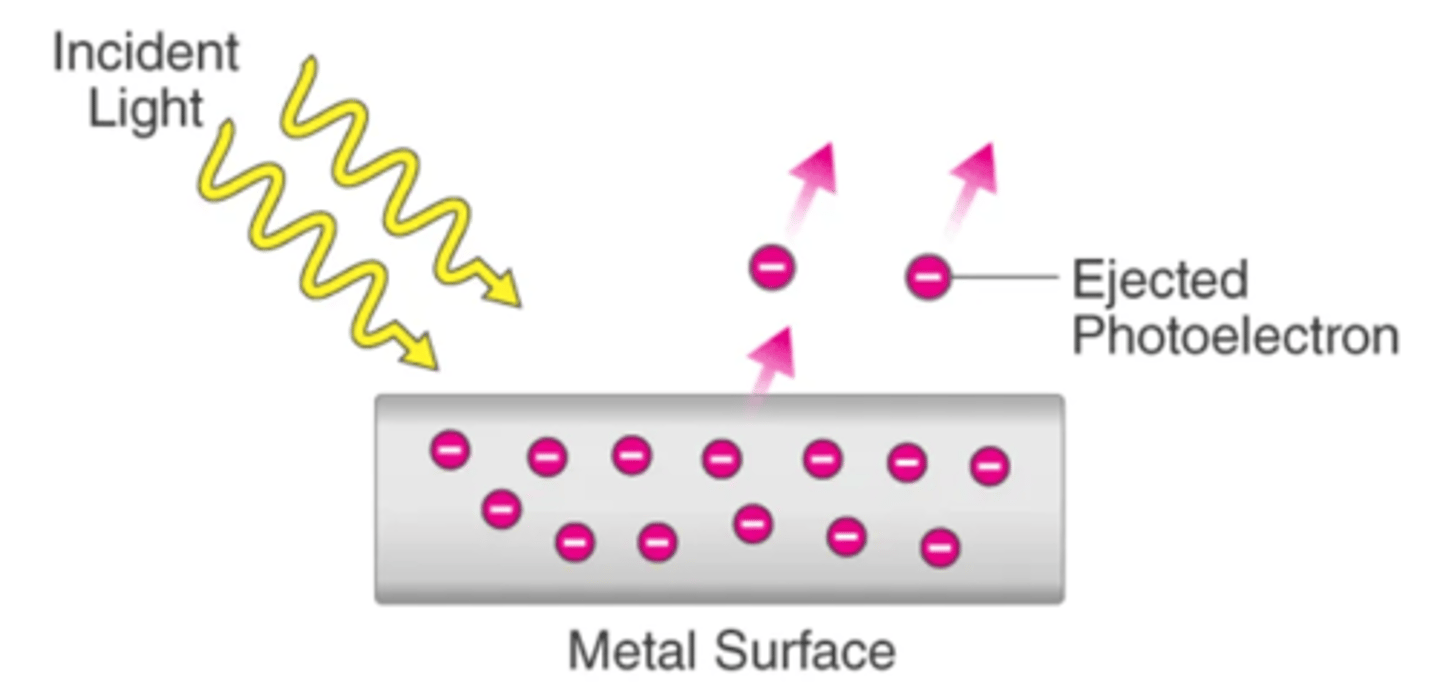
What happens if the photon energy is below the work function? (1)
No electrons are emitted regardless of light intensity or duration.
What is the photoelectric equation? (2)
- The equation is
Eₖ = h × f − ϕ.
- Where Eₖ is kinetic energy (J), h is Planck's constant (6.63 × 10⁻³⁴ Js), f is frequency (Hz), and ϕ is the work function (J).
What is the threshold frequency? (1)
The minimum frequency of light required to emit electrons from a surface.
What is the equation for threshold frequency? (2)
- The equation is
f = ϕ / h.
- Where f is threshold frequency (Hz), ϕ is work function (J), and h is Planck's constant (6.63 × 10⁻³⁴ Js).
How is the kinetic energy of an electron affected in the photoelectric effect? (2)
- The kinetic energy of an electron depends on the frequency of the photon hitting the electron.
- Deeper down, the photons use more energy to emit these electrons so the electrons have a lower kinetic energy.
What is the stopping potential? (1)
The voltage needed to stop the most energetic photoelectrons from reaching the collector.
How is stopping potential used to find maximum kinetic energy? (2)
- The equation is
e × Vₛ = Eₖ(max).
- Where e is the electron charge (1.6 × 10⁻¹⁹ C), Vₛ is stopping potential (V), and Eₖ(max) is maximum kinetic energy (J).
What is the full photoelectric equation found when derived using energy conservation? (2)
- The equation is
h × f = ϕ + Eₖ(max).
- Where h is Planck's constant (6.63 × 10⁻³⁴ Js), f is frequency (Hz), ϕ is the work function (J), and Eₖ(max) is kinetic energy (J).
How do you rearrange the photoelectric equation to find stopping potential? (2)
- The equation is
Vₛ = (h × f / e) − (ϕ / e).
- Where Vₛ is stopping potential (V), h is Planck's constant (6.63 × 10⁻³⁴ Js), f is frequency (Hz), ϕ is work function (J), and e is electron charge (1.6 × 10⁻¹⁹ C).
What does a graph of stopping potential against frequency look like? (2)
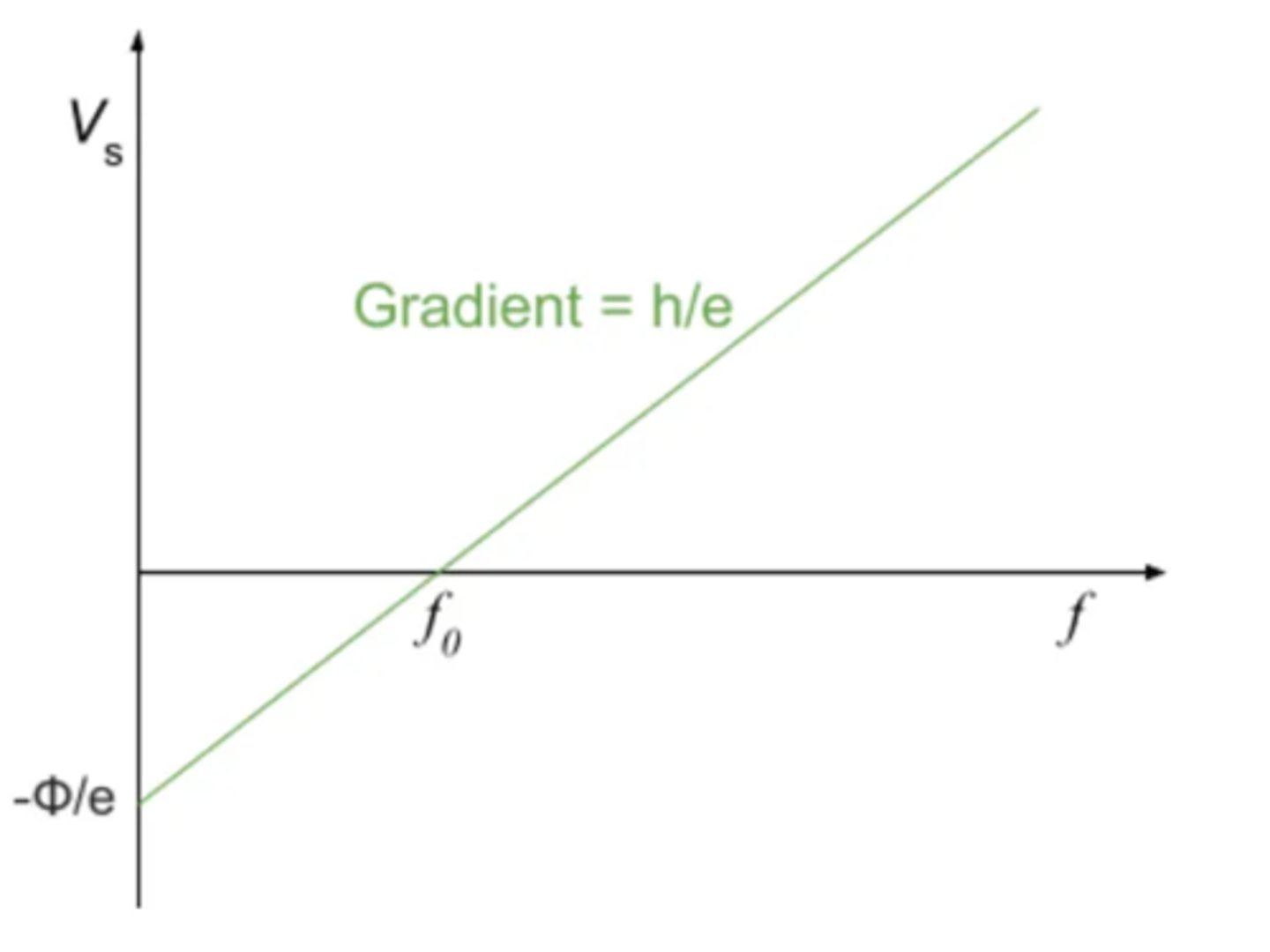
What does a graph of stopping potential against frequency show? (2)
- The graph shows a straight line with gradient h / e.
- It has a y-intercept
−ϕ / e.
How does the graph of stopping potential support the photon model? (2)
- The x-intercept gives the threshold frequency.
- The linear relationship matches predictions from Einstein's theory.
What is the significance of the stopping potential vs frequency graph? (1)
The graph provides strong experimental confirmation of the photon model of light.
What does the de Broglie hypothesis state? (2)
- The de Broglie hypothesis states that all particles exhibit both wave-like and particle-like properties.
- Even particles such as electrons can behave like waves under certain conditions.
What is the de Broglie equation? (2)
- The equation is
λ = h / mv.
- Where λ is the wavelength (m), h is Planck's constant (6.63 × 10⁻³⁴ Js), m is the particle's mass (kg), and v is its speed (m/s).
How can the de Broglie equation be rewritten using momentum? (1)
Since p = mv, the equation becomes
λ = h / p.
What experiment supports the de Broglie hypothesis? (1)
Electron diffraction provides experimental evidence that particles exhibit wave behaviour.
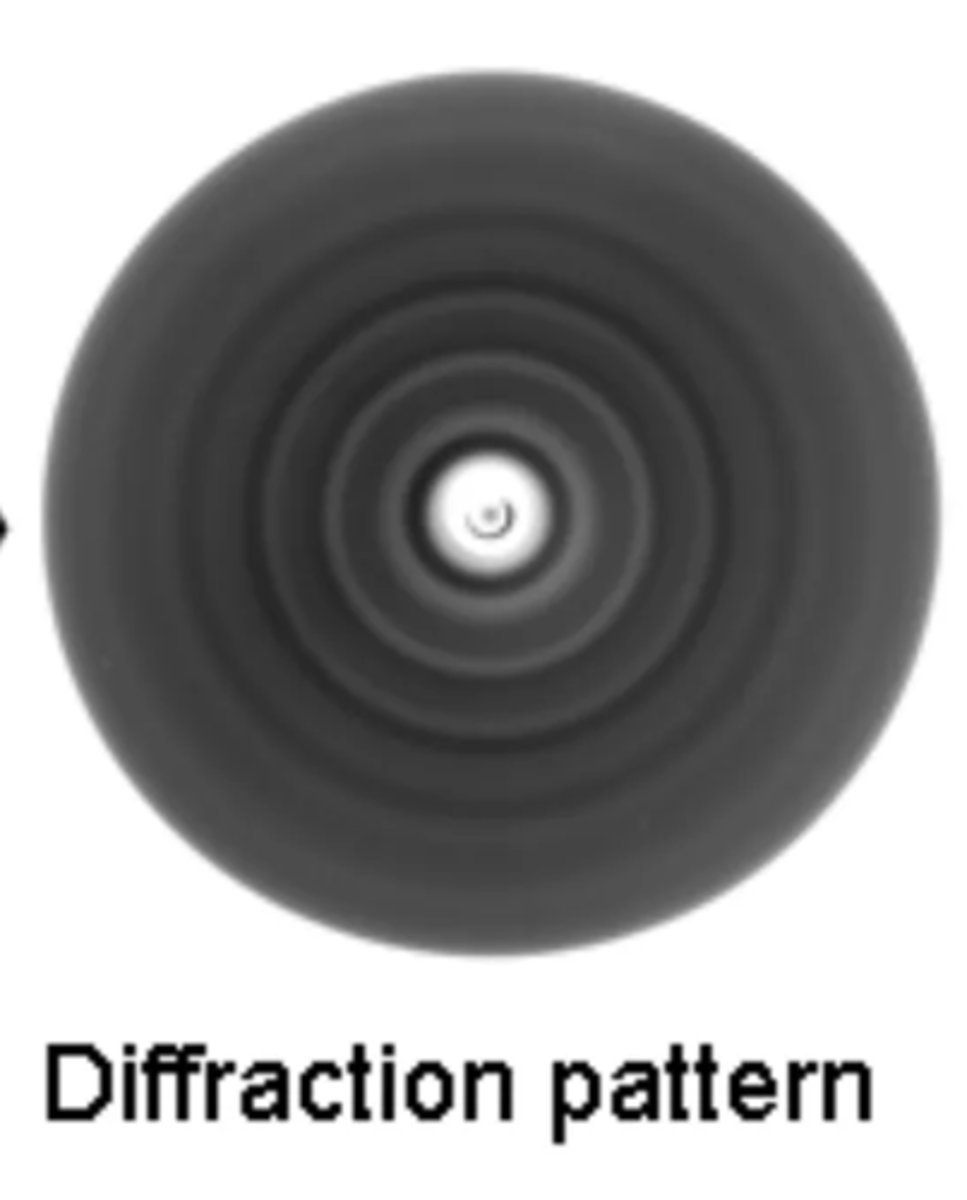
How is electron diffraction carried out? (2)
- Electrons are accelerated using an electron gun through a vacuum tube towards a thin crystal lattice.
- A diffraction pattern forms on a fluorescent screen behind the crystal due to the interaction with atomic spacing.
Why does electron diffraction support wave-particle duality? (2)
- Diffraction is a property of waves and can't be explained by particles alone.
- Since electrons produce a diffraction pattern, they must also act like waves.
What does the electron diffraction pattern look like? (1)
The pattern consists of circular fringes formed on a screen placed behind the crystal.
What does a diagram of electron diffraction look like? (1)
What equation relates an electron's kinetic energy to accelerating voltage? (2)
- The equation is
½ mv² = eV.
- Where m is the electron mass (kg), v is velocity (m/s), e is charge of the electron (1.6 × 10⁻¹⁹ C), and V is the accelerating voltage (V).
What is the derived de Broglie equation for accelerated electrons? (5)
- Start from
1/2 m v² = e V.
- Multiply both sides by 2 to get m v² = 2 e V.
- Take the square root of both sides to get
m v = √(2 m e V).
- Substituting mv into the de Broglie equation λ = h / √(2 m e V).
- Where λ is wavelength (m), h is Planck's constant (6.63 × 10⁻³⁴ Js), m is mass of electron (kg), e is electron charge (1.6 × 10⁻¹⁹ C), and V is accelerating voltage (V).
What happens to fringe spacing when accelerating voltage is increased? (2)
- Electrons move faster and have more kinetic energy.
- Their de Broglie wavelength becomes shorter, so the fringe spacing decreases.
What happens to fringe spacing when accelerating voltage is decreased? (2)
- Electrons move slower and their de Broglie wavelength increases.
- This increases diffraction and the fringe spacing becomes wider.
When do particles show wave-like behaviour? (1)
Diffraction only occurs if objects have a similar size to their de Broglie wavelength.
What is meant by the resolving power of a microscope? (1)
The resolving power is the ability to distinguish two structures that are very close together as separate objects.
How does the resolving power of an electron microscope compare to that of a light microscope? (2)
- The wavelength of an electron beam is much smaller than that of visible light.
- Therefore, electron microscopes have a much higher resolving power than light microscopes.
What is the effect of decreasing electron wavelength on resolving power? (2)
- As electron wavelength decreases, resolving power increases.
- This allows smaller details in a sample to be resolved.
What is the name of one type of electron microscope? (1)
Transmission electron microscope (TEM).
What does the condenser lens do in a TEM? (1)
The condenser lens deflects the electron beam into a wide, parallel beam directed at the sample.
What does the objective lens do in a TEM? (1)
The objective lens forms an image of the sample just above the lens.
What does the projector lens do in a TEM? (2)
- The projector lens magnifies the image formed by the objective lens.
- It then projects it onto a fluorescent screen.
Why must the sample be extremely thin in a TEM? (2)
- The sample must be thin so that electrons do not slow down.
- This is also so that their wavelength remains constant as they pass through.
What limits the resolving power in a TEM? (2)
- If the sample is too thick, electrons slow down and their wavelength increases.
- If electrons have different speeds from thermionic emission, their wavelengths vary, causing image blurring.
Why does increasing accelerating voltage improve TEM resolving power? (2)
- Increasing accelerating voltage increases electron speed.
- This decreases their de Broglie wavelength, improving resolution.
How do you estimate the anode voltage needed to get electron wavelengths similar to atomic diameters? (3)
- Use the equation
λ = h / √(2meV).
- Rearrange it for V
V = h² / (2meλ²m).
- Where λ is wavelength (m), h is Planck's constant (6.63 × 10⁻³⁴ Js), m is mass of electron (9.11 × 10⁻³¹ kg), e is charge of electron (1.6 × 10⁻¹⁹ C), and V is anode voltage (V).
How does a scanning tunnelling microscope (STM) form an image? (3)
- A STM uses quantum tunnelling of electrons to detect the surface profile.
- Electrons tunnel across very small gaps due to wave behaviour.
- Variations in tunnelling current are used to construct an image.
How does the probe-surface gap affect tunnelling current in an STM? (2)
- A larger gap reduces tunnelling current.
- A smaller gap increases tunnelling current.
What is constant height mode in an STM? (2)
- The probe height is fixed.
- The tunnelling current is used to generate the surface image.
What is constant current mode in an STM? (3)
- The current is kept constant.
- This is done by adjusting the probe height as it scans the surface.
- The increased height of the probe is the height of the new surface compared to the original surface.