Week 9: Sex determination
 Call Kai
 Learn
Learn Practice Test
 Spaced Repetition
 Match
Match Flashcards
 Knowt Play
1/10

There's no tags or description
Looks like no tags are added yet.
Name | Mastery | Learn | Test | Matching | Spaced | Call with Kai |
|---|
No analytics yet
Send a link to your students to track their progress
11 Terms
Sex organs
Gonads: Organs (testicles & ovaries) which produce gametes (Sperm & ovum)
Internal genitalia: Accessory glands & ducts within the ECF
External genitalia: All external reproductive structures
Diploid cells
Diploid (2n) cells → All somatic cells (body cells sans gametes)
23 homologous chromosome pairs, 46 chromosomes total
22 pairs are autosomal, 1 pair of sex chromosomes
Autosomal = genes of growth & development
Sex chromosomes (X or Y) = genes of sex organ development
Haploid cells
Haploid (n) cells → Only gametes (sperm & ova)
23 chromosomes total → NO PAIRS
22 chromosomes are autosomal, 1 copy of sex chromosomes
Process of conception:
1 haploid (ovum) + 1 haploid (sperm) → Diploid cell (zygote)
Sex determination in chromosomes — extra scenarios
XXY = zygote will develop into a male
YO = zygote will die
XO = zygote will develop into a female (Turner syndrome)
When ovaries develop, one X chromosome randomly clumps into nuclear chromatin called a “Barr body”
Bipotential Gonads
Differentiation of gonads in an embryo happens at week 7.
Prior to week 7, the undifferentiated gonad is termed a “bipotential gonad”
Bipotential gonads have: (think of adrenal glands)
Outer cortex — develops into ovaries (ABSENCE of signal)
Inner medulla — develops into testes (PRESENCE of signal)
This signal is provided by the SRY gene
SRY gene: Male embryonic development
Directs male embryonic development.
Testicular development does NOT require male sex hormones such as testosterone.
Once the bipotential gonad → testicles
3 hormones secreted:
Testicular Sertoli cells secrete anti-Müllerian hormone (AMH; a glycoprotein).
Testicular interstitial (Leydig) cells secrete androgens: testosterone and DHT
AMH causes embryonic Müllerian ducts to regress.
Testosterone converts the Wolffian ducts into male accessory structures.
Later, testosterone controls migration of the testes from the abdomen into the scrotum. Remaining male sex characteristics, are controlled primarily by DHT.
Female embryonic development
Multiple genes required for ovarian development.
In the absence of testicular AMH, the Müllerian ducts develop into the upper portion of the vagina, the uterus, & fallopian tubes
Without testosterone, the Wolffian ducts degenerate.
Without DHT, the external genitalia take on female characteristics
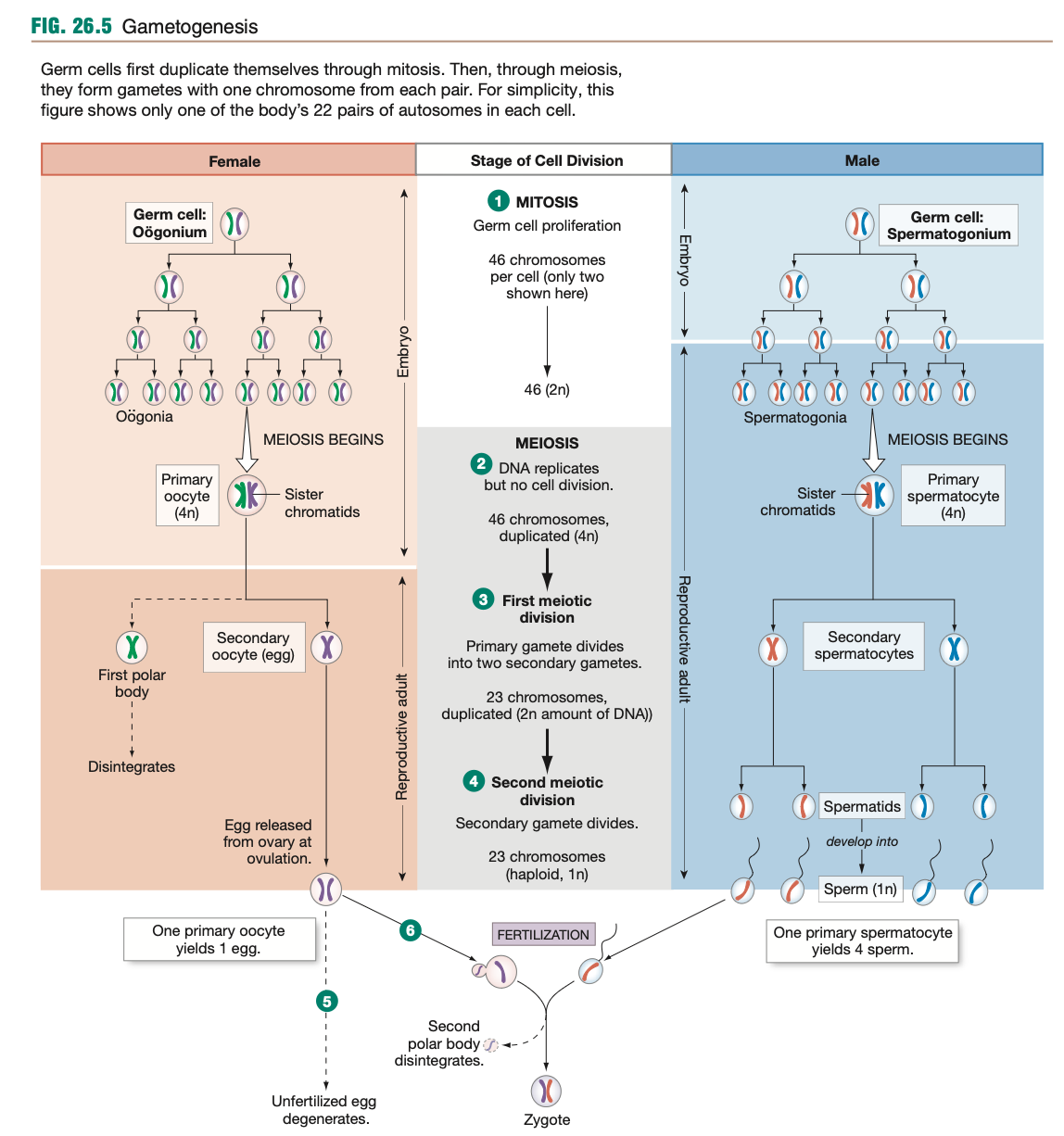
Sperm vs Ovum
Females are born with all the ova they will have.
Males continuously produce sperm when they reach maturity.
Gametogenesis (a.k.a meiosis)
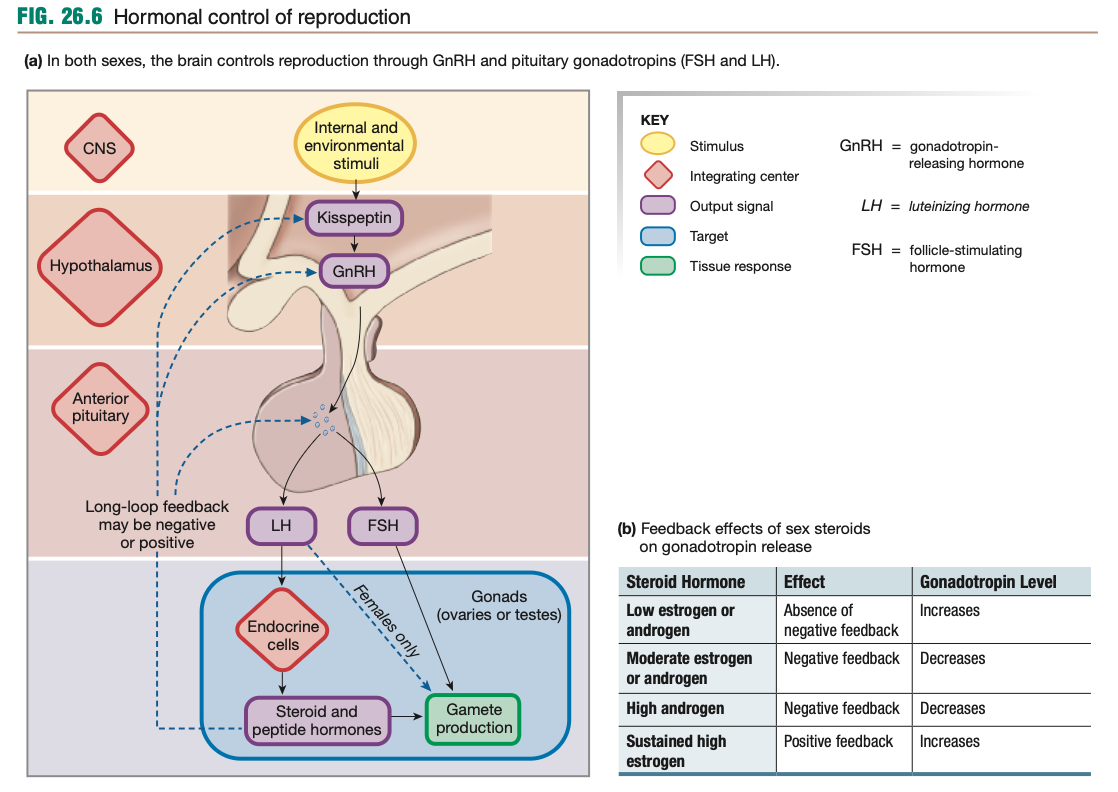
Hormonal control of gamete genesis
Just look at bottom right corner of flow chart.
Female hormones: Progesterone & estrogens
Male hormones: Androgens
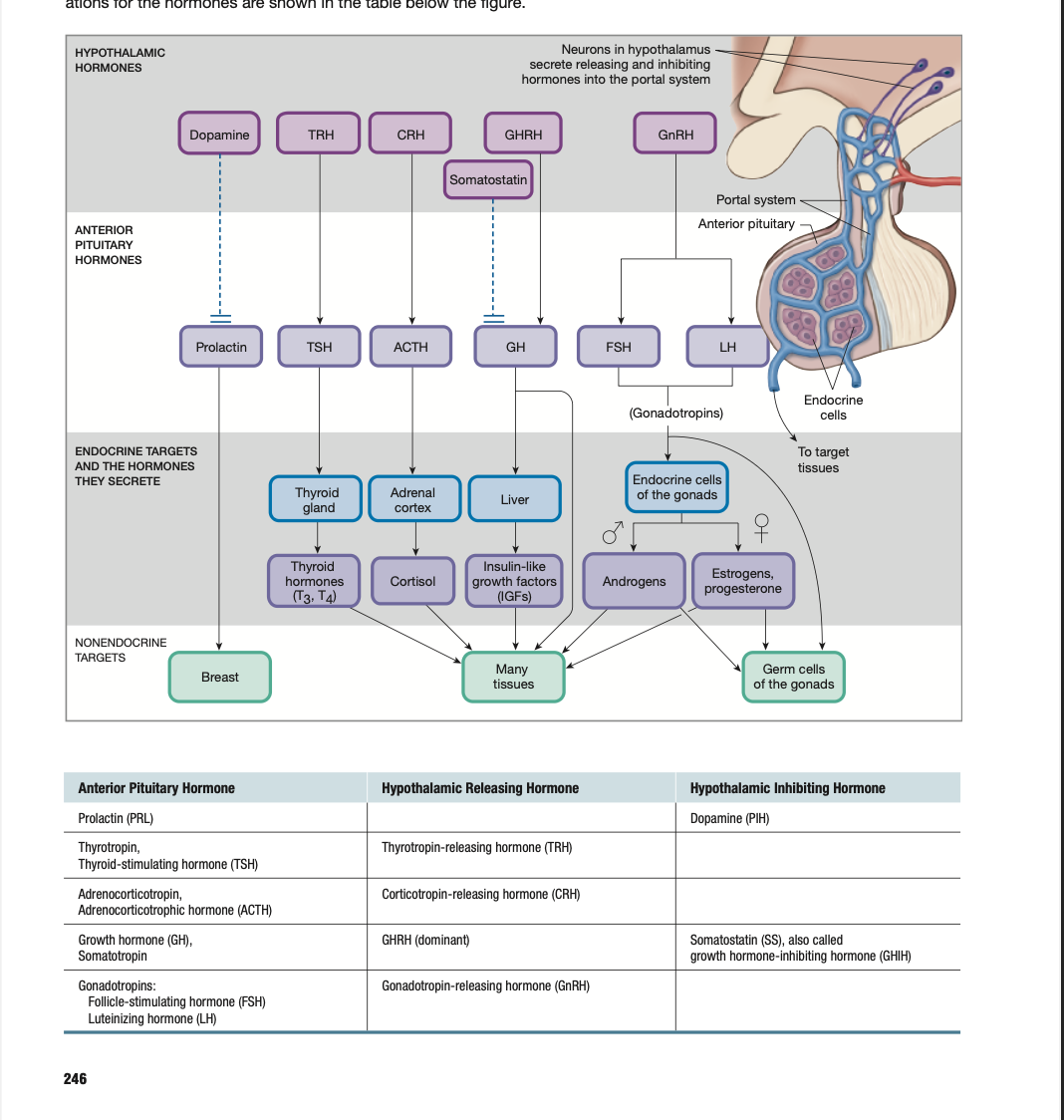
Sex hormone control pathway
GnRH is released in pulses.
If released in a constant, steady stream, does not effectively stimulate the anterior pituitary.