RP12: Separation of species by thin-layer chromatography
 Call Kai
 Learn
Learn Practice Test
 Spaced Repetition
 Match
Match Flashcards
 Knowt Play
1/18

There's no tags or description
Looks like no tags are added yet.
Name | Mastery | Learn | Test | Matching | Spaced | Call with Kai |
|---|
No analytics yet
Send a link to your students to track their progress
19 Terms
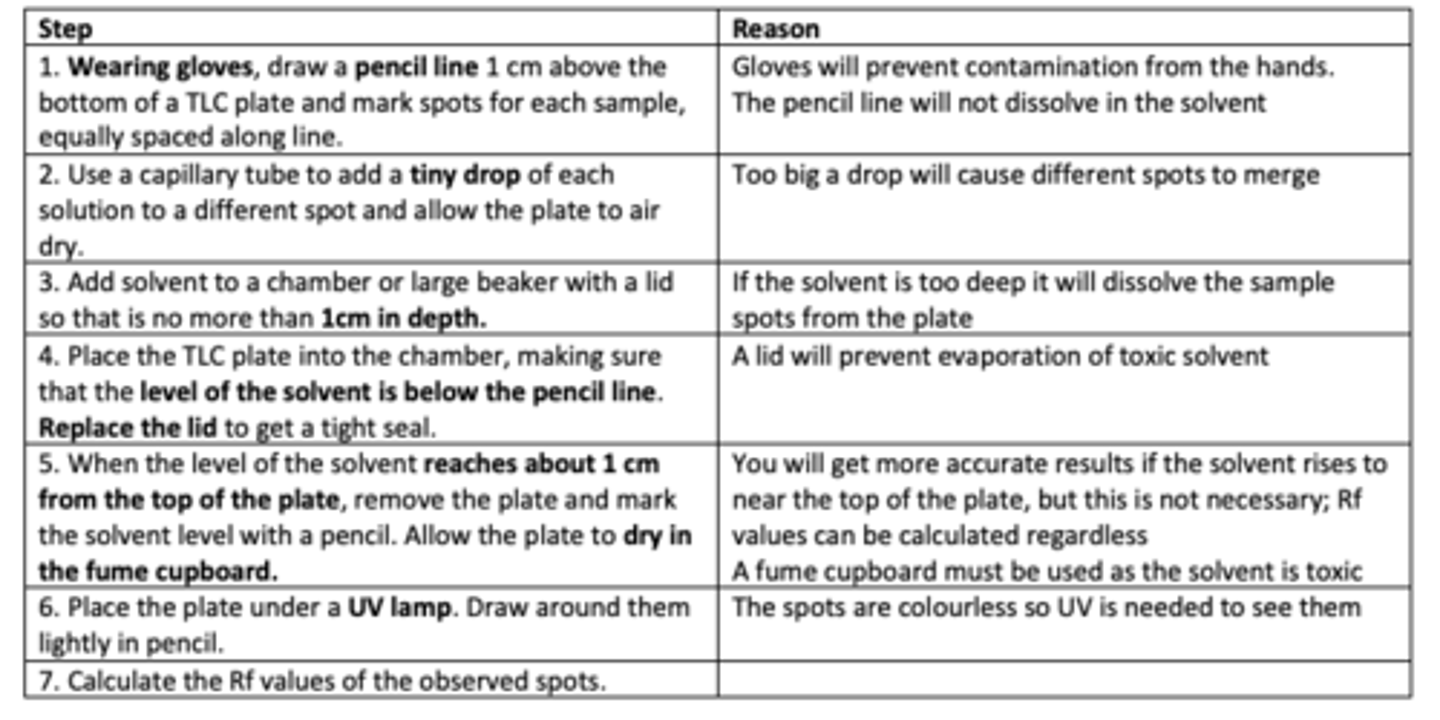
What is the overall method for this experiment? (7)
Why should gloves be worn when handling a TLC plate? (1)
Gloves prevent contamination from hands
Where should the pencil line be drawn on a TLC plate before spotting? (1)
1 cm above the bottom of the plate
Why is a pencil line used instead of a pen on a TLC plate? (1)
The pencil line will not dissolve in the solvent
How should the sample be applied to the TLC plate? (1)
Use a capillary tube to add a tiny drop of each solution to a different spot.
Why should only a tiny drop of solution be added to a TLC plate? (1)
A large drop will cause different spots to merge
How deep should the solvent be in the developing chamber? (1)
No more than 1 cm in depth
Why must the solvent level be kept below the pencil line on a TLC plate? (1)
To prevent the solvent from dissolving the sample spots
Why should the chamber lid be tightly closed during the experiment? (1)
To prevent evaporation of toxic solvent
What should be done once the solvent level reaches 1 cm from the top of the plate? (1)
Remove the plate, mark the solvent level with a pencil, and allow it to dry in the fume cupboard.
Why must the plate be dried in a fume cupboard? (1)
Because the solvent is toxic
How are the spots visualised on a TLC plate? (1)
By placing the plate under a UV lamp
Why is UV light needed for TLC analysis? (1)
The spots are colorless, so UV helps to see them
How should the observed spots on a TLC plate be recorded? (1)
Draw around them lightly in pencil
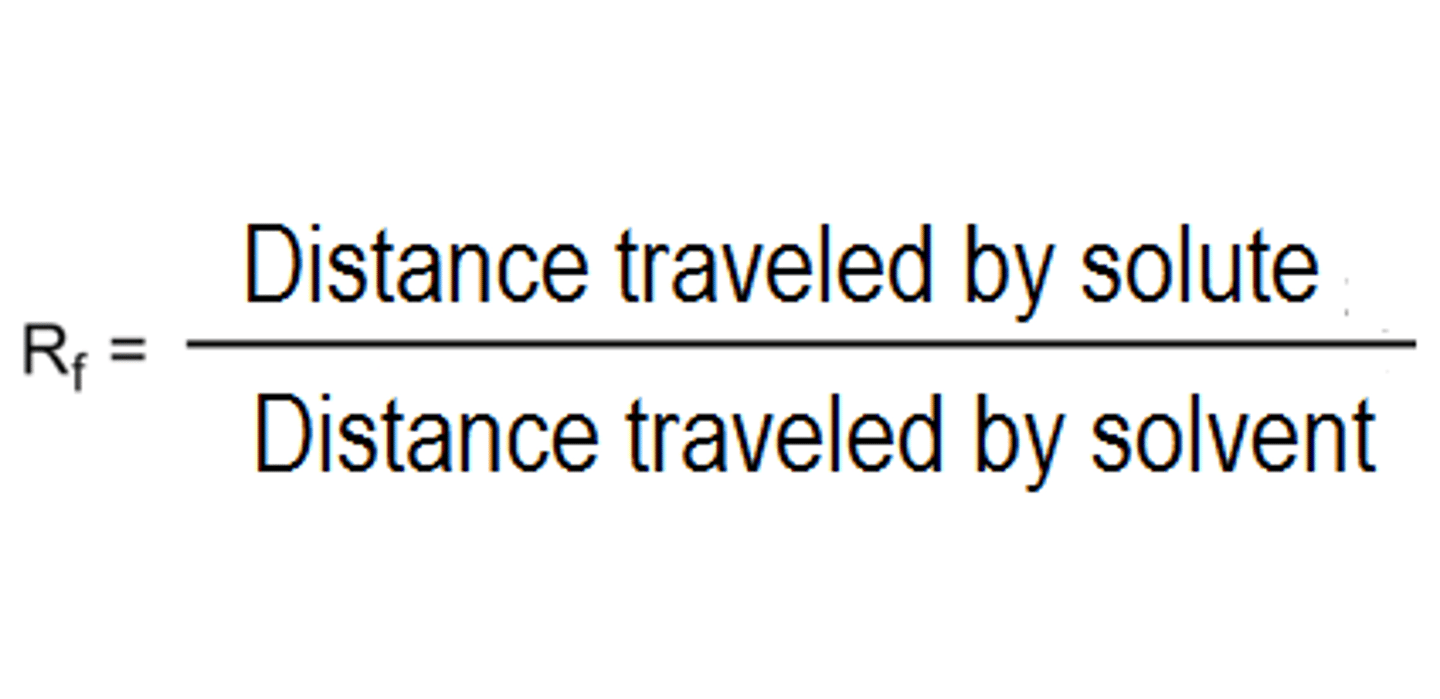
How are Rf values calculated in TLC? (1)
By measuring the distance traveled by each spot relative to the solvent front
What reagent can be used to visualise amino acids on a TLC plate? (1)
Ninhydrin
What is an alternative method to visualise amino acids on a TLC plate? (1)
Using a plate impregnated with fluorescent dye
Why does each amino acid produce a different spot on a TLC plate? (1)
Each amino acid has its own unique Rf value
How do you calculate Rf value? (2)