Phytoplankton functional groups
 Call Kai
 Learn
Learn Practice Test
 Spaced Repetition
 Match
Match Flashcards
 Knowt Play
1/28

There's no tags or description
Looks like no tags are added yet.
Name | Mastery | Learn | Test | Matching | Spaced | Call with Kai |
|---|
No analytics yet
Send a link to your students to track their progress
29 Terms
What are the 6 functional groups of phytoplankton (Taxon)
Cyanobacteria, Diatoms, Crysophytes, Dinoflagellates, Coccolithophores, Cryptophytes
Characteristics of cyanobacteria
Prokaryotes, most of them fix nitrogen, unicellular and colonial species, come toxic
Characteristics of diatoms
unicellular and chain forming species, silica frustule, marine and freshwater, global distribution, account for 40% of marine primary production, few toxic species
Characteristics of dinoflagellates
Mainly marine, some freshwater species, have two flagella, some bioluminescent, some toxic, autotrophic and mixotrophic, heterotrophic species
Characteristics of cryptophytes
Freshwater but also marine and brackish (small to medium in size), 2 flagella
Characteristics of crysophytes
Also called golden algae, mostly freshwater, 2 flagella
Characteristics of chlorophytes
Marine, freshwater, terrestrial, huge group, some members found in extreme environments
Characteristics of coccolithophores
Calcium carbonate scales, global importance
What are the three functional characteristics of phytoplankton
Nitrogen fixers, calcifiers, harmful
Size of picoplankton
0.2-2 μm
Size of nanoplankton
2-20 μm
Size of microplankton
>20 μm
Benefits of small size in phytoplankton
small cells have a larger surface to volume ratio, they can take up low nutrient concentration efficiently (small species dominate in low nutrient waters)
Benefit of large cell size in phytoplankton
They can store nutrients inside the cell
How does cell size play a role in predation dynamics with phytoplankton
some are too small or too big to be eaten
Characteristics of stormer growth strategies
Large, protection against grazing, low growth rate under low iron but rapidly dominate once iron is available
Characteristics of performer growth strategies
Small, highly efficient iron uptake, grows fast but gets eaten quickly
Under what conditions do cyanobacteria dominate
High light, warm, low N, high Fe areas
Ecological strategy of diatoms
High species diversity, clear annual cycle in temperature and polar regions, clear successional pattern, require high nutrients, can deal with turbulence and low light
Ecological strategy of dinoflagellates
Lower species diversity, unpredictable, short duration, shortened succession, swimming strategy, low nutrients, often mixotrophic
What is a resting spore
it is a specialized dormant cell that allows phytoplankton to survive prolonged periods of stress. cells undergo metabolic reprogramming, exhibit thickened cell walls, and accumulate energy reserves. these resting stages settle into sediments, forming extensive seed banks that can persist for very long times. Resting spores germinate when favorable conditions return
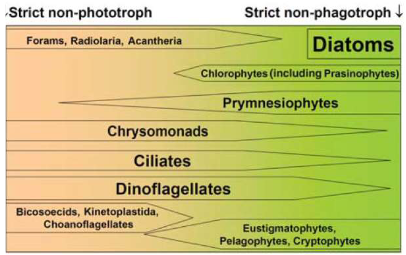
Old versus new understanding of microbial plankton
Used to believe that Phototrophs and Phagotrophs were distinctly different and did not overlap. Current understanding is that there is a spectrum between Phagotrophs and phototrophs and many plankton are mixotrophic
Kleptoplasty in Dinophysis example
Dinophysis needs chloroplasts to photosynthesize but the species that contains chloroplasts (Teleaulax sp.) is too small to eat directly. Teleaulax sp. is eaten by Mesidinium sp. which is large enough for Dinophysis to consume. Once Dinophysis gets chloroplasts it can photosynthesize.
Hatena Arenicola (part time algae) example
Develops a feeding apparatus and feeds on specific algae to steal chloroplasts, feeding apparatus disappears, the cell then divides but isn’t able to split the chloroplasts leaving one daughter cell with the chloroplast and the other without. The cell without the chloroplasts must dorm a feeding apparatus and repeat the cycle
Pallium feeding
When the plankton creates an external membrane around the food to digest it (enables large food to be consumed)
Prorocentrum balticum example
Is a plankton that is like a spider, forms a sticky membrane in the morning to catch prey, consumes what it wants and leaves the membrane to divide (in nutrient poor areas it can sexually reproduce) the membrane is heavy and sinks thus sequestering carbon
Phaeocystis polymorphous life cycle
Different life stages (motile and non-motile forms), different movement strategies (Motility/floating and sinking)
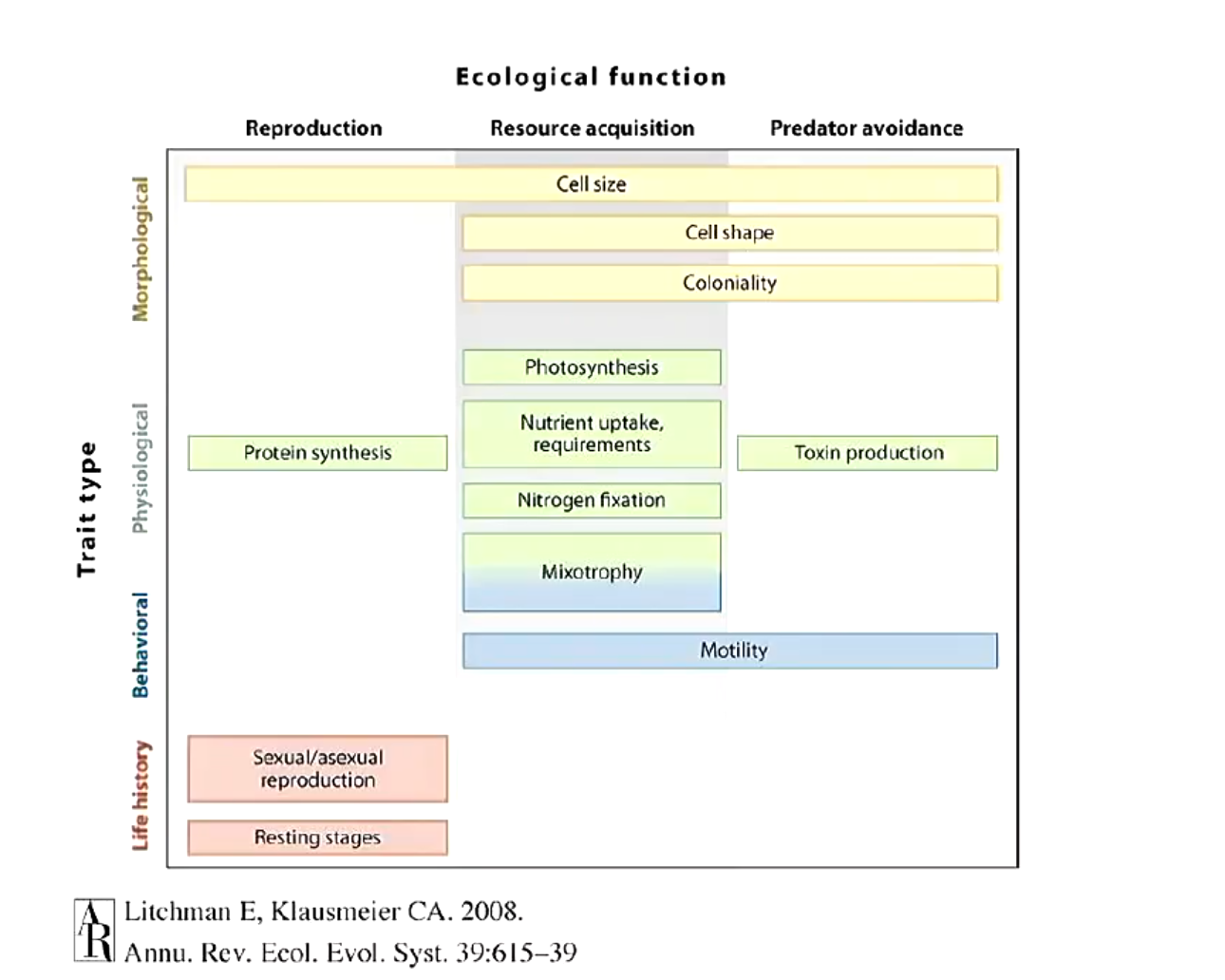
Importance of this figure
Everything in life is about the three main concepts at the top, Trait types are on the left. Even single cell organisms can fit all of the trait types