Arch Society Midterm 2
 Studied by 0 people
 Call Kai
 Learn
Learn Practice Test
 Spaced Repetition
 Match
Match Flashcards
 Knowt Play
1/75

There's no tags or description
Looks like no tags are added yet.
Name | Mastery | Learn | Test | Matching | Spaced |
|---|
No study sessions yet.
76 Terms
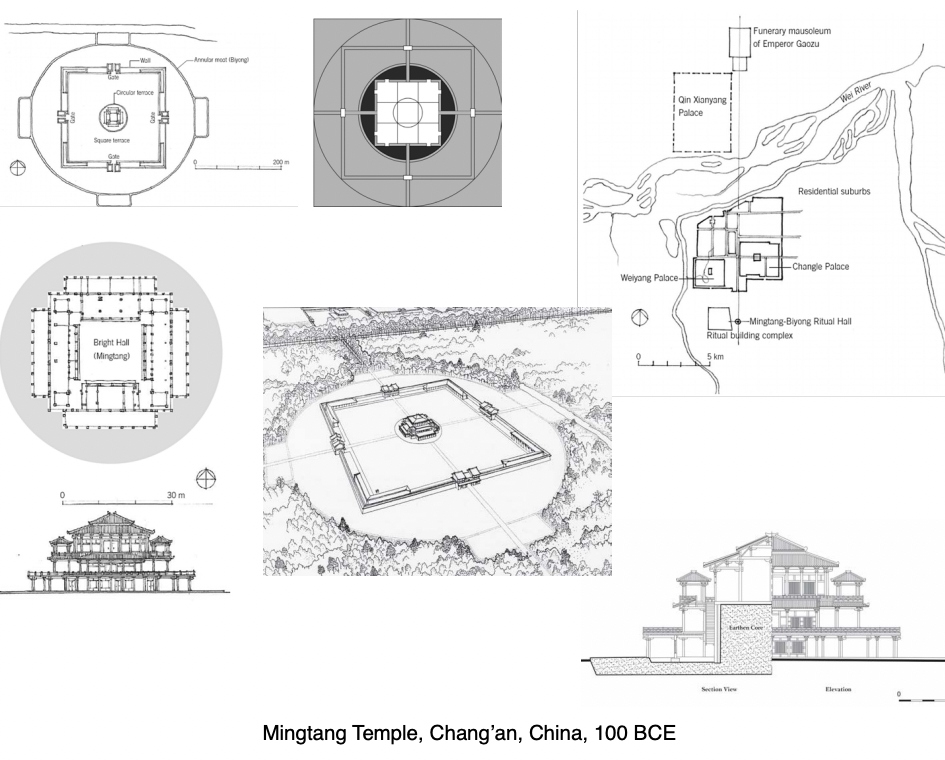
(11) W: Mingtang Temple
Loc. : W: Chang’an, China,
Date: 100 BCE
Cultural origin: Ancient China
Structure:
Interlocking parts
Aligned with the tomb
Intricate wooden carving/design
Interwoven brackets, allowing for flex and bounce, incase of an earthquake for example
^^dougong brackets
Significance:
Bright hall
Circle represents water
Emperor sits in the very middle
Earth is the square, heavens all around it (circle)
EARTHERN core
Earthquakes didn't allow for super tall buildings which is why they built with earthen core.
Axis mundi
Outside is less civilized
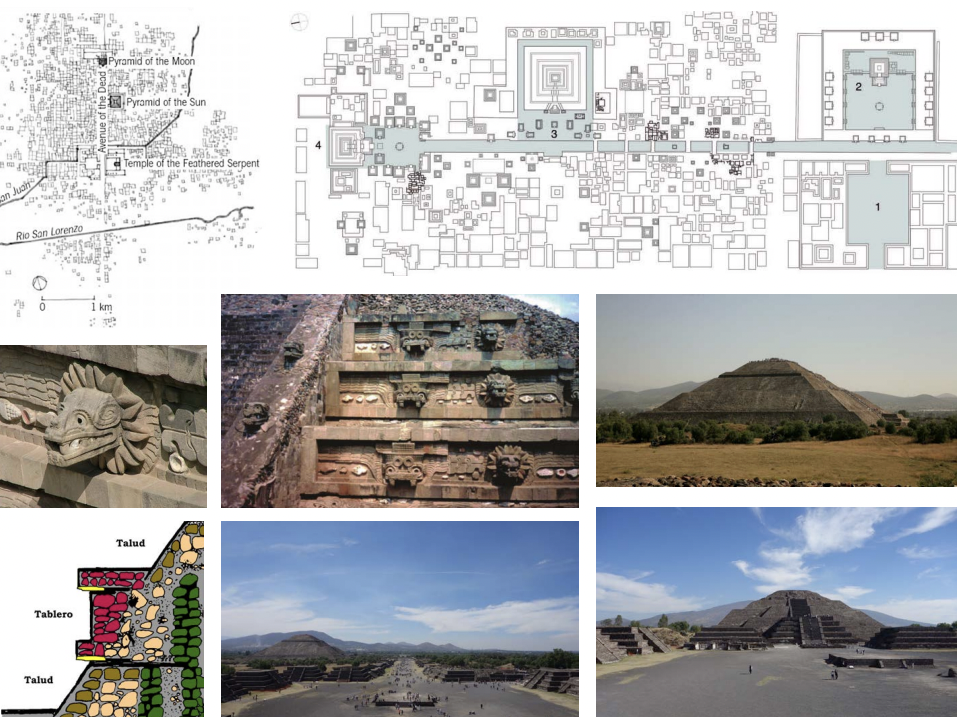
(11) W: Avenue of the Dead and major monuments
Loc. : Teotihuacán, Mexico
Date: 100 CE
Cultural origin: Ancient Mexico
Structure:
used Talud-tablero
abundant local volcanic resources, supplemented by long-distance trade for specialized materials.
Significance:
Biggest city at the time and until the modern era
200k habitants
Emperor controlled immediate territory and neighbors
Eventually surpassed by the aztecs
Debate about its nature, central axis etc.
Name given by its successors.
(1) market; (2) Temple of the Feathered Serpent
compound; (3) Pyramid of the Sun; (4) Pyramid of the Moon (after Rene Millon).
(11) T: Great Wall of China
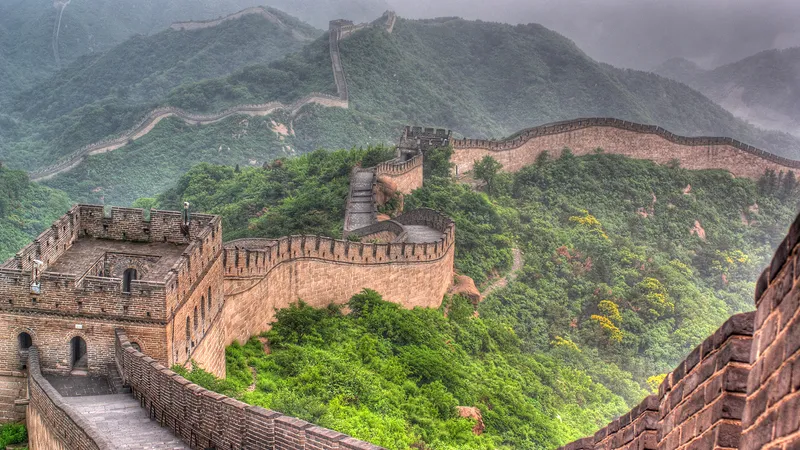
Date China/oc: 221BCE - 1368 CE, Qin Dynasty
15 year dynasty
Creation of walls
Tryna create boundaries between chinese emperor and mongolia
From the north, North is where bad things come from in Chinese culture
originally 20ft high, 13 ft thick, with guard posts
Ming Dynasty rebuilt
Largest single building complex on earth
Built over the course of more than 1000 years
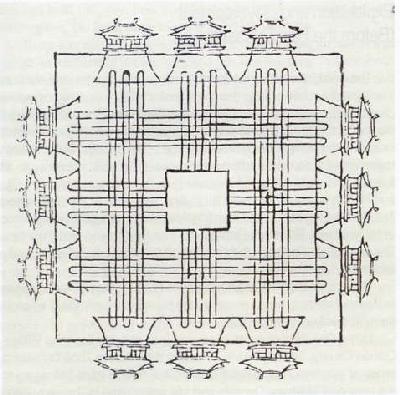
(11) T: Wangcheng diagram
Date/loc: China, ca. 700 BCE
Not an actual Place, just an idea
Clear boundaries
City inside the city
Relationships
Gateways, supervising access
Intersecting roads
A big open space at the center
What a city should be
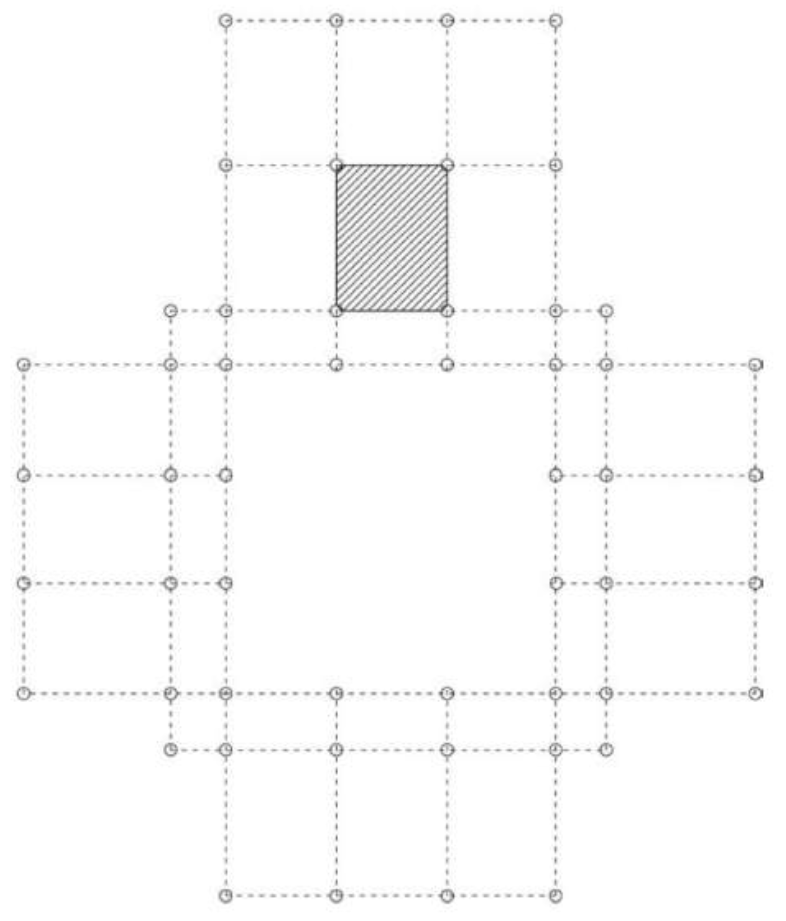
(11) T: building modules (bays or jian)
Jian Proportion system
It was a proportional system used to build buildings
Beginning in the first millennium, the jian, or bay, served as the basic unit of architectural order in China. Structural timber posts defined the jian, which had an average size of 3 x 6 m (10 x 20 ft), setting the size of a room. Chinese designers made their spaces through a process of addition, and a
hall usually expanded to an odd number of jians.
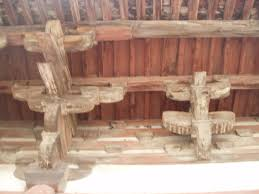
(11) T: dougong brackets
Intricate wooden carving/design
Interwoven brackets, allowing for flex and bounce, incase of an earthquake for example
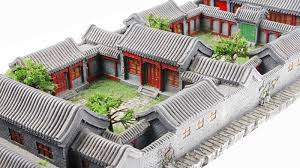
(11) T: siheyuan (courtyard house)
Time: Pingyao China
Courtyards, middle opening
Layout: Four buildings form a square/rectangular courtyard, with the main house typically facing south.
Symbolism: Embodies harmony, family unity, and hierarchy through designated rooms.
Architecture: Uses grey bricks, tiled roofs, detailed woodwork, Built with perishable materials like mud and wood
(11) T: Mesoamerica
Mesoamerica means "Middle America" and refers to a historic cultural region stretching from central Mexico through Central America
Architecture:
Monumental pyramids, temples, and ball courts for ritual games, often aligned with celestial events
(11) T: Mesoamerican pyramid and talud-tablero

Technique that was first used here, became popular all over meso-america.
Slabs on slopes
A series of stacked internal structures made out of stone that is then wrapped in clad, rubble and embedded in clay, sometimes covered in a plaster, painting or/and sculpted.
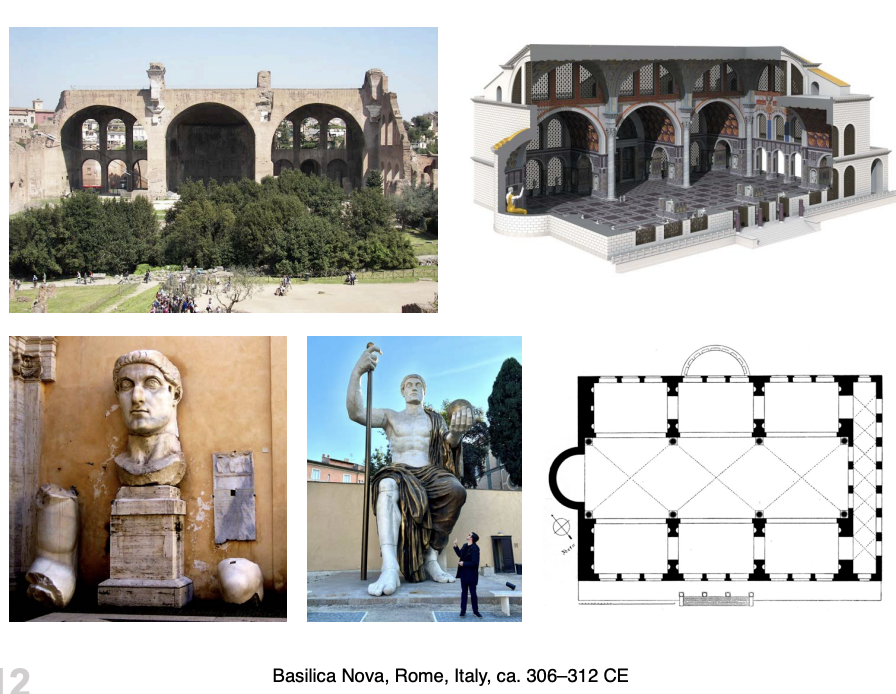
(12) W: Basilica Nova
Loc. : Rome, Italy
Date: ca. 300 CE
Cultural origin: Early Christian Italy
Structure:
longitudinal or basilica plan
contained spolia
Plan: A rectangular building with a large central nave and side aisles, typical of basilicas, but with unique vaulted roofing.
Significance:
Contains Colossus of Constantine and the Portrait of Constantine.
The Basilica Nova's design was foundational for medieval cathedrals and basilicas across Europe
Purpose: Built as a public space for government, court, and meetings, demonstrating imperial power. Transitioned to churches later on.
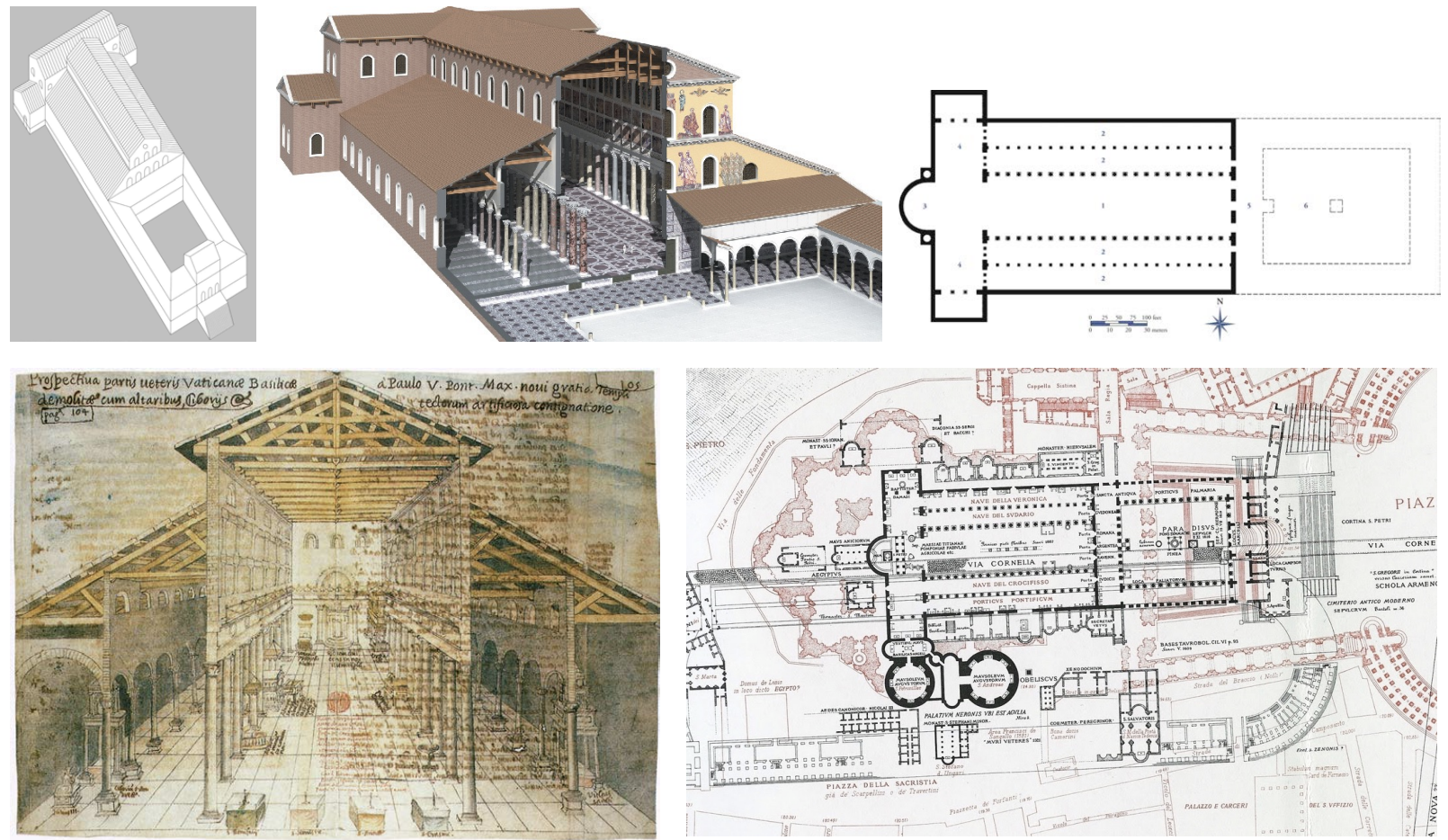
W: Old Saint Peter’s Basilica (12)
Loc. : Rome, Italy
Date: begun ca. 300 CE
Cultural origin: Early Christian Italy
Structure:
looks like the cross
Nave, Transept, Apps,
Significance:
Leaves to build his own city (Constantinople)
New Saint Peters church is built right on top of the tomb.
Axis Mundi
Death spot-> Tomb-> 4th century church -> altar -> heaven
According to biblical traditions, Jesus said to Peter (Whose name in Latin is petris (rock)) “you are Peter, and on this rock I will build my church etc. etc. and they DO build the church right on top of him. All popes succeed him and align with him
Poetic
Building is gone
T: Diocletian and tetrarchs (12)
Date/loc: Split, Croatia, ca. 298-306 CE
Diocletian: Roman emperor who started the tetrarch
Greek Tetrarchy- four rulers
T: Constantine the Great (12)
T: Constantinople (Istanbul) (12)
T: Triumphal arch (hemispherical arch, attic) (12)
T: Spolia (12)
T: Christianity (12)
T: Pope (Bishop of Rome) (12)
T: Catacombs (12)
T: Martyr and martyrium (12)
T: Basilica (nave, aisle, transept, apse) (12)
T: Central plan and ambulatory (12)
(13) W: Hagia Sophia
Loc. : Istanbul (Constantinople), Turkey
Date: 500 CE
Cultural origin: Byzantine Turkey
Structure:
Significance:
(13) W: Church of San Vitale
Loc. : Ravenna, Italy,
Date: 500 CE
Cultural origin: Byzantine Turkey
Structure:
Significance:
(13) T: Constantine the Great (r.306–37)
(13) T: Justinian (r.527–65)
(13) T: Constantinople
Loc/date: Byzantium/Istanbul, (est. 324 CE, ded. 330 CE)
(13) T: Central plan (and ambulatory) (vs. longitudinal or basilica plan)
(13) T: Dome on pendentives vs. squinches
(13) T: Clerestory fenestration
very high up
(13) T: Gold-ground mosaic (and tesserae)
Ravenna, Italy, and Ostrogoths
(13) T: Ravenna, Italy, and Ostrogoths
(14) W: Great Chaitya Hall, Karli, India, ca. 120 CE
Loc. :
Date:
Cultural origin:
Structure:
Significance:
(14) W: Cave of Shiva, Elephanta, India, 590 CE
Loc. :
Date:
Cultural origin:
Structure:
Significance:
(14) W: Shore Temple, Mahabalipuram, India, C7 CE
Loc. :
Date:
Cultural origin:
Structure:
Significance:
(14) T: Gupta dynasty (ca. C4– late C6)
(14) T: Chaitya hall
(14) T: Buddhism
(14) T: Stupa and parikrama
(14) T: Hinduism
(14) T: Shiva
(14) T: Hindu temple (shikhara, gopura, mandapa, gharba griha, and lingam)
(14) T: Bamiyan Buddhas
(15) W: Dome of the Rock, Jerusalem, Israel/Palestine, 690 CE
Loc. :
Date:
Cultural origin:
Structure:
Significance:
(15) W: Great Mosque, Damascus, Syria, C8 CE, dome C12 CE
Loc. :
Date:
Cultural origin:
Structure:
Significance:
(15) W: Great Mosque, Kairouan, Tunisia, 836 CE
Loc. :
Date:
Cultural origin:
Structure:
Significance:
(15) T: Islam (basic tenets)
(15) T: Mecca
(15) T: Hypostyle hall
(15) T: Mosque (including courtyard, prayer hall, qibla, mihrab, minaret, maksura)
(15) T: Arcade vs. colonnade
(15) T: Horseshoe arch and ablaq motif
(15) T: Horseshoe arch and ablaq motif
(15) T: Mosaics (gold-ground, floral patterns, and Islamic [Kufic] epigraphy, e.g. ‘Verse of Light’)
(15) T: Carved plasterwork (stucco)
(15) T: Spolia
(15) T: Lobed arches
(15) T: Maghreb and Andalusia (Al-Andalus)
(15) T: Great Mosque, Cordoba, Spain, 786–988 CE
(16) W: Tang-era Chang’an, China, and the Damingong Palace
Loc. : Chang’an, China
Date: 700 CE
Cultural origin: Tang China
Structure:
Significance:
(16) W: Small Wild Goose Pagoda,
Loc. : Chang’an, China,
Date: 700 CE
Cultural origin: Tang China
Structure:
Significance:
(16) W: Shinto Great Shrine (Ise Shrine),
Loc. : Ise, Japan,
Date: 700 CE
Cultural origin: East Asia
Structure:
Significance:
(16) T: Tang Dynasty (China) (618–907 CE)
(16) T: Silk Road/Route
(16) T: Pagoda (ta)
(16) T: Wu Zetian (623–683 CE) and Zhou Dynasty (690–705 CE)
(16) T: Silla Dynasty (Korea)
(16) T: Shintoism (and kami)
(16) T: Shinto shrine (shoden and torii gate)
(17) W: Temple I,
Loc. : Tikal, Guatemala,
Date: late C7 CE
Cultural origin: Maya Central America
Structure:
Significance:
(17) W: Great Ball Court and El Castillo,
Loc. : Chichén Itzá, Mexico,
Date: C9 CE
Cultural origin: Maya Central America
Structure:
Significance:
(17) T: Maya Civilization
(17) T: Mesoamerica
(17) T: Mayan “pyramid” (with stairs, levels, sanctuaries, and roofcombs)
(17) T: Chacmol
(17) T: Mesoamerican/Maya ball game