Sampling methods to detect disease
 Studied by 0 people
 Call Kai
 Learn
Learn Practice Test
 Spaced Repetition
 Match
Match Flashcards
 Knowt Play
1/42

There's no tags or description
Looks like no tags are added yet.
Name | Mastery | Learn | Test | Matching | Spaced |
|---|
No study sessions yet.
43 Terms
What is monitoring?
Routine collection of information on disease production etc… in a population
What is is surveillance?
Something that is more active than monitoring:
1) Gather record, analyse data, take samples
2) Disseminate the information
3) Detect/Control/Eradicate disease
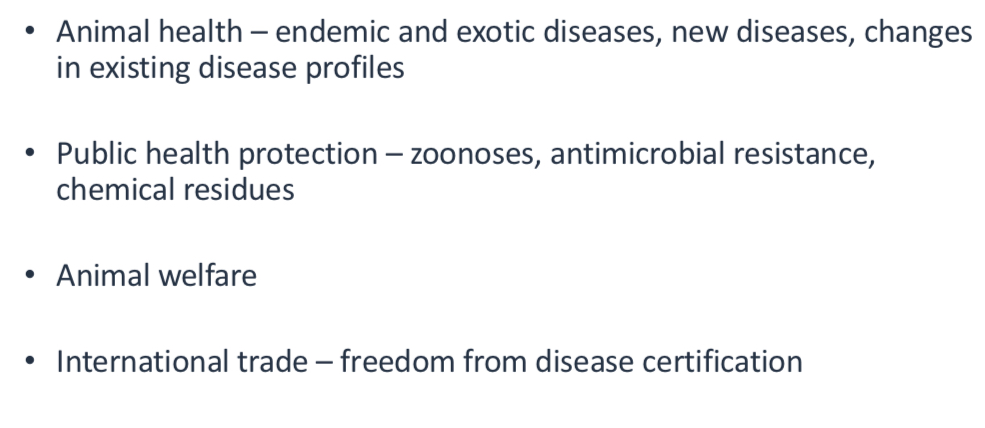
What are the reasons for monitoring and surveillance systems (MOSS) ?
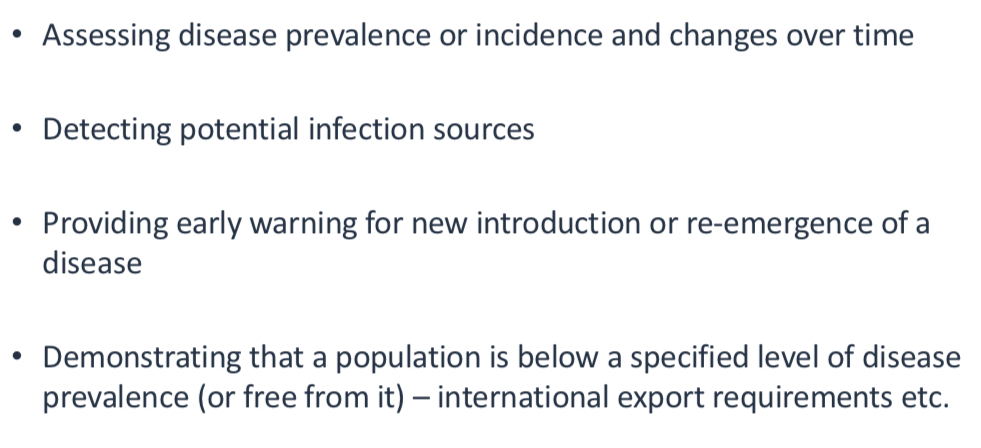
What are the objectives of monitoring and surveillance systems (MOSS)?
How is data collected actively for MOSS?
Systemic and regular recording of cases
Population defined by location and/or time
All population or sample of?- Depends on objective, expected prevalence, diagnostic tests
Random or targeted sampling
How is data collected passively for MOSS?
(Scanning)
Relies on notification of disease suspicions and cases
What does scrutinising the population achieve (active)?
Accurate information for potentially every individual animal
Labour-intensive, lot of sample collection
Expensive
Used disease eradication programmes
What does doing a random sample achieve (active)?
Estimate of disease prevalence/incidence and to describe temporal trends.
Sample size depends on:
. Expected disease prevalence in population
. Population size
. Required precision of estimate
. Sensitivity and specificity of tests
Expensive if the disease is rare
What does using a targeted sample achieve (active)?
Focuses on high-risk population in which specific and commonly known risk factors exist.
Appropriate if:
. Disease is less common in general population
. Specific risk factors are known
. Have knowledge of the epidemiology of the disease
Problem:
. In-detected cases may occur in other segments
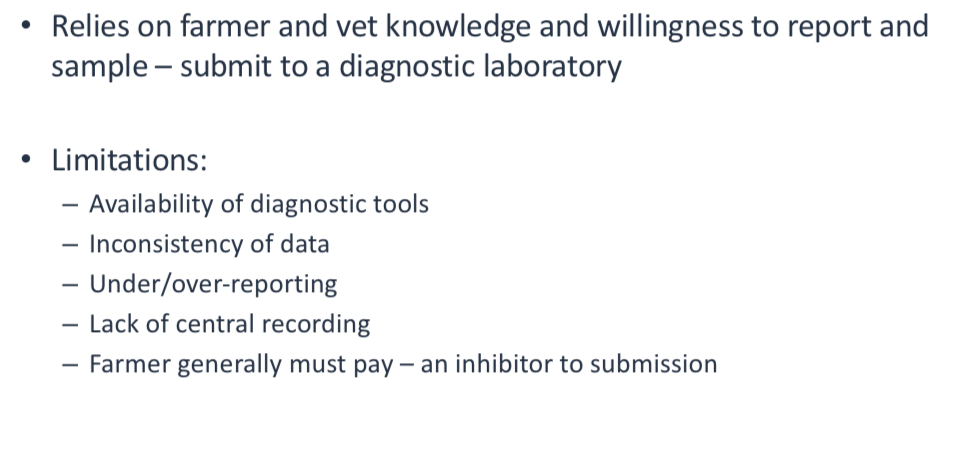
What does reporting cases achieve (passive)?
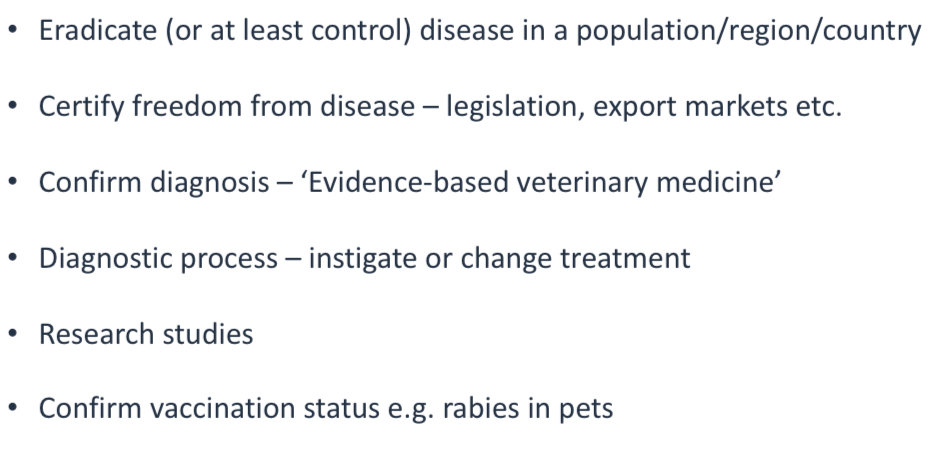
Why is testing a good thing?
What does sensitivity mean?
Ability of a test to detect diseased animals correctly e.g the proportion of diseased animals testing positive
If high used to rule out a disease as few false negatives
What does specificity mean?
Ability of a test to give the correct answer if not diseased e,g proportion of non-diseased animals testing negative
If high used to confirm a disease as few false positives
What are screening tests?
Usually healthy animals, detect subclinical disease
Often national programmes, but can be at herd level
Benefits of early detection, intervention
Often further testing initiated in response to positives
What are diagnostic tests?
Conducted on cases where disease suspected/present
To confirm or classify disease/infection
Guides treatment or gives prognosis
Extremely common in human and veterinary medicine
What might you look for in a test?
Cost
Reliability
Can it detect early and late stages of infection
How long will results take
What is the difference between a census and a sample?
Census- every animal in the population is evaluated (tested). The only source of error is the measurement (tested) itself.
Sample- Only a subset of the population is evaluated (tested).
Both measurement (test) and sampling errors possible
Why sample?
Nearly same information can be obtained for a fraction of the cost.
What does external population mean?
The possible population to which your test results might apply.
What does target population mean?
The immediate population to which your test results should extrapolate.
What does study population mean?
The animals/herds/flocks that have been selected to be tested in the survey.
What is the sampling frame?
The list of all the sampling units in the target population that have a chance of being selected.
E,g herds, flocks, animals
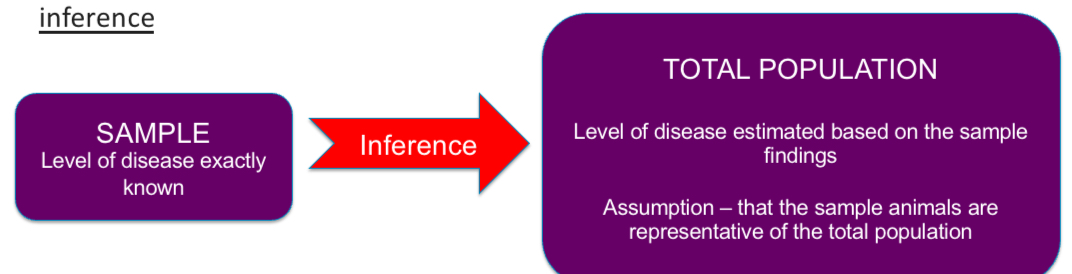
What is interference?
When we can estimate the true provenance of a disease in the total population using a sample.
What is simple random sampling?
List all the sampling units in the sampling frame and select at random.
What is systematic sampling?
Select sampling units at a predefined equal interval.
What is stratified sampling?
Divide the sampling frame into logical groups (strata) and make random selections from within all strata.
What is cluster sampling?
Divide the sampling frame into clusters (space or time), and randomly select clusters (one stage) or also within clusters (two-stage)
Give an example of a two stage sampling strategy?
Stage 1: Select random sample of farms (flocks) in the population.
Stage 2:
Option 1, cluster sample, test all the animals in each selected flock.
Option 2, individual sample, test a pre-determined proportion of each flock
Option 3, limited sample, test the same number of sheep in each flock, regardless of flock size
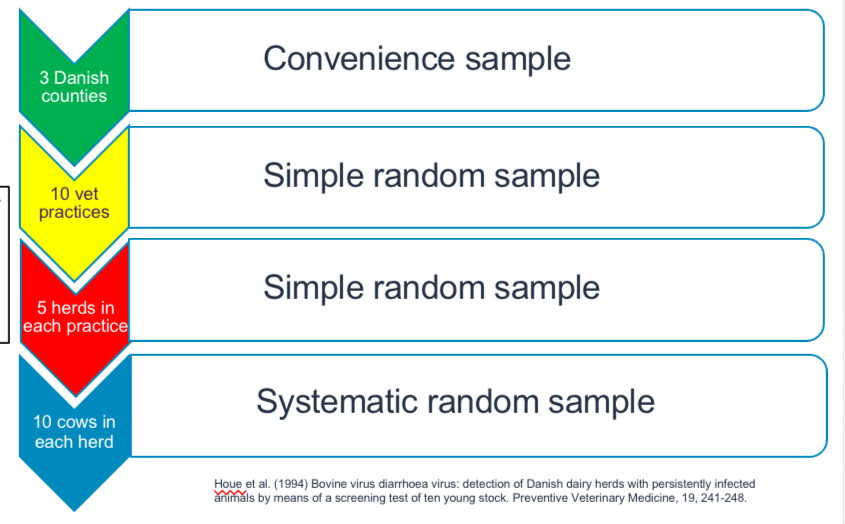
Give an example of a multi-stage sampling strategy?
What is non-probability sampling?
When the probability of selection of an individual within a population is not known, and some groups/individuals are more likely to be chosen than others.
Likely to be biased.
What does convenience sampling mean?
The easiest one to choose.
What does purposive sampling mean?
Most desired are chosen
What does haphazard sampling mean?
No particular scheme or method.
What is variance (random error)?
The built-in error that happens by chance because of samples differing from each other and the true population value.
What is bias?
Caused by systematic errors due to sample selection or measurement, a predictable and repeatable error for each observation.
What does accuracy of the sample estimate mean?
Ability of sample estimate to give a true measure of the level of disease in the population.
If repeated, the mean of the estimates should be close to the true value.
On average, an accurate sample estimate will neither under- or over- estimate the true value.
What does precision of the sample estimate mean?
A measure of how consistently the sample estimate is close to the previous value.
Getting same/almost the same result over and over again.
A sample estimate could still be precise even if not accurate.
Testing the same sample with a precise test for disease will give the same result each time.
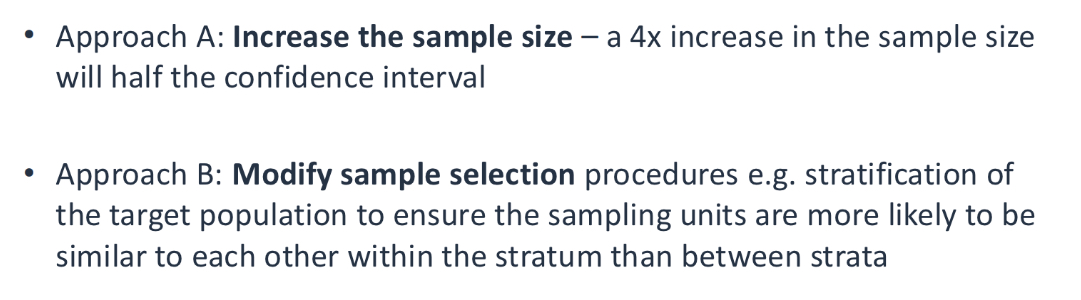
How can you control variance error?
How do non-observational errors occur?
Due to inappropriate sample selection.
How do observational errors occur?
Inappropriate measurements e.g the diagnostic test has low sensitivity for detecting the infection in the population and underestimates the level of disease.
What is a ‘gold standard’ test?
A test that is absolutely correct
How do we decide how many animals we need in a sample?
It needs to be large enough to detect significant differences.
Not so large as to be wasteful/unethical/too expensive/impractical
Guided by some indication of expected results e.g disease prevalence
What does power mean?
Chance of detecting as statistically significant a true effect of given magnitude.
Large sample size=greater power