Response to stimuli
 Call Kai
 Learn
Learn Practice Test
 Spaced Repetition
 Match
Match Flashcards
 Knowt Play
1/81

Earn XP
Description and Tags
Name | Mastery | Learn | Test | Matching | Spaced | Call with Kai |
|---|
No analytics yet
Send a link to your students to track their progress
82 Terms
What is a stimulus?
A detectable change in an environment.
What do you call cells that detect stimuli?
Receptors.
True or false? Organisms increase their chance of survival through certain response mechanisms to different stimuli.
True.
What is tropism?
When plants respond to stimuli via growth and elongation.
What does positive tropism mean?
When plants grow and elongate towards a stimulus.
What is negative tropism?
When plants grow and elongate away from a stimulus.
Give an example of a growth factor.
IAA (indoleacetic acid).
What is IAA a type of?
Auxin.
What are auxins?
Chemicals that control cell elongation in the shoots and inhibit growth of the cells in the roots.
Where is IAA made?
In the tips or roots and shoots.
True or false? IAA is unable to diffuse across cells in a plant.
False. IAA CAN DIFFUSE ACROSS CELLS IN A PLANT.
What is phototropism?
When a plant grows and elongates in response to light.
What is positive phototropism?
When plants elongate and bend towards light.
True or false? If there is a unilateral light source, IAA will diffuse to the shaded side of the shoot.
True.
Talk me through the process of IAA causing positive phototropism.
1) Shoot tip cells produce IAA.
2) IAA diffuses to the cells on the shaded side of the shoot, causing an increased concentration of IAA on the shaded side of the shoot.
3) This causes cell elongation in the cells on the shaded side of the shoot.
4) This cell elongation on the shaded side of the shoot only causes the shoot to bend towards the light source (positive phototropism).
Talk me through the process of IAA causing negative phototropism in plant roots.
1) IAA is produced in the cells in the root tips.
2) IAA diffuses to the lighter side of the root tips, increasing IAA concentration there.
3) This causes cell elongation on the light side of the roots.
4) This cell elongation causes the roots to bend away from the light and go deeper into the soil (negative phototropism).
Are shoots positively or negatively gravitrophic?
Negatively gravitrophic.
Are roots positively or negatively gravitrophic?
Positively gravitrophic.
Talk me through how IAA causes negative gravitropism in the shoots of plants.
1) IAA is produced in shoot cells.
2) IAA diffuses from cells on the upper side of the shoot to cells on the lower side of the shoot.
3) Plant grows upwards (if vertical)/plant bends upwards (if horizontal).
How does IAA cause negative gravitropism in plant roots?
IAA diffuses to the lower sides of roots so that the upper side elongates and the roots grow/bend downwards into the soil.
What is the purpose of taxes and kinesis?
They keep organisms in their favourable conditions in their environment.
What is taxes?
When an organism moves it’s entire body towards or away from a stimulus.
True or false? Taxes is directional.
True.
What is positive taxes?
When an organism moves towards a favourable stimulus.
What is negative taxes?
When an organism moves away from an unfavourable stimulus.
What is kinesis?
A change in the speed of movement and rate of changes of direction in response to a stimulus.
How does kinesis work when an organism goes from a favourable environment to an unfavourable environment?
By increasing the speed of movement and rate at which direction is changed, the organism has a greater chance of returning to the more favourable conditions.
How does kinesis work when an organism is completely surrounded by an unfavourable environment?
The organism will decrease it’s rate of turning (moves in a relatively straight line) to increase the chances of it finding a new location with favourable conditions.
Give two reasons why darker environments may be favourable to some organisms.
Less water lost from evaporation (stop drying out).
More difficult for predators to see.
Give the five stages in a reflex arc.
1) Stimulus.
2) Receptor.
3) Coordinator .
4) Effector.
5) Response.
Name the two components of the nervous system.
Central nervous system.
Peripheral nervous system.
What does the peripheral nervous system consist of?
Receptors.
Sensory neurones.
Motor neurones.
What does the central nervous system consist of?
Brain.
Spinal cord.
(known as ‘coordination centres’)
What is a reflex?
A rapid, automatic response to a stimulus.
What does it mean saying that reflexes are involuntary?
They do not require conscious thought nor do they have to be learnt.
What is the purpose of reflexes?
They protect the body against damage to body tissues and help escape from predators.
Give the three-neurone reflex arc.
1) Sensory neurone.
2) Relay neurone.
3) Motor neurone.
What do sensory neurones do in a reflex arc?
They send a nerve impulse to the spinal cord.
What do relay neurones do in a reflex arc?
They connect the sensory neurone and the motor neurone.
What do motor neurones do in a reflex arc?
They carry the nerve impulse to an effector.
Why are reflexes fast?
They bypass the conscious part of the brain and go only through a shorter reflex arc which only contains two synapses.
Give three examples of receptors.
Pacinian corpuscles.
Rod cells.
Cone cells.
What is the stimulus for pacinian corpuscles?
Changes in pressure.
Describe the structure of a pacinian corpuscle.
A sensory neurone ending wrapped in layers of lamellae separated by gel.
Draw and label a pacinian corpuscle.
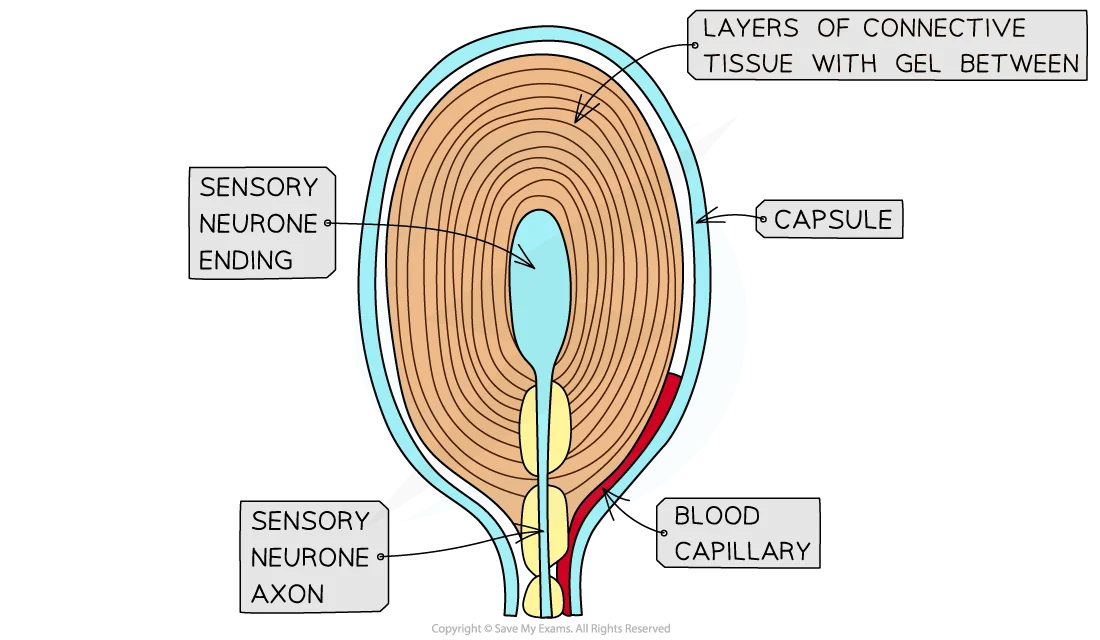
What type of protein channels exist in the cell membrane of a pacinian corpuscle sensory neurone?
Stretch-mediated (pressure sensitive) sodium ion channel proteins.
Talk me through how an action potential is generated in a pacinian corpuscle.
1) Increased pressure stretches and deforms stretch-mediated sodium ion channels.
2) This allows sodium ions to move into the sensory neurone, depolarising it.
3) When -55mV threshold potential is reached, an action potential is generated.
Where are rods and cones found?
In the retina of the eye.
What type of receptors are rods and cones?
Photoreceptors.
What is the resting potential of a pacinian corpuscle?
-70 mV
True or false? Rods process images in black and white.
True.
What is the pigment of rod cells?
Rhodopsin.
What must happen for a generator potential to be generated in rod cells?
Rhodopsin must be broken down by light energy.
Why can rod cells detect light of very low intensity?
Many rod cells connect to one sensory neurone.
What is retinal convergence?
The fact that multiple rod cells connect to one sensory neurone.
What is visual acuity?
The ability for the brain to distinguish between separate sources of light.
Why do rods have low visual acuity?
As many rods are connected to one sensory neurone, it is harder for the brain to distinguish between separate sources of light (lower visual acuity).
True or false? Cone cells process images in black and white.
False. CONE CELLS PROCESS IMAGES IN COLOUR.
How many different types of cone cells are there? What makes them different?
Three different types of cone cells. Each one contains a different iodopsin pigment (red, green, blue).
Why do we only really see in black and white in the dark?
Iodopsin requires high light intensity (large amounts of light energy) to be broken down, rhodopsin doesn’t - in the dark there is only enough light energy to break down rhodopsin so you see in black and white.
Why do cone cells give high visual acuity?
Only one cone cell is attached to per sensory neurone.
Give two reasons why cones only work in high light intensity.
1) Only one cone is connected per sensory neurone meaning the stimulus must be greater (greater light intensity) for an action potential to be generated.
2) Iodopsin can only be broken down at high light intensities.
True or false? The distribution of rods and cones in the retina in uneven.
True.
Where are cone cells most concentrated and why?
In the fovea, the fovea receives the highest light intensity.
True or false? The cardiac muscle is neurogenic.
False. THE CARDIAC MUSCLE IS MYOGENIC.
What does myogenic mean?
A muscle contracts on it’s own accord and the rate of contraction is controlled by a wave of electrical activity.
Where is the SAN (sinoatrial node) located? What else is it known as?
In the right atrium of the heart. It is also known as the pacemaker.
Where is the AVN (atrioventricular node) located?
Near the border of the right and left ventricle but still in the right atrium.
Where does the bundle of His run through in the heart?
The septum.
Where are the Purkyne fibres found in the heart?
Branching into the walls of the ventricles.
Talk me through the myogenic stimulation of the cardiac muscle.
1) The SAN releases a wave of depolarisation across the atria, causing them to contract.
2) Once the first wave of depolarisation reaches the AVN, the AVN releases another wave of depolarisation.
3) The bundle of His conducts the wave of depolarisation down the septum and to the Purkyne tissue, causing the ventricles to contract.
What prevents the AVN wave of depolarisation from travelling down into the ventricles?
There is a layer of non-conductive tissue between the atria and the ventricles.
What causes the delay between the contraction of the atria and the contraction of the ventricles? What is the advantage of this delay?
The AVN releasing a second wave of depolarisation. This is advantageous as it gives time for the atria to pump all the blood into the ventricles.
Where in the brain controls heart rate and through which part of the nervous system?
Medulla oblongata. Autonomic nervous system (part of the peripheral nervous system).
Which part of the nervous system increases heart rate?
Sympathetic nervous system.
Which part of the nervous system decreases heart rate?
Parasympathetic nervous system.
Give two things that can stimulate changes in heart rate.
Changes in pH.
Changes in blood pressure.
What type of receptors detect changes in pH and blood pressure in the heart? Where are they found?
Chemoreceptors and pressure receptors, found in the aorta and carotid artery.
When will blood pH decrease and why?
Blood pH will decrease during times of high respiration as more carbon dioxide or lactic acid are being produced making the blood more acidic (lower pH).
Why must blood pH be raised if it decreases?
A pH that is too low will denature enzymes in the blood making them non-functional.
Talk me through the response when blood pH decreases.
1) More impulses are sent from the medulla oblongata through the sympathetic nervous system and to the SAN.
2) This causes the SAN to release waves of depolarisation more frequently.
3) This causes the heart to contract more frequently, so heart rate increases.
4) This causes carbon dioxide to move out of the blood more quickly, so blood pH is increased back to normal.
How does the parasympathetic nervous system act if heart rate is too high?
More nerve impulses are sent along the parasympathetic nervous system to stop waves of excitation being released from the SAN.