Aviation Weather CH 1 - 3
 Call Kai
 Learn
Learn Practice Test
 Spaced Repetition
 Match
Match Flashcards
 Knowt Play
1/164

Earn XP
Description and Tags
Q&A from Jeppesen Aviation Weather Chapters 1 - 3
Name | Mastery | Learn | Test | Matching | Spaced | Call with Kai |
|---|
No analytics yet
Send a link to your students to track their progress
165 Terms
The Atmosphere
An envelope of gases surroundng the planet
Nitrogen 78%
Oxigen 21%
Other Gases 1%
Composition of the atmosphere and its proportions in the first 260,000 ft (43 NM)
Water Vapor (H2O)
Varies greatly. Over the tropical oceans it can be over 4% of the total volume of the atmosphere while over the deserts and at high altitudes it can be near zero
Water Vapor (H2O)
Absorbs radiant energy from the Earth (terrestial Energy) which reduces cooling, causing temperatures tat the surface to be warmer.
Trace Gases
Ocuppy a small part of the total volume of the atmosphere. Two of the most important are CO2 and O3
CO2
Absorbs terrestial radiation as well which is one of the main causes of the global warming of the armosphere
Ozone O3
It’s a toxic highly reactive pollutant. It’s produced in the lower stratosphere by the action of the sun on oxides of nitrogen (NOx) and by electrical discharges (lightning). It’s greatest concentration is between 50,000 - 100,000 ft
The upper ozone layer
Absorbs ultraviolet radiation from the sun (protects animals and plants) but it can be dangerous to crews and passengers at high-altitude flights.
Particulates or Aerosoles
Liquid or solid particles that are small enough to remain suspended in the air. Some of it sources are: volcanoes (ashes), forest fires, dust storms, industrial processes, automobile/aircraft engines, ocean, etc. They are important because they intercept solar and terrestial radiation, provide surfaces of condensation for water vapor (precipitation), reduce visibility and can foul engines.
Temperature, pressure and density
Variables to describe the state of the atmosphere
Kinetic Energy
Energy that exist by virtue of motion. The…a molecule has is proportional to the square of its speed movement
Temperature
The average of the kinetic energy of the many molecules that make up a substance.
0° K - Absolute Zero temperature in the Kelvin or Absolute Scale ( -273.15° C)
The point where all molecular motion ceases
273° K (0° C) / 373° K (100° C)
Melting point of ice and Boiling point of water in the Kelvin or absolute scale
Density
Mass of the molecules in a given volume. Its units are express in mass per unit volume (ex: 1 kg/m3)
Decreases
If mass in a volume decreases, the density…
Decreases
If the mass remains the same, but the volume increases, the density…
Pressure
The force exerted by the moving molecules of the gas on a given area. It acts equally in all directions
ISA atmospheric pressure
14,7 lb/in2 , 1013.25 mb, 1013.25 hPa, 760 mmHg, 29.92 inHg
The Gas Law
The ratio of pressure to the product of density and temperature is always the same. All gases obey this law.
P/DT = R
R: constant
In practice we normally measure pressure and temperature and calculate density.
Pole to equator
5,397 NM (in terms of dimensions of the earth)
Radius of the Earth
3,438 NM (in terms of dimensions of the earth)
Circumference of the Earth
21,625 NM (in terms of dimensions of the earth)
Gravity
Force that causes the atmosphere to be much more horizontally large than vertically thick which maked temperatue, pressure and density to vary much more rapidily on the vertical direction than in the horizontal direction.
164,000 ft (27 NM)
The density at this altitude is about 1/100 the sea level density. 99.9% of the atmosphere mass is below this level.
53,000 ft
90% of the atmosphere mass is below this level
18,000 ft
50% of the atmosphere mass is below this level
Troposphere
The average temperature decreases with altitute. Clouds and weather accur here. Top is at 36,000 ft in the middle latitudes.
Tropopause
Around 36,000 ft. Relates to jet stream, CAT, thunderstorms and high clouds. Its altitude varies with the latitude and season: It’s lower in the poles and in winter and higher in the equator and in summer. (“Trope” means turn or change. Strong vertical air motions)
Stratosphere
Temperature increases with the altitude. Air moves horizontally in layer. More stable section of the atmosphere.
Stratopause
Around 160,000 ft. The temperature reaches a maximum value at this height.
Mesosphere
Temperature decreases with height. Top is a little more than 280,000 ft where the coolest temperature exist going up through the layers (…pause)
Thermosphere
Highest layer. Temperature generally increases. At this height the meaning of “air temperature” is not clear. There are very few molecules of air.
Ozone layer or Ozonsphere
Found in the lower stratosphere. Maximum concentration is at 80,000 ft. The increment and maximum temperature in the stratosphere and stratopause is due to the absortion of solar radiation by this layer
The Ozone hole
A region in the ozone layer with lower concentration of O3. It’s created when man-made CFCs (chlorofluorocarbons) reach stratospeheric levels and the sun (sola radiation) breaks them down so the chlorine is free to destroy O3 molecules. It’s more noticeable over the South Pole in spring (Sep-Dec)
The ionosphere
Deep layer (very thick) of charged particles (ions and free electrons). Extendes from the lower mesosphere through the thermosphere. Charged particles are produced because solar radiation has sufficient energy to strip electrons from atoms and molecules. AM radiom waves are reflected or absorbed by different sublayers of this layer. Radio comms may be greatly influenced by variations in the lower part of this layer at sunrise and sunset (greater solar activity)
10,000 ft / 5,000 ft
For unpressurized aircraft: supplemental breathing O2 is RECOMMENDED for cabin pressure altitudes above__________ during the day and _________ during the night. Becasue of visual impairment due to reduced O2.
12,500 ft / 14,000 ft
For unpressurized aircraft: Supplemental O2 is REQUIERED FOR for the crew at cabin pressures above________ up to and including _________ on flights of more than 30 minutes.
14,000 ft
For unpressurized aircraft: At cabin pressures above_________the flight crew is REQUIERED to use supplemental O2.
15,000 ft
For unpressurized aircraft: At cabin pressure altitudes above___________ EACH OCCUPANT of the aircraft MUST BE PROVIDED with supplemental O2
25,000 ft
For pressurized aircraft: A 10 minute supplemental O2 supply is REQUIERED for ALL OCCUPANTS above_______ ft in case of loss of cabin pressure (the standard on most commercial airliners)
FL350
For pressurizes aircraft: Above_________ one pilot must wear an O2 mask at all times
40,0000 ft
For high altitude flights: In an unpressurized environment above__________supplemental O2 must be supplied under pressure.
50,000 ft
In an unpressurized environment the pressure exerted by the gases escaping from the body fluids exceeds the atmospheric pressure at around 63,000 ft. The bodily fluids will vaporize. The pilot of an unpressurized aircraft must wear a full pressure suit above__________
Standard atmosphere (ISA)
An idealized atmosphere with specific vertical distributions of pressure, temperature and density. It is most representative of the middle latitude conditions. The temperature decreases 2°C for each 1,000 ft increase in altitude.
Radiation, conduction and convection/advection
Solar energy enters the system and is redistributed within the stratosphere by three energy transfer processes which are…
Radiation
Transfer of energy by electromagnetic waves
Conduction
Transfer of energy through molecular motion
Convection/Advection
Transfer of energy through movement of mass
93,000,000 miles / 150,000,000 KM
Average distance from the sun
Tropic of Cancer
Northern tropic at 23.5 ° N
Tropic of Capricorn
Southern tropic at 23.5° S
Artic Circle
At 66.5° N
Antartic Circle
At 66.5° S
Radiation
The energy from the sun accros nearly empty space must be accomplised by
Time of the day
Time of the year
Latitude
The intensity of the sun radiation received at any one point on the Earth’s surface depends on the location of the sun relative to that point. That location depends on…
23.5°
The axis of the Earth is tilted_________to the plane of its rotation about the sun.
The Equinoxes
At noon on the first day of Spring and Fall, the sun’s rays are perpendicular to the Earth’s surface at the Equator (90°). The lenght of daylight is 12 hours everywhere on Earth. This dates are…
The Solstices
On the first days of summer and winter the noonday sun reaches its highest and lowest latitudes. The low sun angles produce unique visibility hazards at high altitude
Solar Elevation Angle
Angle of the sun above the horizon. If it’s small the solar energy is spread over a broad surface area, minimizing heating (Sunset, sunrise and at high latitudes in winter). If it’s large, the solar energy is concentraded in a smaller area, maximzing heating (Noon, summer and at low latitudes)
Electromagnetic Energy
Type of energy that radiates from any object that has a temperature above absolute zero (0° K). The higher the temperature, the greater the radiation. It behaves as a collection of waves.
T4
The total radiation emitted from an object is proportional to_____, where T = The object’s temperature in °C above above absolute zero. The total energy radiated by an object is proportional to this.
6,000 °C
Effective radiating temperature of the sun above absolute zero.
288 °C
Effective radiating temperature of the Earth above absolute zero
186,000 MPS / 300,000 KMS
Speed of radiated energy across vacuum which is the same as the speed of light.
Solar elevation angle: e = 90 - (L - Lp)
Lp = Solar declination. The latitude where the noon sun is directly overhead.
L = Latitude of the station
The formula will work for either hemisphere, but if Lp is in the opposite hemisphere from L, then Lp must be negative.
c = f x L
The speed of any simple wave is related to frequency and wavelenght
c = speed
f = frequency
L = wavelenght
Red light
When it comes to visible radiation: Long waves / Low frequencies. Frequencies lower than this are IR
Blue light
When it comes to visible radiation: Short wavelenghts / High frequencies. Frequencies higher than this are UV.D
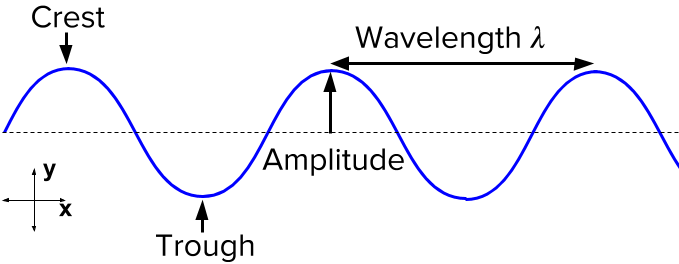
Wavelenght (L)
Distance between two successive identical wave features (two crests or two troughs)
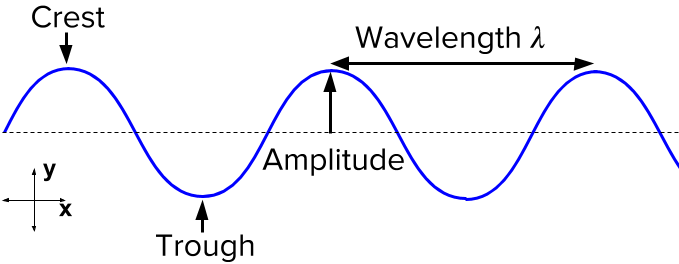
Amplitude (A)
Half the distance between the lowest and highest points of the wave. The energy of a wave is related to this feature. Wave energy in proportional to the square of the___________
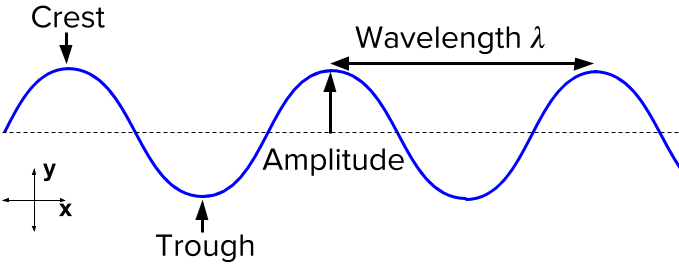
Frequency
The number of waves that some fix point in a given time interval. Their units are cycles per second (cps) of Hertz (Hz)
Wavelengths (L)
As the temperature of an object increases the maximum radiation occurs at shorter and shorter_________
UV region (left of the graph)
The maximum energy radiated in the solar spectrum is at significantly shorter (visible) wavelenghts with a large contribution in the________
IR region (right of the graph)
The maximum energy radiated in the terrestial spectrum is at longer wavelenghts well into the_____
19%
Percentage of the solar energy (radiation) entering the earth’s atmosphere that is absorbed by atmosphere gases and clouds.
Albedo of the Earth
Loss of solar radiation that enters the Earth’s atmosphere, represents 30% of the total radiation divided in:
6% scattered from atmosphere
20% scaterred and reflected by clouds
4% reflected by surface
Also known as
51%
Percentage of the total solar energy entering the Earth’s atmosphere that is absorbed by the earth itself.
The Earth’s surface
The primary source of energy for the atmosphere.
Processes by which energy is transfered from the Earth to the atmosphere
Terrestial radiation, conduction, convection/advection, evaporation and transpiration (Loss of water from plants)
Because at night there’s no solar input and the earth continues to emit its terrestial radiation
During the day the Earth’s radiation is offset by the Solar radiation, why does the earth cools significantly during the night? This diurnal variation in the temperature of the Earth is critical in producing day to day changes in wind, visibility and ceiling.
Heat capacity
Is the amount of energy that is necessary to raise the temperature of a substance by a certain amount
Because solar radiation can penetrate to a greater depth in water and because water can easily mix the energy which is spread around
Why does water have a higher heat capacity compared to dry soil?
Waters cools slower than land due to its great reservoir of heat. This differences in temperature cause the land and sea breezes
What surface cools slower at night, the land or the water and what does this produce?
Snow
What kind of surface reflects a large fraction of incomming solar radiation and gives up infrared (IR) radiation easily which keeps temperatures lower over this surfaces under clear skies?
Water vapor
Terrestial radiation behaves differently than solar radiation because it is emitted in the IR portion of the Spectrum. The atmoshphere is highly transparent to much of the solar radiation, but certain atmospheric gases absorb IR radiation from the Earth and reemit it downward and upward. The IR that returns to the Earth reduces the loss of energy from the surface and lowest layers pf the atmpsphere, maintaining the high temperatures. Clouds at night increase the capture of IR further restricting nighttime cooling. Which is an examples of this gases?
Green house effect
Capture of terrestial radation by certain atmospheric gases (Greenhouse gases: Carbon dioxide, methane, CFCs, Water vapor)
Conduction
Its best example is the “Spoon in a bowl of hot soup”. Differently from radiation, this energy transfer process requieres mass. It involves molecular motion.
Conduction (air to earth @ night)
The most significant energy transfer by conduction in the atmosphere is the Earth’s surface. At night the ground cools by radiation (terrestial radiation) and takes away heat from the air immediately in contact with it by…
Conduction (Earth to air during the day)
During the day, solar radiation heats the ground which heats the air next to ir by…
Advection
North-South movements of large warm and cold air masses (fronts) represents
Convection
Large scale ascent and descent of air masses and the smaller scale development of thunderstorms represents
100° C / 180° F (Ratio 5/9)
There are ______ and __________between the boiling and melting points of water (@ Sea Level)
-40 °C = -40 °F
At which temperature do the Celsius and Fahrenheit scales cross?
[(°C + 40) × 9/5] - 40 = °F (9/5 = 1.8)
Formula to convert from Celsius to Farenheit
[(°F + 40) × 5/9] - 40 = °C (5/9 = 0.56)
Formula to convert from Farenheit to Celsius
For every 10°C there’s a 18°F increment, starting at 32°F
Quick estimation to convert from °C to °F
Surface Air Temperature (Surface Temperature)
Temperature of the air measured at 1.5 m (5 ft) above the ground. Usually measure in the shade to avoid direct solar radiation, but allowing for free ventilation of the outside air
Upper Air Temperature (Temperatures aloft)
Measured in the free atmosphere with reference to height or pressure level
Indicated Air Temperature (IAT)
Temperature of the ar as measured by a temperature probe on the outside of the aircraft. This temperature is greater than the temperature of the surrounding air (uncompressed) because of friction and heating. O