Anatomically Modern Humans - 5
 Call Kai
 Learn
Learn Practice Test
 Spaced Repetition
 Match
Match Flashcards
 Knowt Play
1/16

There's no tags or description
Looks like no tags are added yet.
Name | Mastery | Learn | Test | Matching | Spaced | Call with Kai |
|---|
No analytics yet
Send a link to your students to track their progress
17 Terms
Out of Africa Hypothesis
Modern humans, Homo sapiens, evolved in Africa and then migrated outward, replacing other archaic humans worldwide
Multiregional Continuity
Modern humans evolved simultaneously in different regions from populations of Homo erectus with ongoing gene flow between regions
Assimilation Hypothesis
Modern humans evolved in Africa, spread globally, and partially interbred with local archaic humans like Neanderthals and Denisovans instead of fully replacing them
rounder/globular skull, vertical forehead, expanded frontal/parietal lobe, tall/smooth occipital, gracile face/mandible, and chin
Cranial Traits
Thinner bones, smoother features, narrow pelvis, longer limb proportions, and adapted to longer distance running
Postcranial traits/Gracility
The set of advanced cognitive and cultural traits associated with fully modern humans and Homo sapiens including symbolic thinking, complex language, art, and sophisticated tool use
Behavioral Modernity
What are the traits of the cognitive abilities in the frontal lobe?
Cognition and emotion, personality, judgment and self control, muscle control, and ST memory
What are the traits of the cognitive abilities in the Parietal lobe?
Sensory processing and language processing
What are the traits of the cognitive abilities in the Temporal lobe?
Auditory processing, LT memory formation, and speech processing
Hypothesis that anatomically modern humans entered the Americas about 13 kya by traveling inland through a gap between the Laurentide and Cordilleran ice sheets.
Ice-Free Corridor Hypothesis
Hypothesis that anatomically modern humans entered the Americas around 16 kya by moving along the Pacific coastline using coastal resources and waterways
Coastal route hypothesis
Upper Paleolithic tool industries
Chatelperronian, Aurignacian, Solutrean, and Magdalenian
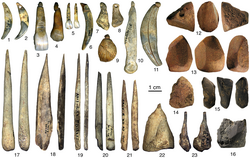
Long thin blades made of bone/ivory that could be used as needles from 45kya
Chatelperronian
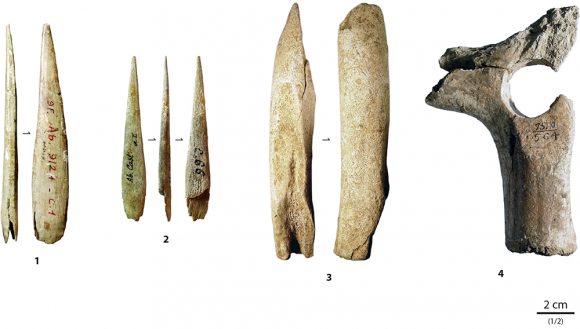
Long thin blades made of bone/ivory for fishing weights from 43 kya
Aurignacian
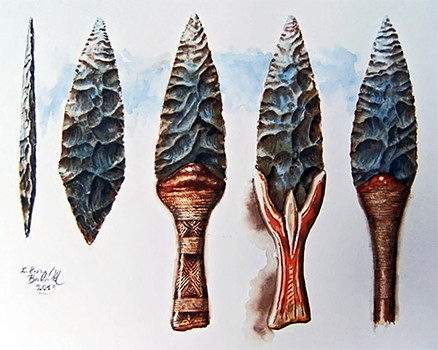
Highly refined, symmetrical stone tools (especially leaf-shaped points made by pressure flaking) for advanced hunting weapons from 23 kya
Solutrean
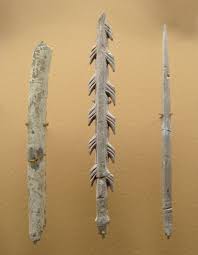
Highly refined bone, antler, and stone tools, as well as extensive cave art and specialized hunting technology from 17 kya
Magdalenian
The shift when humans transitioned from hunting and gathering to farming and domesticating plans and animals around 10 kya
Neolithic Revolution