Module 2 - Atoms, Ions and Compounds
 Call Kai
 Learn
Learn Practice Test
 Spaced Repetition
 Match
Match Flashcards
 Knowt Play
1/48

There's no tags or description
Looks like no tags are added yet.
Name | Mastery | Learn | Test | Matching | Spaced | Call with Kai |
|---|
No analytics yet
Send a link to your students to track their progress
49 Terms
The nuclear atom
consists of a nucleus made up of two types of subatomic particles - protons and neutrons
a 3rd type of subatomic particle, called an electron, occupies a region outside the nucleus
electrons are arranged around the nucleus in shells
Mass of the subatomic particles
proton - 1
neutron - 1
electron - 1/1836
Charges of the subatomic particles
proton - +1
neutron - 0
electron - -1
the total positive charge from protons is cancelled by the total negative charge from electrons
the overall charge of an atom is 0 - an atom is neutral
Structure of the atom
nearly all of an atom’s mass is in the nucleus
atoms contain the same number of protons as electrons
most atoms contain the same number of, or slightly more, neutrons than protons
as the nucleus gets larger, more and more neutrons are needed
Atomic number - the identity of an element
the number of protons in the nucleus of an atom
Isotope
atoms of the same element with different numbers of neutrons and different masses
most elements are made up of a mixture of isotopes
Isotopes and chemical reactions
different isotopes of the same element have the same number of electrons
the number of neutrons has no effect on reactions of an element
different isotopes of an element therefore react in the same way
there may be small differences in physical properties - with higher mass isotopes of an element having a higher melting or boiling point or density - but the chemical reactions are the same
Atomic structure of ions
an ion is a charged atom - the number of electrons is different from the number of protons
cations (+ve) are atoms with fewer electrons than protons
anions (-ve) are atoms with more electrons than protons
Relative isotopic mass
the mass of an isotope relative to 1/12th of the mass of an atom of carbon-12
Relative atomic mass
the weighted mean mass of an atom of an element relative to 1/12th of the mass of an atom of carbon-12
it takes account of the percentage abundance of each isotope and the relative isotopic mass
Determination of relative atomic mass (mass spec)
A sample is placed in the mass spectrometer
The sample is vaporised and then ionised to form positive ions
The ions are accelerated. Heavier ions move more slowly and are more difficult to deflect than lighter ions, so the ions of each isotope are separated
The ions are detected on a mass spectrum as a mass to charge ratio (m/z). Each ion reaching the detector adds to the signal, so the greater the abundance, the larger the signal
m/z = relative mass of ion / relative charge on ion
Simple ions
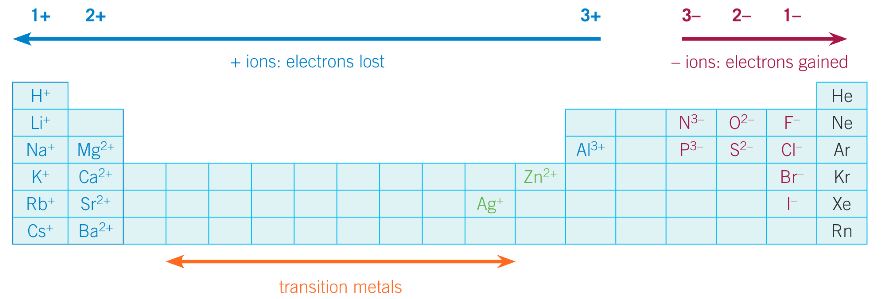
atoms of metals on the left of the periodic table lose electrons to form cations
atoms of non-metals on the right of the periodic table gain electrons to form anions
Polyatomic ions
Avogadro’s constant
6.02×10²3
Molar mass
mass per mole of a substance
Mole
one mole is the amount of a substance that contains 6.02×10²3 atoms
Molecular formulae
the number of atoms of each element in a molecule
e.g H2, O2, N2 etc
Empirical formulae
simplest whole number ratio of atoms of each element in a compound
Relative molecular mass
compares the mass of a molecule with the mass of an atom of carbon-12
can be calculated by adding together the relative atomic masses of the elements making up a molecule
Relative formula mass
compares the mass of a formula unit with the mass of an atom of carbon-12
it is calculated by adding together the relative atomic masses of the elements in the empirical formulas
Hydrated salts
many coloured crystals are hydrated - water molecules are part of their crystalline structure
this water is known as water of crystallisation
when blue crystals of hydrated copper sulfate are heated, bonds holding the water within the crystal are broken and the water is driven off, leaving behind white anhydrous copper sulfate
without water, the crystalline structure is lost and a white powder remains

Concentration of a solution
the amount of solute, in moles, dissolved in each 1dm³
Standard solution
a solution of known concentration
Molar gas volume
the volume per mole of gas molecules at a stated temperature and pressure
at RTP the molar gas volume = 24.0 dm³ mol-1
Assumptions for molecules making up an ideal gas
random motion
elastic collisions
negligible size
no intermolecular forces
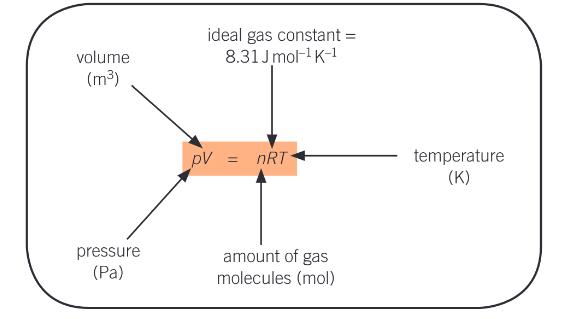
Ideal gas equation
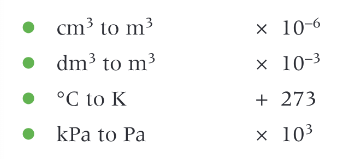
Conversions for ideal gas equation
Stoichiometry
in a balanced equation, the balancing numbers give the ratio of the amount, in moles, of each substance
this ratio is called the stoichiometry of the reaction
What do chemists use balanced equations for?
the quantities of reactants required to prepare a required quantity of a product
the quantities of products that should be formed from certain quantities of reactants
these quantities can then be changed to adjust the scale of a preparation
Theoretical yield
the maximum possible amount of product
Why is theoretical yield difficult to achieve?
the reaction may not have gone to completion
side reactions may have taken place alongside the main reaction
purification of the product may result in loss of some product
therefore the actual yield obtained from a reaction is usually lower than the theoretical
Percentage yield
actual yield / theoretical X 100
Limiting reagent
a reactant that is totally consumed when the chemical reaction is completed
the amount of product formed is limited by this reagent, since the reaction cannot continue without it
Atom economy
a measure of how well atoms have been utilised
sum of molar masses of desired products / sum of molar masses of all products X 100
atom economy is based solely on the balanced chemical equation for a reaction and assumes a 100% yield
Reactions with high atom economies
produce a large proportion of desired products and few unwanted waste products
are important for sustainability as they make the best use of natural resources
Acid
when dissolved in water, releases hydrogen ions as protons (H+), into the solution
Strong acid
completely dissociates in aqueous solution e.g hydrochloric acid
Weak acid
partially dissociates in aqueous solution e.g ethanoic acid
Base
neutralised an acid to form a salt
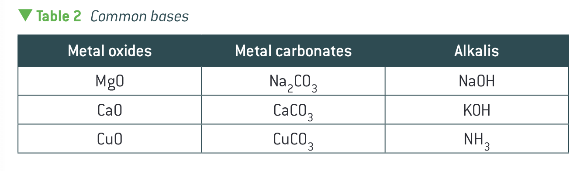
e.g metal oxides, metal hydroxides, metal carbonates and ammonia
an alkali is a base that dissolves in water releasing hydroxide ions into the solution
Neutralisation
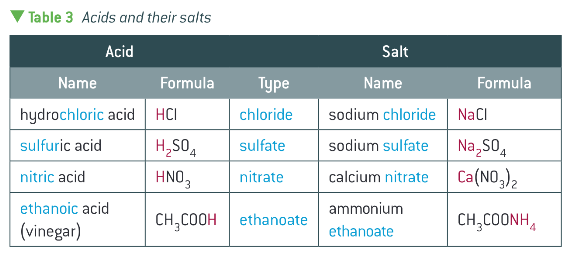
H+(aq) ions react with a base to form a salt and neutral water
the H+ ions from the acid are replaced by metal or ammonium ions from the base
metal oxides and alkalis neutralise acids to form salt and water only
metal carbonates form salt, water and carbon dioxide
Titration
a technique used to accurately measure the volume of one solution that reacts exactly with another solution
they can be used for - finding the concentration of a solution, identification of unknown chemicals and finding the purity of a substance
Oxidation number
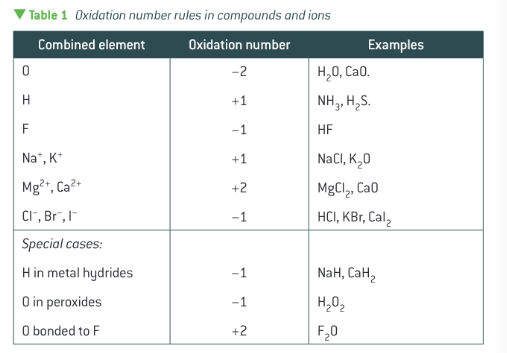
based on a set of rules that apply to atoms, and can be though of as the number of electrons involved in bonding to a different element
use of oxidation numbers helps when writing formulae and balancing electrons as a check that all electrons have been accounted for
Oxidation rules for elements
oxidation number for elements is always 0
in a pure element, any bonding is to atoms of the same elements
Oxidation rules for compounds and ions
Working out oxidation numbers
sum of the oxidation numbers = total charge
Redox reactions
involve reduction and oxidation
if one process happens so must the other
Reduction and oxidation in terms of oxygen
oxidation is addition of oxygen
reduction is removal of oxygen
Redox in terms of electrons
reduction is the gain of electrons
oxidation is the loss of electrons
Redox in terms of oxidation number
reduction is a decrease in oxidation number
oxidation is an increase in oxidation number