info analytics ozaki final

0.0(0)
studied byStudied by 0 people
0.0(0)
full-widthCall Kai
learnLearn
examPractice Test
spaced repetitionSpaced Repetition
heart puzzleMatch
flashcardsFlashcards
GameKnowt Play
Card Sorting

1/90

encourage image

There's no tags or description

Looks like no tags are added yet.

Study Analytics
Name
Mastery
Learn
Test
Matching
Spaced

No study sessions yet.

91 Terms

1
New cards

What does subgroup analysis examine in clinical research?

Examining treatment effects in specific subsets of a study population.

2
New cards

Why must results from subgroup analyses be interpreted with caution?

Multiple comparisons increase the risk of type I error.

3
New cards

What does a p-value for interaction tell you in a subgroup analysis?

Whether treatment effects differ between subgroups.

4
New cards

Do p-values for interaction measures the effectiveness of a treatment compared with the control group?

No.  Effectiveness in each subgroup is measured by its own HR and CI; the interaction p-value asks if subgroup effects differ.
5
New cards
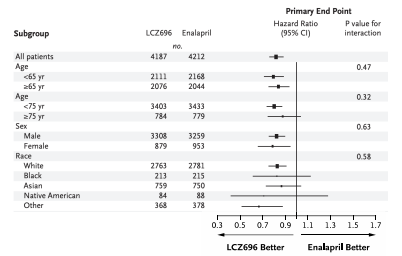
<p>How do patients aged ≥75 years respond to LCZ696 compared with younger patients? </p>

How do patients aged ≥75 years respond to LCZ696 compared with younger patients?

Show similar treatment effects based on hazard ratios and interaction p-values.
6
New cards
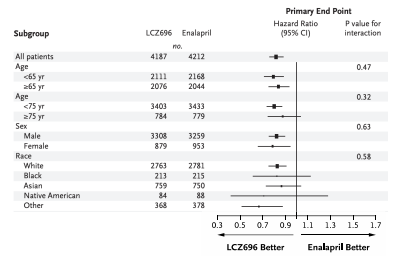
<p>What do subgroup results show about differences in LCZ696 effects by race? </p>

What do subgroup results show about differences in LCZ696 effects by race?

No differences; the interaction p-value is not significant.
7
New cards
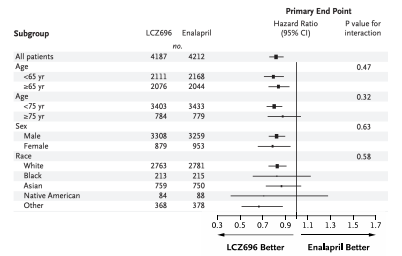
<p>Why are confidence intervals wider in the subgroup of Black patients taking LCZ696?</p>

Why are confidence intervals wider in the subgroup of Black patients taking LCZ696?

The sample size is small and causes imprecision.

8
New cards

What is the primary goal of conducting a noninferiority trial?

To show a new treatment is not unacceptably worse than a standard therapy.

9
New cards

What does a noninferiority trial NOT attempt to demonstrate?

Prove a drug is better.

10
New cards

What does the noninferiority margin represent within a trial design?

The maximum acceptable loss of efficacy.

11
New cards

How does selecting a wide noninferiority margin affect the trial?

Makes the trial easier to meet but less clinically meaningful.
12
New cards
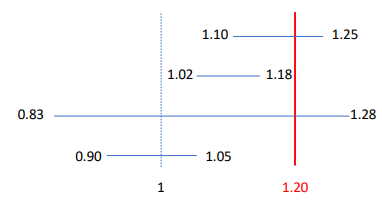
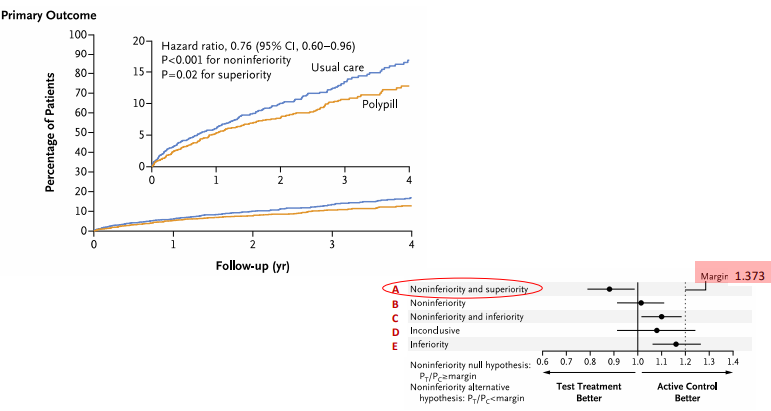
<p>Which confidence intervals (margin 1.20) support noninferiority in a trial?</p>

Which confidence intervals (margin 1.20) support noninferiority in a trial?

HR 1.08 (1.02–1.18) and HR 0.96 (0.90–1.05).
13
New cards
<p>What did the polypill trial demonstrate when considering its CI and p-value results?</p>

What did the polypill trial demonstrate when considering its CI and p-value results?

Both noninferiority (CI < margin) and superiority (CI < 1.0, p=0.02).

14
New cards

What is the primary purpose of using composite outcomes in a clinical study?

To combine endpoints and increase study efficiency.

15
New cards

Why can composite outcomes be misleading when minor components dominate the results?

They may exaggerate the perceived treatment benefit.

16
New cards

Why does variability in clinical importance among composite components create interpretation problems?

The results become misleading and harder to interpret.

17
New cards

How can composite outcomes obscure clinically meaningful results?

They can hide opposite effects among individual components.

18
New cards

What is incorrect about stating that factorial trials randomize patients to only two interventions?

The incorrect part is that factorial trials involve more than two interventions or factors. In a typical 2×2 factorial design, patients are randomized to all combinations of two independent interventions, creating four groups:

  1. Intervention A + Intervention B

  2. Intervention A + No B

  3. No A + Intervention B

  4. No A + No B

19
New cards

What does a factorial design create when assigning patients to multiple interventions?

Separate randomized groups for each treatment combination.

20
New cards

Do factorial trials always require larger sample sizes than standard trials?

A factorial trial does not always require a larger sample size than a standard two-arm trial. It depends on the goals of the study and how the sample size is calculated.

21
New cards

Can factorial trial designs incorporate non-drug interventions?

Yes, Factorial trials can include non-drug interventions, such as behavioral programs, lifestyle changes, or devices, alongside or instead of drugs.

22
New cards

Why does increasing the sample size alone fail to eliminate confounding?

Increasing the sample size reduces random error but does not remove confounding, because confounding is a systematic bias.

23
New cards

How does matching help control confounding during trial design?

By controlling confounding at the design stage.

24
New cards

How does randomization reduce confounding in clinical trials?

By balancing known and unknown confounders.

25
New cards

Can residual confounding still occur after statistical adjustment procedures?

Yes. Residual confounding can remain if confounders are unmeasured, mismeasured, or modeled incorrectly.

26
New cards

How does propensity score matching help in observational studies?

By reducing confounding through covariate balancing.

27
New cards

Which aspects of a study can misclassification affect?

The exposure, the outcome, or both.

28
New cards

Why is nondifferential outcome misclassification still a threat to validity?

It biases results and is not harmless.

29
New cards

What type of error decreases accuracy in a study measurement?

Systematic error.

30
New cards

What type of error decreases precision in a study measurement?

Random error.

31
New cards

Do Kaplan–Meier curves require every patient to have identical follow-up time?

No. Kaplan–Meier curves do not require identical follow-up times. They handle censored data, so patients can enter and leave the study at different times or be lost to follow-up.

32
New cards

Do survival curves serve only descriptive purposes in clinical trials?

No. Survival curves are descriptive and can also be used to compare groups statistically.

33
New cards

What information do Kaplan–Meier curves primarily display?

Event proportions over time and patterns of event occurrence.

34
New cards
Prevalence measures what?
Prevalence measures both new and existing cases at a specific point in time.
35
New cards
What do incidence proportion and incidence rate both measure?
They both measure new cases but differ because incidence proportion uses persons at risk and incidence rate uses person-time.
36
New cards
Is prevalence useful for identifying risk factors?
Prevalence is less useful for identifying causal risk factors because it mixes new and existing cases.
37
New cards
What does attributable risk represent?
The difference in disease incidence between exposed and unexposed groups.
38
New cards
How is population attributable risk estimated?
Population attributable risk equals attributable risk multiplied by exposure prevalence.
39
New cards
What does a β coefficient represent?
It represents the strength and direction of association between a predictor and an outcome.
40
New cards
What does a hazard ratio indicate?
It indicates relative event rates over time accounting for censoring.
41
New cards
What does an odds ratio indicate?
It compares the odds of an outcome between exposed and unexposed groups.
42
New cards
What does a relative risk indicate?
It compares the probability of an outcome between exposed and unexposed groups.
43
New cards
When is HR used?
HR is used in time-to-event analyses.
44
New cards
When is OR used?
OR is used when risk cannot be directly measured, such as in case-control studies.
45
New cards
When is RR used?
RR is used in cohort studies where incidence can be measured.
46
New cards
If OR = 2.5 in smokers vs nonsmokers, what does that mean?
Smokers have 2.5 times higher odds of pneumonia than nonsmokers.
47
New cards
What percent increase in odds does OR = 2.5 represent?
It represents a 150 percent increase in odds.
48
New cards
If RR = 0.6 for depression in diabetes, what does it mean?
Diabetes is associated with a 40 percent lower risk of depression.
49
New cards
What range does the CI 0.4–0.8 suggest?
It suggests the reduction in risk is between 20 percent and 60 percent.
50
New cards
What does HR compare?
It compares the rate at which events occur between two groups over time.
51
New cards
Why is OR used in case-control studies?
Because actual risk cannot be measured since incidence is not known.
52
New cards
Can RR be estimated in a case-control study?
RR cannot be estimated because incidence is not measured.
53
New cards
Can RR and OR be estimated in cohort studies?
Both OR and RR can be estimated because incidence is measured.
54
New cards
Why is HR preferred over RR in survival analysis?
HR accounts for censoring and varying follow-up.
55
New cards
Can RR be estimated using logistic regression?
RR is not estimated from logistic regression; logistic regression estimates OR.
56
New cards
What does randomization do?
It assigns participants so each has equal chance of being in any group, reducing confounding.
57
New cards
What does restriction do?
It limits study participants to reduce confounders.
58
New cards
What does matching do?
It selects comparison subjects with similar characteristics to reduce confounding.
59
New cards
What does stratification do?
It compares outcomes within subgroups that share similar risk.
60
New cards
What does standardization do?
It mathematically adjusts crude rates to equalize group characteristics.
61
New cards
What does multivariable adjustment do?
It adjusts for many confounders simultaneously via modeling.
62
New cards
What is propensity score matching?
It matches individuals with similar baseline characteristics to balance covariates.
63
New cards

Is PSM used in experimental studies?

No. Propensity score matching (PSM) is primarily used in observational studies to balance baseline characteristics between treatment groups. In experimental studies, randomization already controls for confounding, so PSM is generally unnecessary.

64
New cards
Does PSM guarantee causal inference?
No, it does not guarantee validity of causal inference.
65
New cards
Does PSM remove unmeasured confounding?
No, it only addresses measured confounders.
66
New cards

What does misclassification bias from coding errors affect?

It reduces internal validity. Misclassification bias happens when people are put in the wrong exposure or outcome group due to coding errors. It can make results seem weaker, stronger, or just wrong, leading to incorrect conclusions and misleading recommendations.

67
New cards

Does confounding by indication affect internal or external validity?

It reduces internal validity because the treatment is given for a reason related to the outcome, making it harder to determine the true effect of the intervention.
68
New cards
Are results from VA or Medicare generalizable to all populations?
They may not be generalizable to the entire population.
69
New cards
Are self-reported adherence measures objective?
No, they are subjective and prone to bias.
70
New cards
What is a strength of pharmacy claims data?
They allow large-scale evaluation but may miss OTC or non-insurance purchases.
71
New cards
Do dispensing records confirm ingestion?
No, they confirm fills but not actual medication use.
72
New cards
What are spontaneous reporting systems used for?
They help detect unexpected adverse drug reactions early.
73
New cards
What is a limitation of spontaneous reporting systems?
They can contain missing or duplicate reports that distort signals.
74
New cards
Are spontaneous reporting systems designed to evaluate drug effectiveness?
No, they focus on safety, not effectiveness.
75
New cards
Are EHR-based safety studies free of bias?
No, they may contain measurement and recording errors.
76
New cards
What bias may affect EHR drug safety studies?
Confounding due to differences in patients or prescribing patterns.
77
New cards
What is a major limitation of EHR data?
Missing or incomplete data can cause misclassification bias.
78
New cards
What does interrupted time series evaluate?
It evaluates outcome trends before and after an intervention.
79
New cards
Can ITS distinguish immediate vs gradual changes?
Yes, it detects level changes and trend changes.
80
New cards
Is ITS useful for large-scale non-randomizable policies?
Yes, it is useful when randomization is not feasible.
81
New cards
Does ITS adjust for all simultaneous events?
No, it does not automatically adjust for other events happening at the same time.
82
New cards
What does a before-and-after study measure?
It measures outcomes before and after an intervention in the same group.
83
New cards
Does a before-and-after study capture long-term effects?
It is not ideal for long-term evaluation.
84
New cards
What external factors can influence before-and-after results?
Policy changes, seasonal effects, or concurrent events.
85
New cards
How does ITS improve on before-and-after?
ITS uses multiple time points to better separate real changes from random variation.
86
New cards
Is a composite outcome always a better indicator of treatment effect than individual outcomes?
No, it can sometimes obscure the effects of individual outcomes.
87
New cards
When a composite outcome is used, are the individual components typically not analyzed separately?
No, individual components are often analyzed separately to assess their clinical relevance.
88
New cards
When are composite outcomes particularly useful in clinical studies?
They are useful when the primary endpoints are expected to occur infrequently.
89
New cards
Should the heterogeneity of effects across individual components of a composite outcome be assessed?
Yes, assessing heterogeneity helps interpret the results accurately.
90
New cards
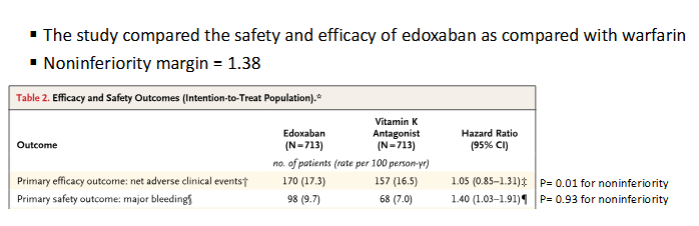
<p>Is Edoxaban noninferior to warfarin for the efficacy outcome?</p>

Is Edoxaban noninferior to warfarin for the efficacy outcome?

Edoxaban was noninferior to warfarin because the upper bound of the 95% CI (1.31) was below the noninferiority margin (1.38).
91
New cards
<p>Is Edoxaban noninferior to warfarin for the efficacy outcome?</p>

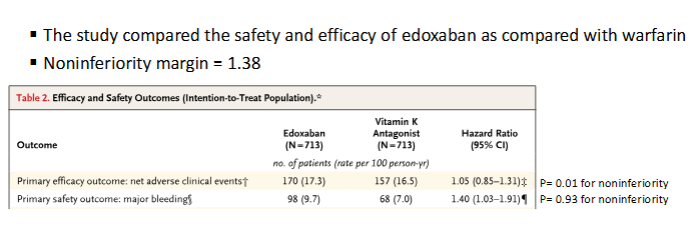
Is Edoxaban noninferior to warfarin for the efficacy outcome?

Edoxaban was not noninferior to warfarin because the upper bound of the 95% CI (1.91) exceeded the noninferiority margin (1.38). Edoxaban’s safety outcome would be considered inferior of the new drug compared to the standard because the entire CI > 1.0.