Immune system (wk 10)
 Call Kai
 Learn
Learn Practice Test
 Spaced Repetition
 Match
Match Flashcards
 Knowt Play
1/47

There's no tags or description
Looks like no tags are added yet.
Name | Mastery | Learn | Test | Matching | Spaced | Call with Kai |
|---|
No analytics yet
Send a link to your students to track their progress
48 Terms
antigen vs antibody
Antigen - any molecule that generates a response by the adaptive immune system
Either self or non-self
Normally, the body learns to not attack "self" antigens
If it does respond to self antigens = autoimmune disease
Antibody - a molecule produced by the immune system to neutralise antigens
why must immune system know the difference between self and non-self antigens
allows it to recognise, respond to and eliminate harmful entities without harming the organism it should be protecting

First line of defence: Barriers
Prevents the harmful entity from entering the body in the first place
Two types: physical and chemical
Physical
Epithelial cells of skin, gut, respiratory tract
Secretions including sweat, wax and tears
Mucus in the nose, trachea, gut
Urine
Chemical
Proteolytic enzymes
Low stomach pH
Normal Gut flora
Primary lymphoid organs in immune system
what are they
examples
Sites of development of immune cells
All immune cells start as bone-marrow derived stem cells
Bone marrow and thymus
Bone marrow
Haematopoiesis occurs -> i.e. where blood cells are made
Place of growth and storage of immune cells
Maternity ward: where immune cells are "born"
Retirement: where plasma cells survive/stay -> they ;produce antibodies
Secondary lymphoid organs in immune system
what are they
examples
Sites of activation
Where immune cells reside or migrate between
Spleen and lymph nodes
Mucosal and cutaneous associated lymphoid tissues
Peripheral sites in immune system
what are they
examples
Other sites immune cells briefly visit
Skin, liver, gut, CNS, lungs, etc
list the cells of the immune system
Innate
Phagocytes: Neutrophils, monocytes, dendritic cells, eosinophils, basophils, mast cells
Adaptive
Lymphocytes: B and T cells
what is the innate immune system
general immune response to all pathogens/non-self antigens: Cells and molecules recognise physical/chemical essential structures shared by classes of microbes -> through evolution
E.g. different chemicals in bacterial cell walls not in humans
Present since birth
Other names
Natural / native immunity
First line of defence
Consists of epithelial barriers; molecules and cells in tissues and circulation
function of innate immune system
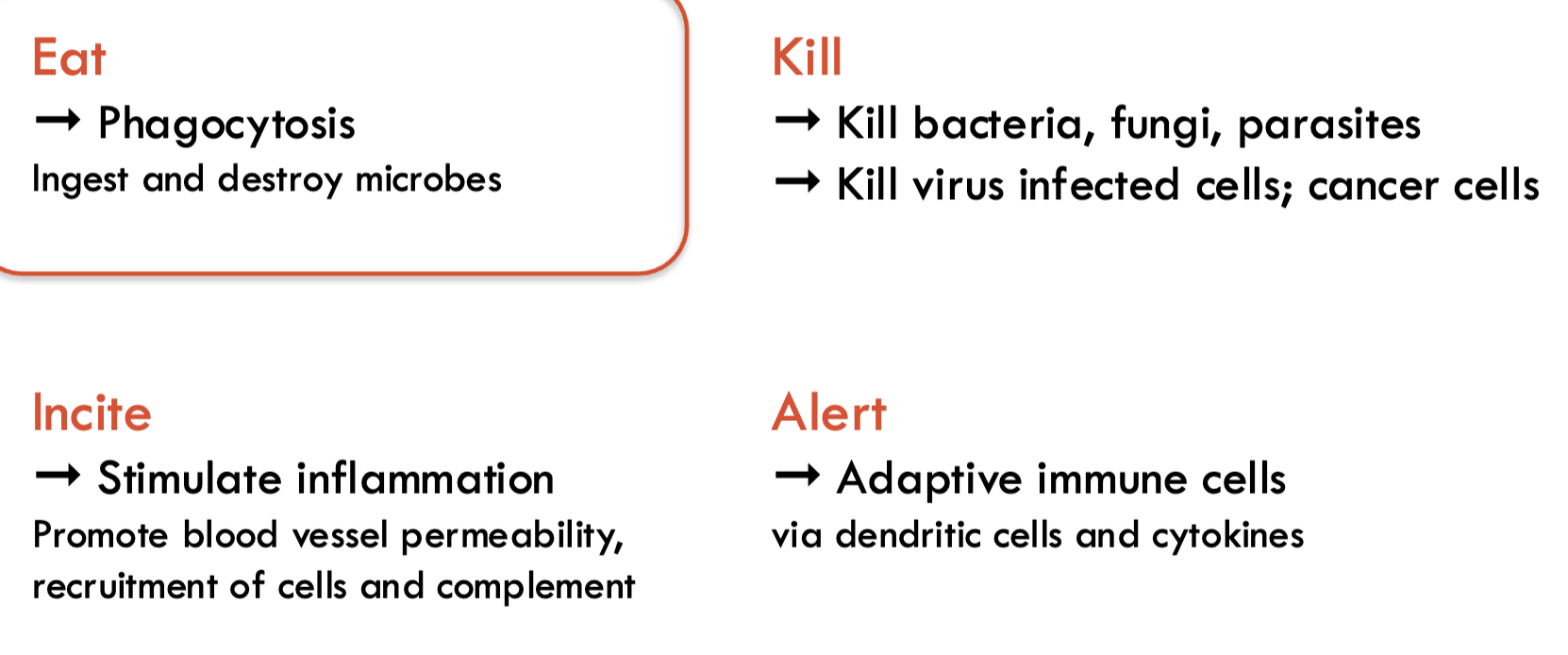
qualities of innate immune system
Speed
Is fast responding
The earliest to respond
Short duration
Responds to foreign body in the same way each time encountered
Interacts with other cells of innate and adaptive immune system
Does not react to "self" antigens/cells -> not responsible for autoimmune disease
what are Receptors
How innate immune cells differentiate between
• Self and non-self
• Healthy and damaged
types of receptors
What it recognises
Where it is located
Detected by… in immune system
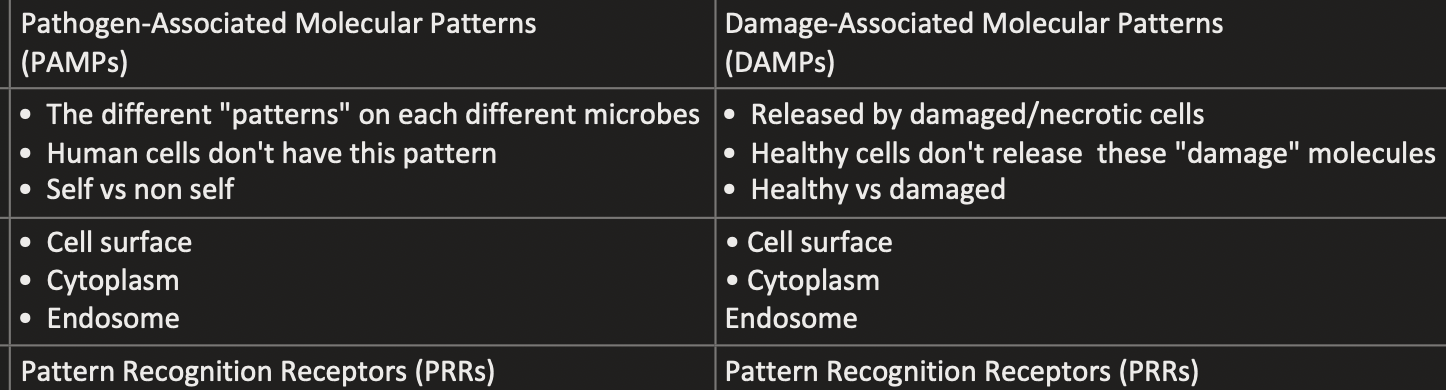
molecules of innate immune system
Complement proteins
Anti-microbial peptides / proteins
Cytokines
Note: antibodies are part of adaptive immune system
function of Complement proteins
Circulate in blood or on cells
Dormant
Triggers a cascade when encountering a microbe
Three outcomes:
Kills target
Causes inflammation
Opsonize (coat) microbes to enhance phagocytosis
innate
function of Anti-microbial peptides / proteins
Peptides / proteins with antimicrobial activity made by epithelial / immune cells
Against bacteria, fungi and viruses
Nature's antibiotics
Target microbes
innate
function of Cytokines
Soluble proteins that cause inflammation
Responsible for communication
immune-immune cells
immune-other cells
Many different types
innate and adaptive
what is Phagocytosis
Ingesting and destroying microbes
By dendritic cells, neutrophils and macrophages
steps of phagocytosis
Microbe binds to receptor
Phagocyte extends cell membrane around it to form
Membrane closes up and pinches off to make a phagosome
Phagosome fuses with lysosome to form phagolysosome
Microbe killed by enzymes and toxic substances contained by lysosome
Nitric oxide (NO) and Reactive oxygen species (ROS)
how does innate immune system directly kill harmful enemies
harmful pathogens
Complement protein killing
insert into cell membrane of microbes
Forms holes in cell membrane to "pop" cells
Eosinophil killing of parasites
By eosinophils -> specialised cells for parasites
Most parasites are to big to be phagocytosed
Release cytoplasmic granules that damage and kill the parasite
Neutrophil Extracellular Traps (NETs)
By neutrophils
Release internal contents on bacteria/fungi -> traps and kills the pathogen
harmful cells (cancer)
Natural Killer cells
Attach to cell via receptors
Inject cytotoxic granules into cell to kill it
what is Inflammation
tissue reaction that brings defence cells/proteins to site of infection/damage
injured tissue + mast cells releases
Histamines
increase permeability of blood vessels in area
Brings more blood flow to area
More fluid in area = more antibodies, antimicrobial proteins, complement proteins
Chemokines
Special type of cytokine
Make cell migration possible
Cells follow from least concentration of chemokines to highest concentration
allows them to arrive at sight of injury
immune system responsds
phagocytes attracted to area
Neutrophils/macrophages migrating to site of scratch injury
complement proteins move to area
Innate vs Adaptive Immunity
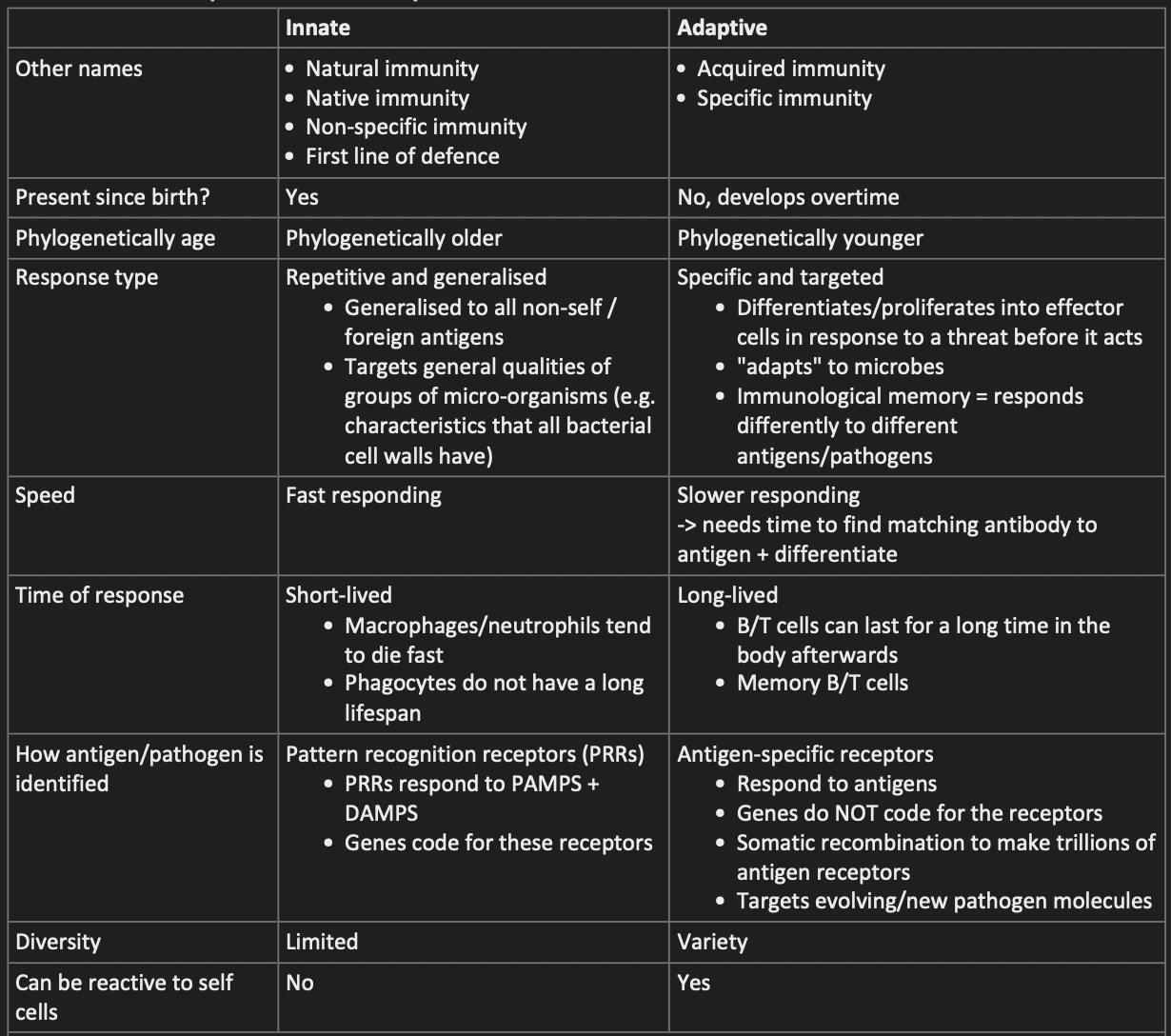
cells in innate vs adaptive immune response
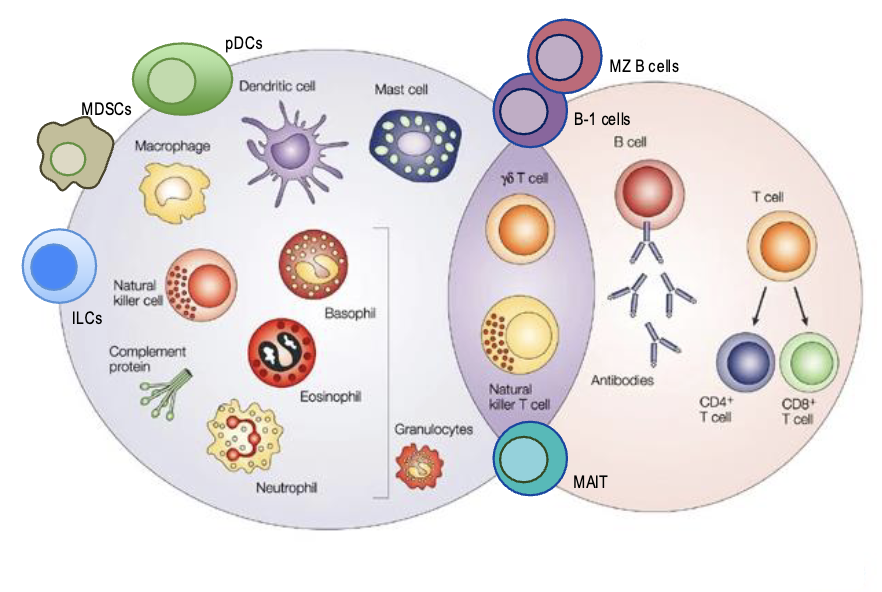
cells in adaptive immunity
Only lymphocyte
Two types:
B cells
Develop in bone marrow
Plasma B cells, memory B cells
T cells
Develop in thymus
Stem cells made in bone marrow and move to thymus
Cytotoxic T cells, helper cells, suppressor cells, memory T cells
Antigen receptors purpose
Allow lymphocytes to recognise its targets
are membrane bound
Each single lymphocyte only has one type of antigen receptor
few lymphocytes with the same antigen receptor
antigen receptor types
types
B cell receptor = BCR
Two antigen binding sites
Can bind to free antigens in blood
T cell receptor = TCR
One antigen binding site
Cannot bind to free antigens -> must be presented an antigen by a dendritic cell
parts of antigen receptor
variable regions - antigen binding sites
constant regions
pros and cons of antigen receptors in human immune system
Pros: Large variety of antigen receptors
Cons: low frequency
Barely any other lymphocytes with the same antigen receptor in the body
Must undergo clonal expansion
Means each lymphocyte must clone itself to respond to specific pathogen
Why the adaptive immune system responds slower
why is adaptive immune system slower (to respond) than innate
antigen receptors are made by randomly reorganising gene segments during development -> somatic recombination
i.e. have the receptor before you are exposed to the antigen
So that when you are exposed, the dendritic cell can find a T cell with a matching antigen and produce an appropriate immune response
Why adaptive immune response is slower
+takes time for dendritic cell to travel from infection site to lymph node and find a helper T cell to present processed antigen to
purpose of B cells
produce antibodies
Neutralises extracellular antigens/microbes and microbial toxins
Extracellular microbe - survive outside a host cell
Intracellular microbe - survive inside a host cell
B cell recognises an antigen -> B cell proliferates -> B cell differentiates into plasma and memory B cells
types of b lymphocytes
Plasma B cells = produce the antibody
Memory B cells = remembers antibody for specific antigen
another name for antibodies
immunoglobulin
Function of antibodies
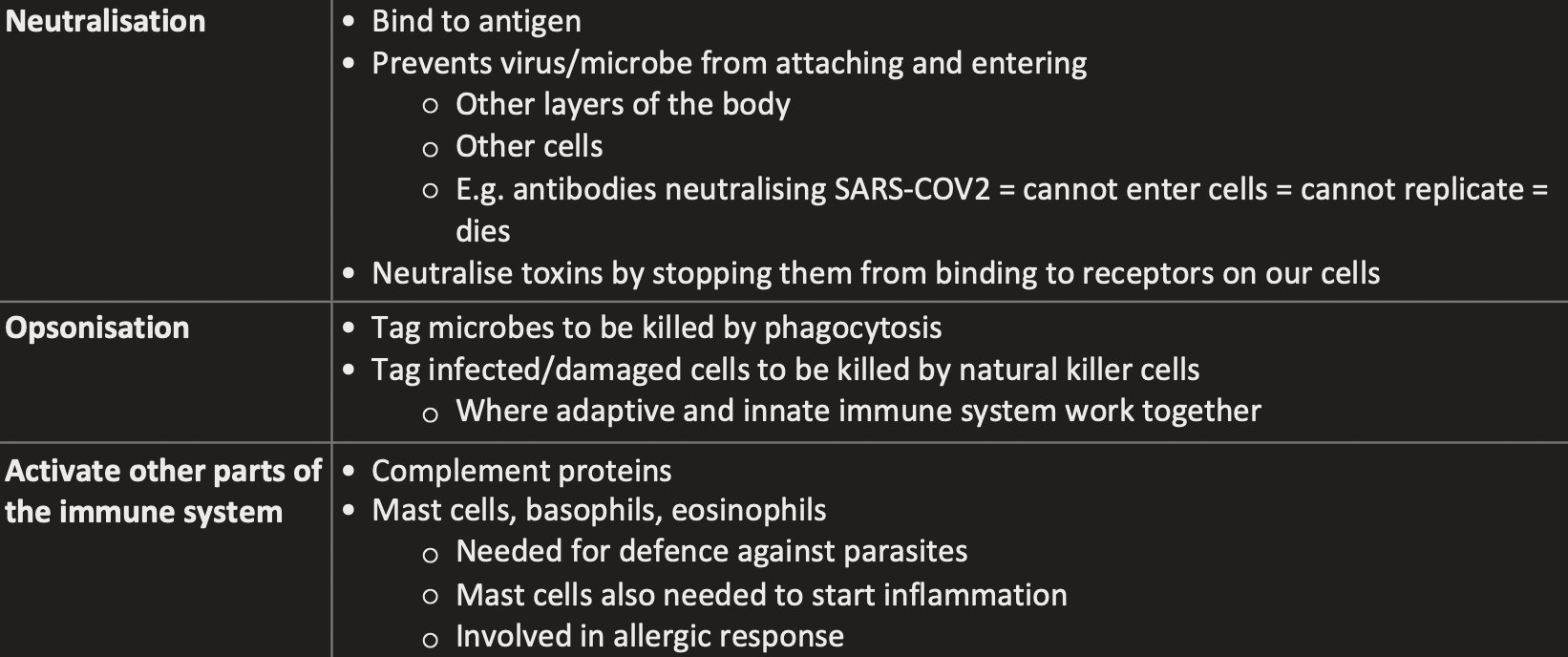
what are Isotype
Isotype - "flavour" of antibody
Five different types
Different isotypes have different effector functions
To switch between isotypes, B cells need help from T cells
Since IgM is produced first
B cell gets signal from T cell to then produce IgG/E/A -> allows B cell to change DNA (whole cell switches)
Called "class switching"
list all isotypes
five:
IgM
IgD
IgG
IgE
IgA
IgM isotype function
BCR of Naïve B cells
Produced first
Do not need T cells to make this isotype
T cells needed to make other isotypes
Function:
Neutralise pathogens
Activate complement proteins
star shape → the only pentamer
IgD isotype function
• BCR of Naïve B cells
• Function not understood
Y shape
IgG isotype function
Most abundant in blood
For antibacterial and antiviral defence
Function:
Neutralise antigens
Opsonise
Activate complement
Crosses placenta into baby during pregnancy
So when baby is born it already has maternal antibody in blood
Natural passive immunity
Y shape
IgE isotype function
• For defence against worms and parasites
• Function:
○ Activate mast cells, basophils, eosinophils
• Involved in allergy
Y shape
IGA isotype function
Most abundant in mucosal sites
Pushed from gut into lumen
To neutralise pathogens before they can even get to gut
First line of defence
Function
Neutralise pathogen
Controls commensal microbes in lumen of gut and lungs
looks like an X shape
Function of T cells
Antibody/innate immune system are good at dealing with extracellular pathogens
Antibodies / phagocytes cannot get inside cells
Need T cells to fight intracellular pathogens / transformed cells
T cells can also help B cell and macrophage function
Role of dendritic cells
Dendritic cells link the innate and adaptive immune systems
Captures antigen via phagocytosis
Dendritic cell process the antigen -> chops it up into little pieces
Migrates to nearest lymph node
Presents antigen to naïve T cell and activates it
So T cells are MHC (or HLA) restricted -> must have an antigen presented to them by a dendritic cell before activating
Types of T cells
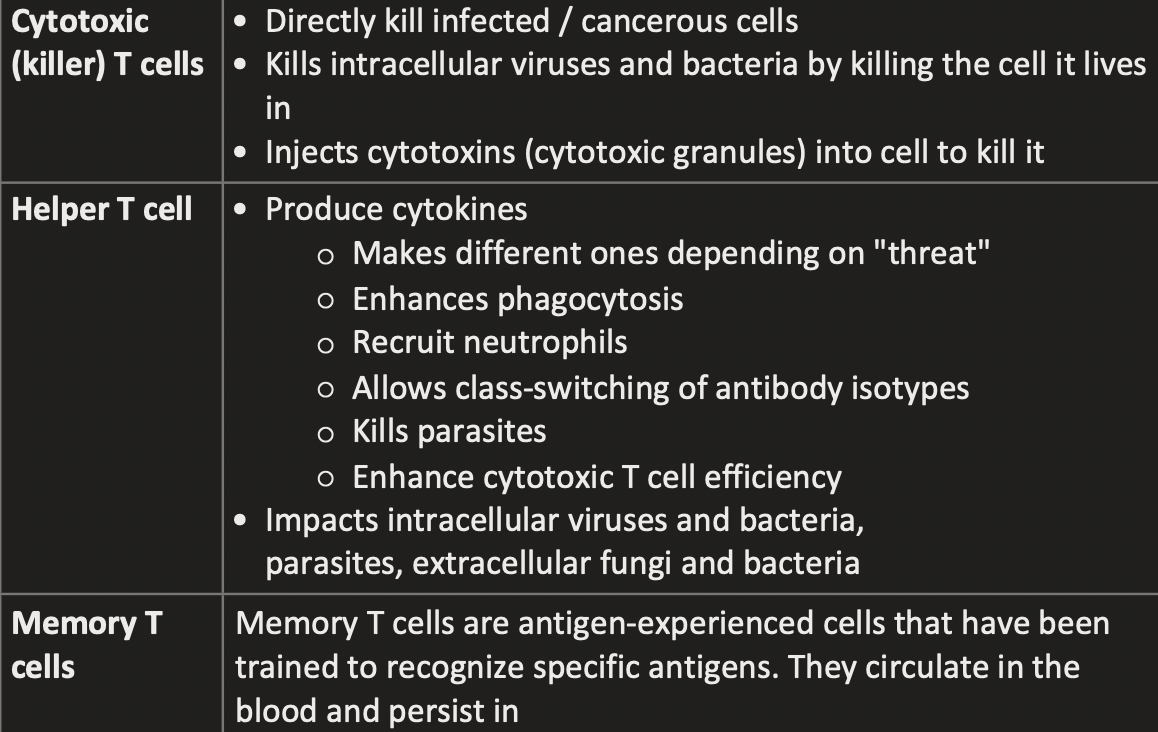
what is Immunological memory
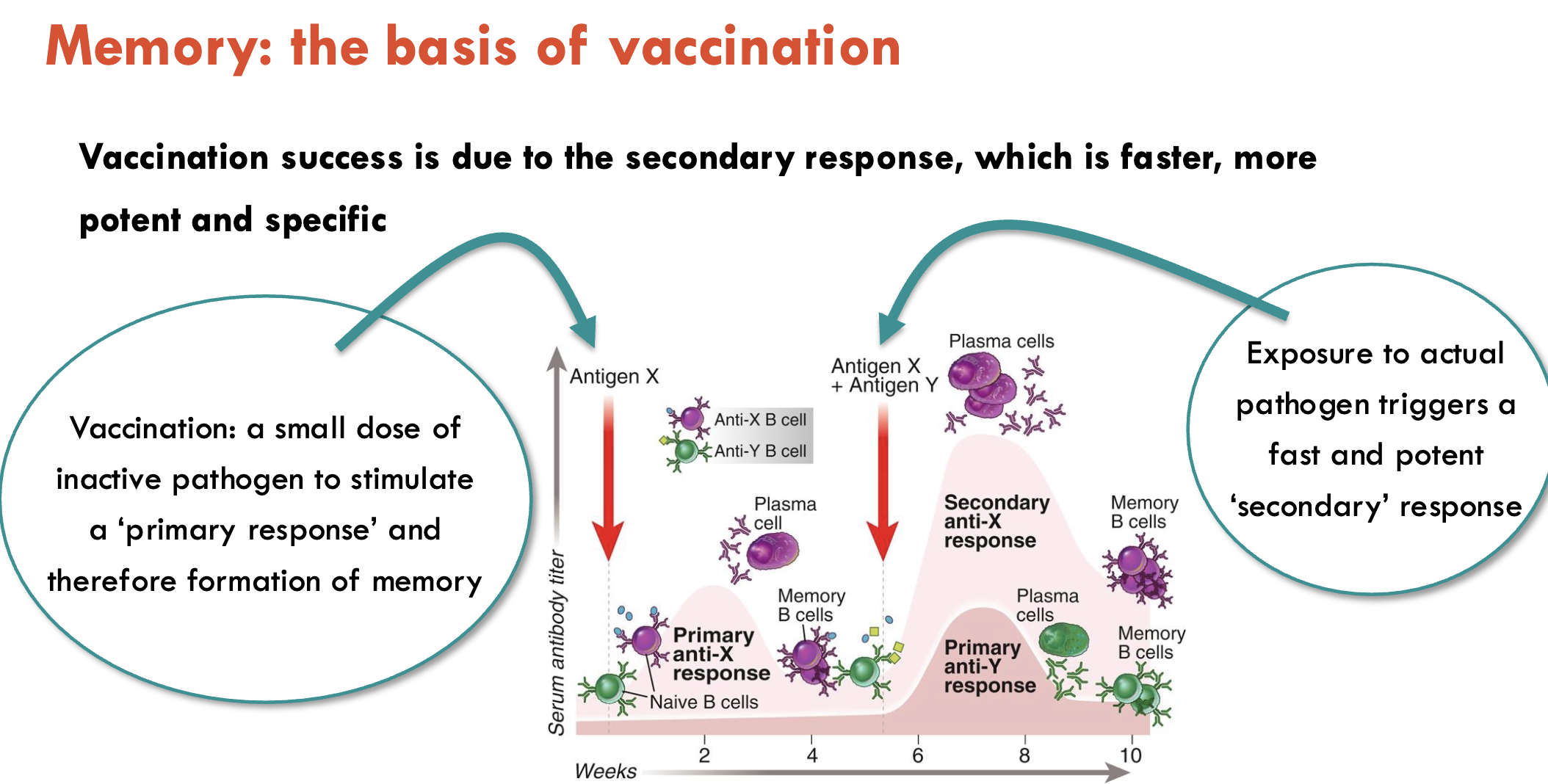
B and T cells have memory cells
Remember the antigen and the antibodies used/way to kill it after primary exposure
Upon secondary exposure, B/T cells can multiply faster = neutralise pathogen/antigen faster
how does vaccination work
The production of memory B/T cells allow vaccinations to be effective
By inoculating a patient = giving them the primary exposure to the virus
Introducing the antigen to their immune system
Allows their body to find the antibodies / chemicals or proteins to kill it
Upon secondary exposure to pathogen (i.e. when patient contracts it naturally) = they have a less severe reaction to pathogen
Successful vs unsuccessful immune responses
Successful:
It only responds to harmful or "non-self" antigens
E.g. virus protein coat, cancer cells, asbestos
Does not "overproduce" a response -> i.e. response is controlled
Unsuccessful:
not activated at the right times
Responds to "self" or non-harmful antigens
E.g. dust, pollen, own healthy cells
Autoimmune disease
cannot neutralise infection/antigen effectively
Cannot get rid of infection or cancer
Due to genetic mutations
Cancer / immunodeficiency
define Autoimmunity
→ how does this link to autoimmune disease
Immune system fails to ‘tolerate’ self cells
occurs when tolerance mechanisms fail
Autoimmunity = Predisposing genetic factors + ‘Environmental’ triggers
Autoimmune disease are caused by a lose of immune tolerance to specific self antigens
A highly specific immune attack against one cell type or molecule in the body
E.g. type 1 diabetes -> only pancreatic cells attacked
Due to large variety of antigen receptors = likely to have self-reactive cells that attack its own healthy body cells
Body has immune tolerance mechanisms
Either delete or suppress potentially self-reactive cells
how does immune system prevent autoimmunity
Immune tolerance mechanisms
Central tolerance
While cells are being developed
Delete highly self-reactive clones during development in thymus/bond marrow
Cells with some autoreactivity aren't deleted
Peripheral tolerance
After cells are developed
Supress activation of autoreactive cells
Due to "regulatory" T cells
Treatment for autoimmune diseases
Traditionally managed with broad-acting immunosuppression
By supressing whole immune system = we supressauto-reactive B and T cells
Can now use therapeutic monoclonal antibodies
Target specific cells / molecules causing autoimmunity
Target underlying mechanisms causing autoimmunity
immunotherapy for cancer
We now know that the body is constantly looks for cancerous cells and killing them
Promising new cancer therapies target the immune system
Therapeutic antibodies
Remove the ‘immunological brakes’
Apply the ‘immunological accelerator’ -> allow the immune system to more effectively fight antigen
Mostly aimed at activating cytotoxic T cells
Engineered T cells
Chimeric Antigen Receptor (CAR) T cells