Gas Exchange, Infectious Diseases, and Immunity
 Studied by 1 person
 Call Kai
 Learn
Learn Practice Test
 Spaced Repetition
 Match
Match Flashcards
 Knowt Play
1/19

There's no tags or description
Looks like no tags are added yet.
Name | Mastery | Learn | Test | Matching | Spaced |
|---|
No study sessions yet.
20 Terms
Describe the structure of the trachea and explain how each feature enables its function.
The trachea has C-shaped cartilage rings which prevent collapse while allowing flexibility during breathing.
It is lined with ciliated epithelium, whose cilia sweep mucus upwards away from the lungs.
Goblet cells secrete mucus to trap dust and pathogens.
Smooth muscle can contract to help control airflow.
Elastic fibres allow recoil during exhalation.
Explain why squamous epithelium is found in alveoli.
Squamous epithelium is one-cell thick, creating a short diffusion pathway for gases. This speeds up the diffusion of oxygen into the blood and carbon dioxide out of the blood.
Describe how alveoli are adapted for efficient gas exchange.
Thin squamous epithelium → short diffusion distance.
Large surface area due to many alveoli.
Dense capillary network maintains steep concentration gradients.
Moist lining allows gases to dissolve before diffusion.
Elastic fibres allow expansion and recoil.
Explain how cilia and mucus protect the lungs from infection.
Goblet cells produce mucus which traps pathogens. Cilia beat rhythmically to move mucus up the trachea toward the throat to be swallowed and destroyed by stomach acid.
Why do capillaries surrounding alveoli have such a small diameter?
Their diameter is only wide enough for one red blood cell at a time, slowing blood flow and allowing more time for diffusion of gases.
Compare transmission of cholera and tuberculosis.
Cholera: water-borne or food-borne; spreads via contaminated water and poor sanitation.
TB: airborne; spreads via droplets released when infected individuals cough/sneeze.
Key difference: cholera spreads through contaminated water, TB spreads through air.
Describe the role of the mosquito in malaria transmission.
The female Anopheles mosquito acts as a vector. When feeding on infected blood, it takes up Plasmodium. During its next bite, the parasite is transferred into the bloodstream of a new human host.
Explain why HIV is difficult to control using vaccines.
HIV has a high mutation rate and frequently changes its surface proteins, making it difficult for the immune system (or a vaccine) to recognise and respond to effectively.
Suggest two public health measures to reduce the spread of TB.
Contact tracing and testing exposed individuals.
BCG vaccination programmes.
Improving ventilation in crowded areas.
(Any two)
Describe how penicillin kills bacteria.
Penicillin inhibits enzymes needed to form cross-links in peptidoglycan during cell wall synthesis. Autolysins continue forming holes, weakening the wall until osmotic pressure causes the cell to burst.
Explain why penicillin is ineffective against viruses.
Viruses lack cell walls, metabolic pathways, or their own enzymes. They replicate using the host’s cellular machinery, which penicillin does not target.
Describe how antibiotic resistance develops in bacteria.
Random mutations create new resistance alleles.
Antibiotic use kills non-resistant bacteria, leaving resistant ones to survive and reproduce.
Resistance alleles increase in frequency through natural selection.
Plasmids may transfer resistance genes horizontally via conjugation.
State two ways humans contribute to antibiotic resistance.
Over-prescribing antibiotics.
Using antibiotics for viral infections.
Routine use of antibiotics in livestock.
(Any two)
Describe the process of phagocytosis.
Pathogen releases chemicals that attract neutrophils (chemotaxis).
Neutrophil binds to pathogen using receptors.
Pathogen engulfed into a phagocytic vacuole.
Vacuole fuses with lysosome → digestive enzymes released.
Pathogen broken down; neutrophil dies.
What is the role of macrophages in triggering the specific immune response?
Macrophages present fragments of ingested pathogens as antigens on their surface, becoming antigen-presenting cells which activate T-lymphocytes.
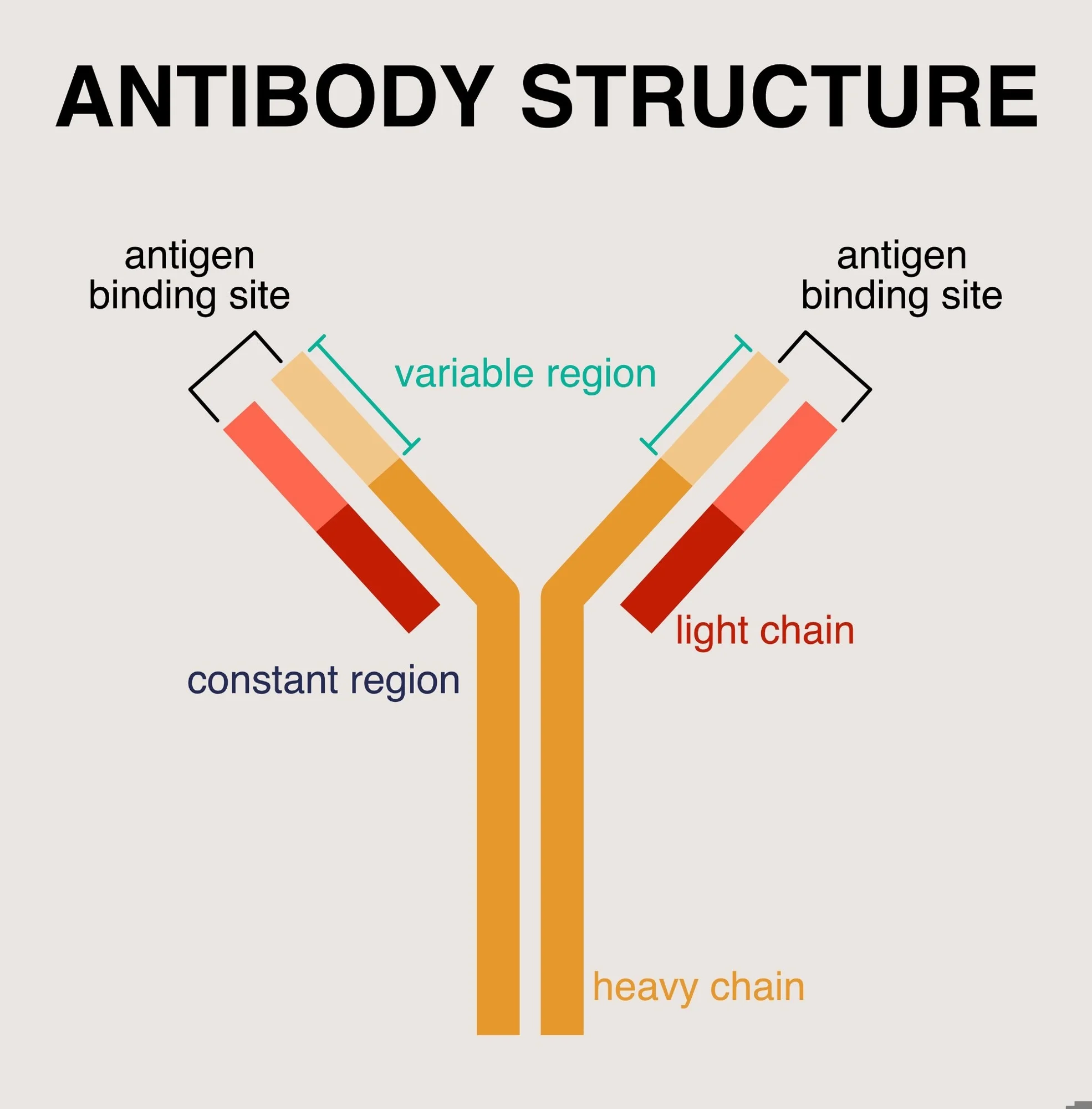
Describe the structure of an antibody.
Y-shaped glycoprotein with two heavy and two light chains.
Variable regions form antigen-binding sites; specific to one epitope.
Constant region determines mechanism of antigen destruction.
Disulfide bonds hold chains together.
Hinge region provides flexibility.
Explain how antibodies aid pathogen destruction.
Neutralisation (bind to toxins/viruses).
Agglutination (clump pathogens).
Opsonisation (mark pathogens for phagocytosis).
Lysis (trigger complement that bursts cells).
Outline how monoclonal antibodies are produced (hybridoma method).
Mouse injected with antigen → produces plasma cells.
Plasma cells fused with tumour cells → hybridoma cells.
Hybridomas screened for desired antibody.
Selected hybridomas cultured to produce large quantities of identical antibodies.
Distinguish between active and passive immunity.
Active immunity: body produces its own antibodies and memory cells after infection or vaccination; long-term.
Passive immunity: antibodies obtained externally (e.g., maternal antibodies); no memory cells formed; short-term.
Explain why secondary immune responses are faster than primary responses.
Memory B and T cells remain in the blood after the primary response. Upon re-exposure, these cells rapidly divide and produce large quantities of antibodies much quicker than during the first exposure.