Risks to Embryo and Fetus
 Call Kai
 Learn
Learn Practice Test
 Spaced Repetition
 Match
Match Flashcards
 Knowt Play
1/82

There's no tags or description
Looks like no tags are added yet.
Name | Mastery | Learn | Test | Matching | Spaced | Call with Kai |
|---|
No analytics yet
Send a link to your students to track their progress
83 Terms
Embryo and fetus risks are both
deterministic and stochastic
If we are talking about embryo/fetus risks, we are talking about
post conception
Embryo/fetus deterministic risks
Death of the embryo
Abnormalities with organ formation (congenital)
General growth disturbance (baby born w low weight)
Embryo/fetus stochastic risks
Childhood cancer
Potentially microcephaly
What are the factors that influence radiation risks to the embryo/fetus?
Dose
Dose rate
Gestational period
Like cancer and heritable effects, embryo/fetus effects are modeled how?
Relative risk
At birth, what is the natural incidence of congenital malformations
6%
In older children, what is the incidence of malformations?
12%
Radiation only increases the
risk that already exists in the general population
What are the three phases of fetal development
Preimplantation
Organogenesis
Fetal Period
Gestational time period for preimplantation
0-9 days
Gestational time period for organogenesis
Day 9-6 weeks
Gestational time period for fetal period
6 weeks to birth
Preimplantation marks the time between fertilization and
the egg attaching to the uterine wall
Organogensis marks the period of
major organ development
foundational work!!
fetal period refers to the growth
of existing structures
embryo-fetus
Preimplantation stage is most sensitive to what from radiation exposure
Prenatal death
Irradiation during the preimplantation phase results in a
all or nothing effect
In preimplantation, the radiation will either cause
too many cell death killed by radiation so the embryo dies and is reabsorbed
or
the embryo attaches and develops normally
In the preimplantation phase, the cells are too undifferentiated to result in
birth defects
What happened to the mice during irradiation in the preimplantation phase?
A decrease in litter size
NO observable growth disturbances
NO observable increase in congenital malformations
In the preimplantation the phase, the embryo will either die or
develop normally during this phase if irradiated
Organogenesis stage is most sensitive to what from radiation exposure
Organ malformations and temporary growth disturbances
What is happening during the organogenesis phase?
The embryonic cells are differentiating into whatever organ they will eventually become
Irradiation during organogenesis may induce
congenital malformations by depleting the cells in the developing body organs or structures
Irradiation during EARLY organogenesis may result in
temporary growth disturbance, although normal adult weight is possible
If death is going to occur as a result of radiation exposure during organogenesis, it is most likely
neonatal death
What were the congenital malformations seen in mice during organogenesis?
Exencephaly (brain outside skull)
Eviseration (organs outside body)
Anencephaly (absence of brain tissue)
Growth stunting
Microphthalmus (small eye)
Anophthalmus (Absence of eye)
Preimplantation vs. Organogenesis
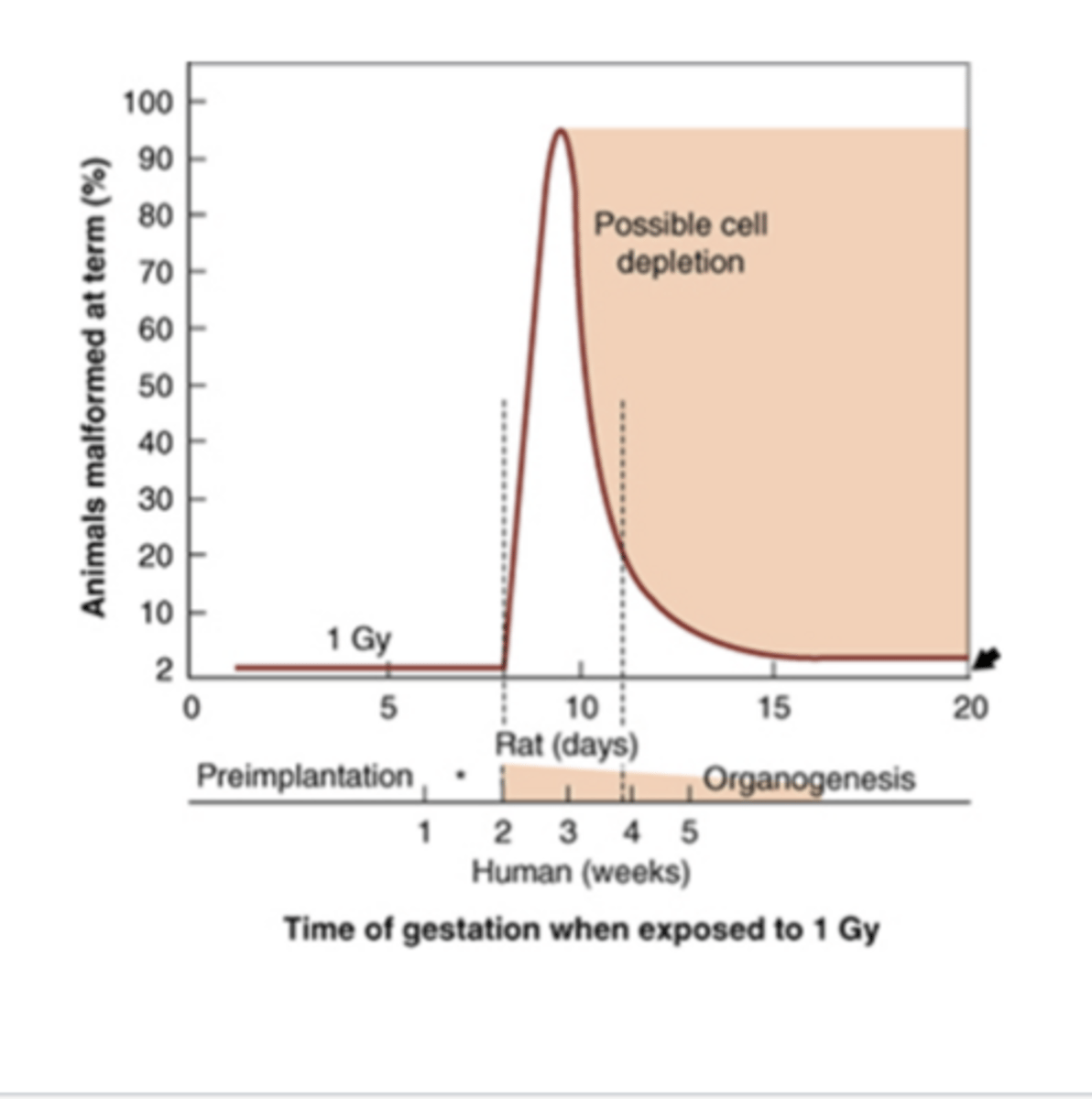
Fetal period stage is most sensitive to what from radiation exposure
PERMANENT growth disturbances
(ex: low birth weight)
Irradiation during the fetal period can have a large impact on what for the offspring?
fertility
Natal lethality during the fetal period occurs at
MUCH HIGHER DOSES than preimplantation or organogenesis
Graph of all stages of development from when mice received a dose of 2 Gy at different stages
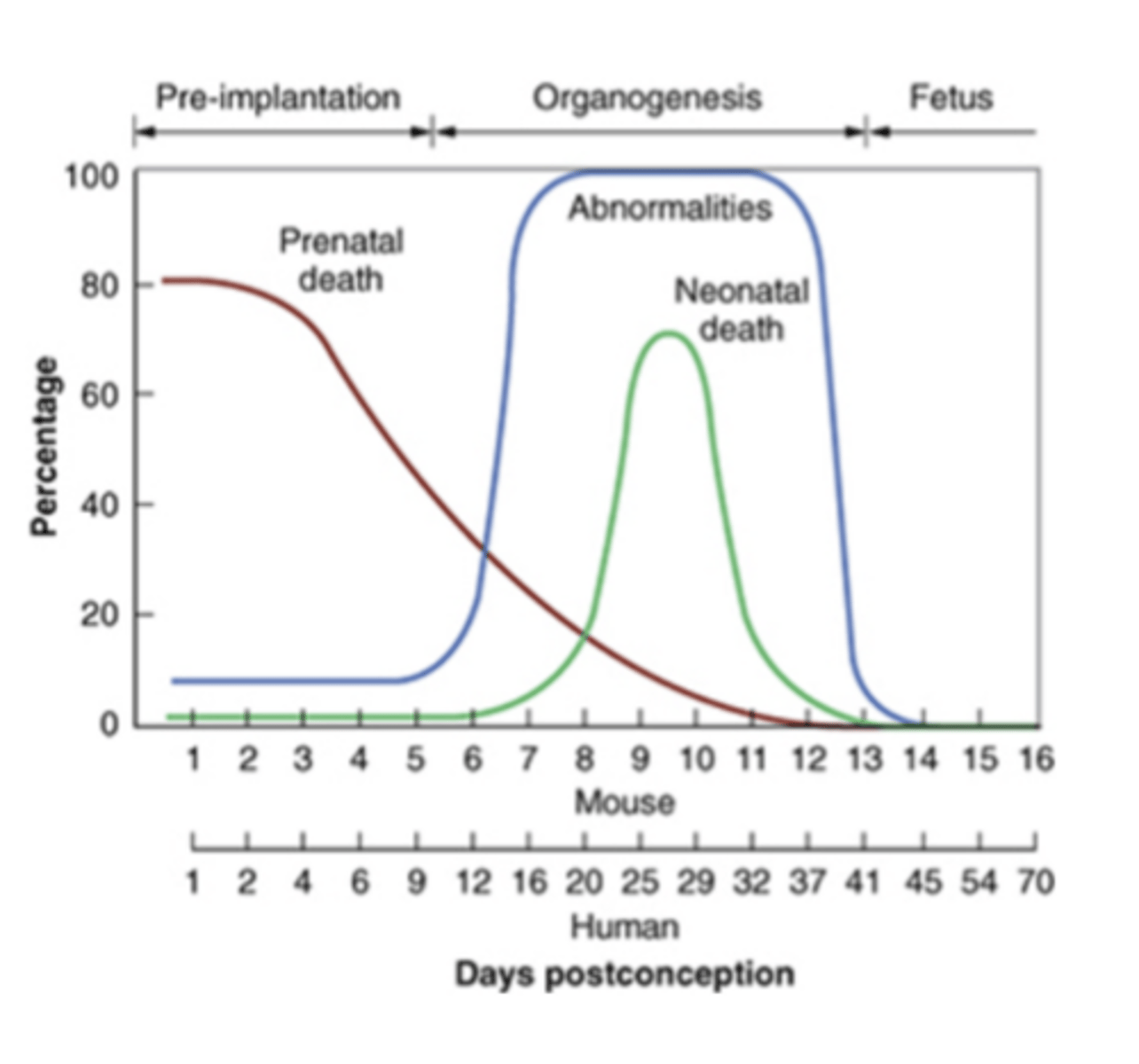
What is the threshold for radiation effects in preimplantation?
100 mGy for prenatal death
What is the threshold for radiation effects in organogenesis?
100 mGy for malformations
What is the threshold for radiation effects in fetal period?
Doses below 100 mGy appear to have no significance to intellectual disability
What happened to pre-atomic bomb, early rad therapy studies?
Involved in-utero exposure as a consequence of pelvic radiation therapy to the moth
Describe the fetal effects seen in studies on individuals exposed to radiation therapy treatments in utero
-Large doses (2.5 Gy) delivered before 2-3 weeks did not produce organ abnormalities
-Irradiation between 4-11 weeks produced severe organ abnormalities
-Irradiation after 30 weeks did not produce significant organ abnormalities
As well as
-MICROCEPHALY
-INTELLECTUAL DISABILITY
Microcephaly quick summary
structural abnormality
small head size
impairment of glial cell development
intellectual disability summary
functional abnormality
decreased cognition
impairment of neuron development
Majority of the effects seen in early rad tx studies (microcephaly and intellectual disability) between
11-25 weeks gestation
the atomic bomb survivors give us some evidence about human
preimplantation effects
-First, there were too few children born that would have been less than 4 weeks in utero at the time of the blast
-Second, there was no birth defects observed in individuals who were more than 15 days in utero
the atomic bomb survivors prove the
all or nothing effect in preimplantation
Microcephaly results in
small head size
What is a permanent form of growth disturbance?
Microcephaly
Microcephaly was mostly observed in survivors that were within
1,500 m (1 mile) from the blast epicenter
Microcephaly was only seen in those that were exposed
before 15 weeks
Microcephaly appears to be what type of effect?
Stochastic because there was little evidence for a dose threshold
Since microcephaly does not have a threshold, the data implies that microcephaly also has a
GENETIC COMPONENT or some other factor that leads to stochastic rather than deterministic
Intellectual disability appears to be
deterministic
There is a 40% chance of intellectual disability at a dose of
1 Gy
What is the threshold for intellectual disability?
300 mGy
For atomic bomb survivors, intellectual disability was only seen in children exposed between
8-25 weeks
Children with IQ less than 68 (avg is usually 90-110)
Both microcephaly and intellectual disability are seen with irradiation between
8-15 weeks gestation
Microcephaly occurs without intellectual disability from weeks
0-7
Intellectual disability occurs without microcephaly from weeks
16-25
8-15 weeks is a
critical time for protecting brain development
What is the threshold for intellectual disability as observed in the atomic bomb survivors?
300 mGy
Increased risk of childhood cancer is always a concern, regardless of
timing of irradiation
Risk appears to be slightly increased for childhood cancer with irradiation in
last trimester
What is the most common cancer associated with in-utero exposure
Childhood leukemia
Doll and Wakeford's review on childhood cancer risk
1997 summary paper
Tells us that obstetric x-ray exam leads to excess relative risk of 40%
Doses of 10 mGy increase cancer risk
Absolute risk is 6% per Gy
Obstetric x-ray exam leads to excess relative risk of
40%
Doses of how much increase cancer risk
10 mGy
Absolute risk is
6% per Gy
Childhood cancer estimates are highly uncertain, but not
zero
data is controversial due to confounding factors
Childhood cancer in atomic bomb survivors
The relative cancer risk for individuals exposed in utero was observed to be 1 per Gy of dose (100% increase)
For childhood cancer in atomic bomb survivors, however:
there was no statistically significant increase in the number of childhood cancers (less than 15 years)
the risk was higher if exposed as an infant of young child rather than in utero!!!
According to atomic bomb data, the relative cancer risk exposed in utero
observed to be 1 per Gy of dose (100%)
NRC fetal dose limit
500 mrem for the entire pregnancy
NRCP occupational fetal dose
50 mrem per month
The dose limits for occupational exposure to the embryo and fetus are designed to
minimize the risk of cancer, malformations, and growth disturbances
Embryo/fetal dose limit is
VOLUNTARY
Declared pregnancy woman
Means a woman who has voluntarily informed the licensee, in writing, of her pregnancy and the estimated date of conception. The declaration remains in effect until the declared pregnant woman withdraws the declaration in writing or is no longer pregnant.
The regulatory term for a radiation worker who has officially requested fetal monitoring.
Recommendations for pregnant individuals working in medical radiation professions
No I-131 admin by pregnant employees
Reduce or eliminate admin of other therapeutic radiopharmaceuticals
Pregnant employees should not be involved in radiation emergency response
Pregnant employees in intense fluoro departments should consider the possibility of reducing caseload
All pregnant employees should practice ALARA
What can pregnant women not administrate?
I-131
Patients should be asked about
possible pregnancy before receiving routine diagnostic scans, and answer should be documented
If the procedure is high dose or therapeutic, what is required?
BLOOD pregnancy test (BETA HCG)
If the patients medical condition warrants intentional exposure, the decision must be made in collaboration with the
physician
if a pregnant patient is accidentally exposed...
careful dosimetry should be performed by qualified expert
small doses pose a very low
deterministic risk (malformations)
-less than 100 mSv during preimplantation and organogensis
-less than 300 mSv during fetal period
Stochastic risk is always
a concern at ANY dose levels
higher doses may require a
tough conversation