8-The Moon
 Studied by 0 people
 Call Kai
 Learn
Learn Practice Test
 Spaced Repetition
 Match
Match Flashcards
 Knowt Play
1/42

There's no tags or description
Looks like no tags are added yet.
Name | Mastery | Learn | Test | Matching | Spaced |
|---|
No study sessions yet.
43 Terms
What is the landing site of the Mars Opportunity rover mission?
Meridiani Planum
What method is used on rover missions to determine geochemical data from rocks on the Martian surface?
XRF
Which are Viking Mission Experiments to search for life on Mars?
Gas exchange, labeled release, pyrolytic release
What compound is the Exomars Trace Gas Orbiter trying to identify from orbit?
Methane
What is the abbreviated name for the main group Martian meteorites?
SNC
Where did the Apollo 11 mission land?
Mare Transquillitatis
Apollo 17 mission collected the orange glass beads true or false?
True.
What is the difference between the farside of the moon vs the dark side of the moon?
Farside = always facing away from Earth.
Dark side = currently unlit side (changes daily).
What is the Luna 3 USSR mission?
1959 - flyby. First pictures of the farside.
What were the apollo missions?
6 successful lunar landings.
1969-1973.
12 astronauts walked on surface of moon.
382kg of moon rock.
In situ experiments.
Orbital experiments and photography
All of nearside, equatorial.
How come you don’t see minerals like biotite, muscovite, and amphibole on the moon?
Moon is dry.
Moon has plagioclase, pyroxene, and olivine.
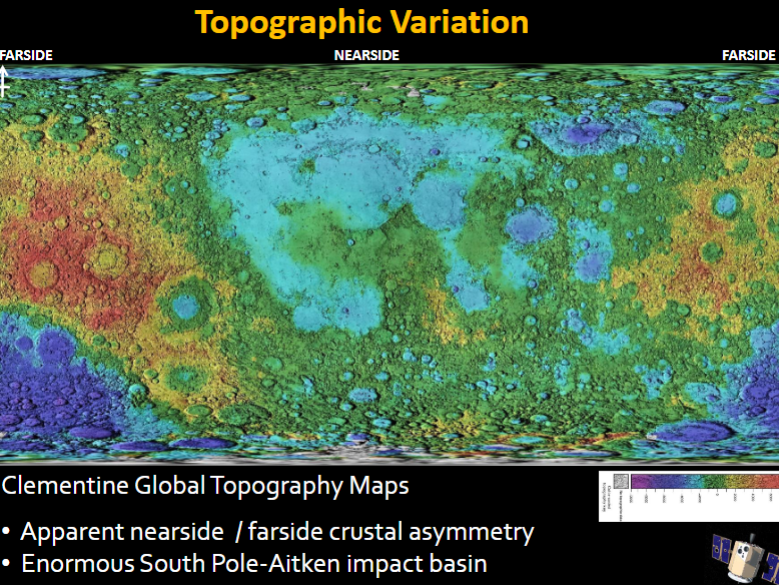
What is the Clementine Mission?
CCD camera mapping of the lunar surface in UV/VIS wavelengths.
Hotter colours are thicker crust, farside is thicker crust.
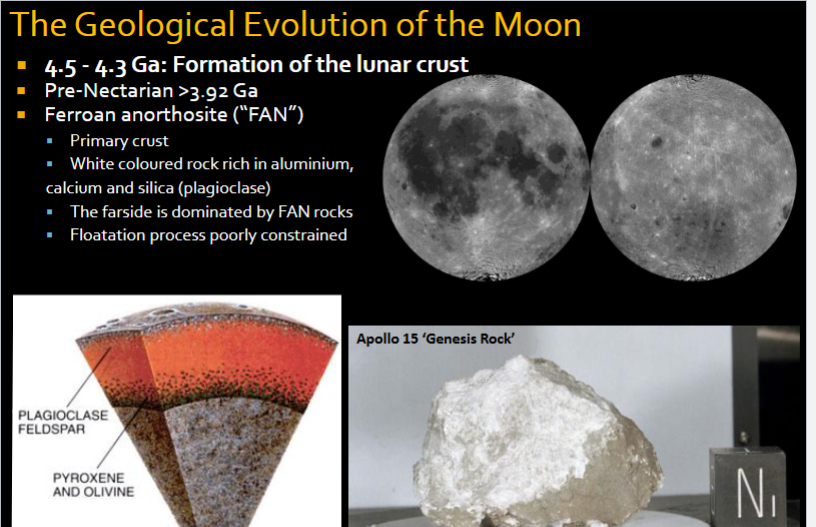
What is difference between primary, secondary, and tertiary crust?
Primary crust (original) e.g. anorthosites
Secondary Crust (volcanic and magmatic)
Tertiary Crust (impact, soil, sediments)
What is the giant impact theory?
The Giant Impact Theory (also called the Theia Impact) is the leading scientific explanation for how the Moon formed
The Giant Impact Theory says the Moon formed when a Mars-sized body (Theia) crashed into the early Earth.
The impact blasted debris into orbit, and that material eventually clumped together to become the Moon.
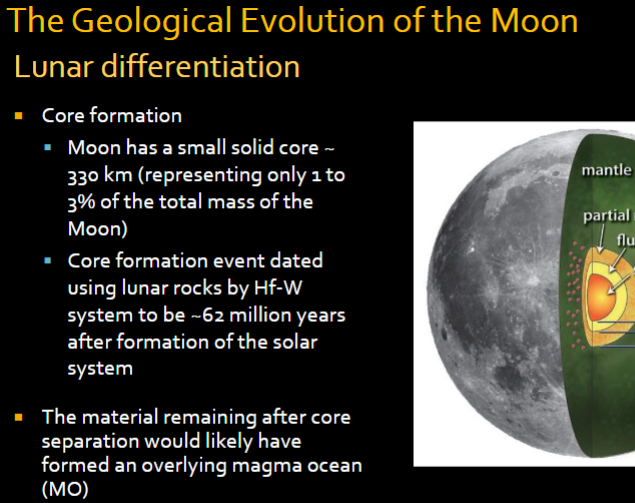
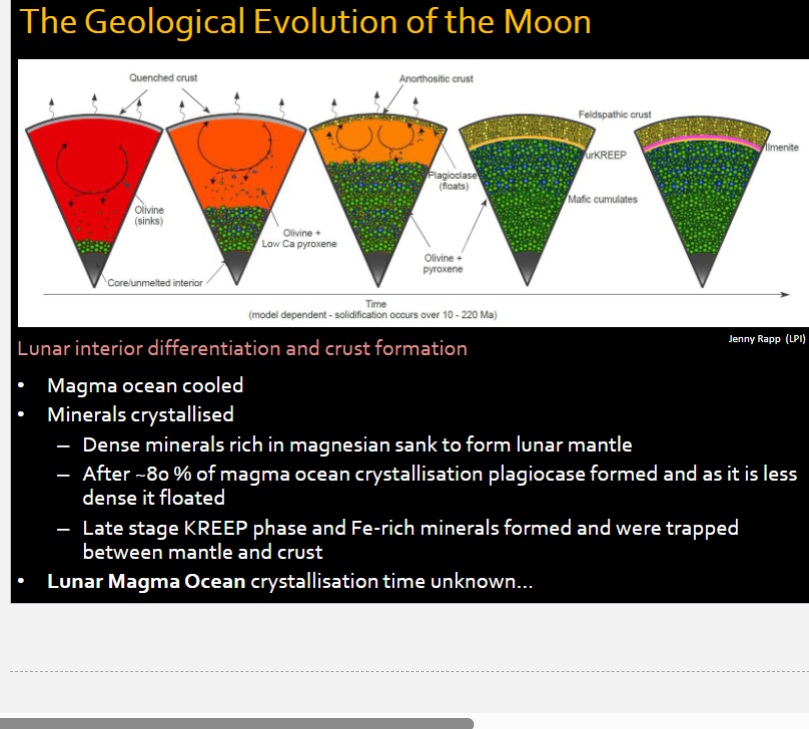
How did the moon undergo lunar differentiation?
Forms small core, lots of silicate material left over. Forms magma ocean.
What types of lunar samples did astronauts collect?
basalts
breccias
anorthosite
regolith/soil
volcanic glasses
Why was Apollo 17 important for lunar science?
Has the only trained geologist who discovered important samples such as orange volcanic glass
What are drive tubes and drill holes?
Drive tubes: hammered into the ground by hand, sample top 50–70 cm.
Deep drill cores: rotary drills used from Apollo 15 onward, reached up to ~3 metres, deepest drilled on any planetary body besides Earth.
What is Breccia and why is it common on the Moon?
Breccia is a rock made of angular fragments welded together by an impact.
Because the Moon has no erosion, impacts dominate — so breccias form everywhere.
How did landing site selection evolve through Apollo?
Early missions → flat, safe mare basalts (Apollo 11, 12)
Later missions → rugged highlands, rilles, basins (Apollo 14, 15, 16, 17)
How many Apollo missions successfully landed on the Moon?
6 missions
What type of terrain did Apollo 11 land on?
A flat mare basalt plain (Mare Tranquillitatis)
Basalt rocks sampled
What was significant of Apollo 12’s landing site?
Targeted multiple basalt types and was near surveyer 3.
Where did Apollo 14 land and what was special about it?
Landed in the Fra Mauro Formation, sampling impact-ejected highland materials from the Imbrium impact
What kind of samples did Apollo 14 return?
Breccias from deep crust excavated by the Imbrium impact.
What was unique about Apollo 15’s landing site?
Located at Hadley Rille, giving access to:
Mare basalts
Highland material
A sinuous rille (volcanic channel)
What important samples came from Apollo 15?
Olivine-rich samples and basalts of different ages, showing long volcanic history.
What terrain did Apollo 16 land in?
Lunar highlands - rugged bright, heavily cratered.
What rock types was expected at Apollo 16 but not found in abundance?
Pure anorthosite, instead they found mixed breccias.
Which mission landed in Taurus-Littrow Valley?
Apollo 17
What major discoveries were made by Apollo 17?
Orange volcanic glass
Deep crustal rocks
Which Apollo mission returned the greatest mass of samples?
Apollo 17, brought back 110kg of material.
What types of samples are common across all apollo missions?
Regolith (lunar soil) created by repeated impacts
How many astronauts walked on the Moon and over how many landing sites?
12 astronauts across 6 landing sites 1969 - 1972
How much lunar material did Apollo return to Earth?
382kg over 2000 samples
What major scientific discovery did Apollo samples support about the Moon’s origin?
That the Moon likely formed from a giant impact between early Earth and a Mars-sized body (Theia)
Chemical evidence
low volatile elements
low iron content
similar isotopes to earth rocks
What surprising discovery was made about water in the Moon?
Apollo volcanic glasses and minerals (like apatite) contain tens of ppm of water, much more than the older belief of ≤1 ppb.
What is the lunar magma ocean hypothesis?
The early Moon had a global magma ocean that crystallised to form the mantle (sinking olivine + pyroxene) and primary crust (floating plagioclase → anorthosite).
Which Apollo mission directly samples the lunar primary crust?
Apollo 16, which landed in the highlands
What did Apollo seismic experiments discover about the Moon’s interior?
The Moon is a differentiated body with crust, mantle, and core, and experiences moonquakes
What is lunar cataclysm?
The lunar cataclysm, also called the Late Heavy Bombardment (LHB), refers to a period around 3.9 billion years ago when the Moon (and probably Earth and other inner planets) was struck by an unusually intense wave of asteroid impacts.
Where should we send future missions to the Moon and why? DISCUSSION
South Pole. Permanently shadowed regions, volatiles being trapped in dark craters. Water/Ice maybe present.