Science - Physical and Chemical Changes
 Call Kai
 Learn
Learn Practice Test
 Spaced Repetition
 Match
Match Flashcards
 Knowt Play
1/28

There's no tags or description
Looks like no tags are added yet.
Name | Mastery | Learn | Test | Matching | Spaced | Call with Kai |
|---|
No analytics yet
Send a link to your students to track their progress
29 Terms
Physical Change
A change where no new substance is formed, usually done by heat or force
Sugar dissolving in tea
Ice melting
Chopping wood
Usually can be reversed easily
Chemical Change
A change in which a new substance is formed, cannot be reversed easily
Burning paper
A nail rusting
Acid reacting with a base
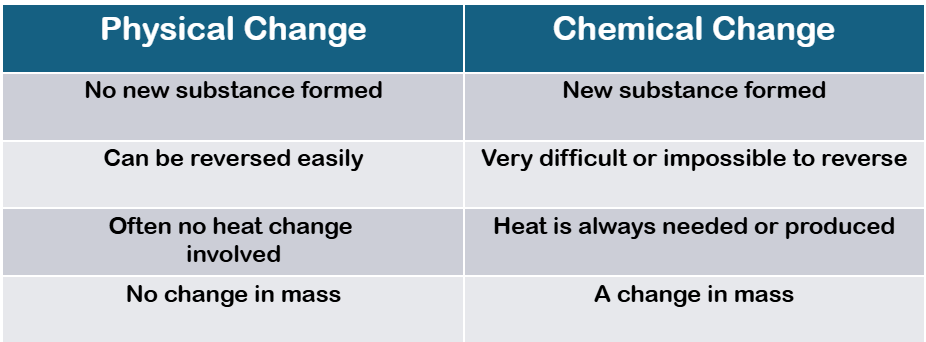
Difference between physical and chemical changes
Physical Change
No new substance formed
Often no heat change involved
Can be reversed easily
Chemical Change
New substance formed
Very difficult or impossible to reverse
Heat is always needed or produced
Describe an experiment that shows if mass changes during a physical change
First you measure a block of ice
Then you melt it in a sealed container
Next you weigh the water leftover
The masses should be the same as there is no loss of mass during the change
Describe an experiment that shows if mass changes during a chemical change
Get a flask, balloon, water and an effervescent tablet
Then pour the water into the flask
Weigh all the apparatus
Put the tablet into the water and then quickly put the balloon over the flask
After the reaction is complete, weigh all the items again
The masses combine should be nearly the exact same but a little weight is lost in the time when you put on the balloon as the gas escapes
Law of the conservation of mass
Mass is neither created nor destroyed but simply moves from one form to another
Matter
Anything that has space and mass (solids, liquids and gases)
Particle theory
All physical matter is composed of tiny, constantly moving particles that have spaces between them,
Properties of a solid
Definite Shape
Definite Volume
Cannot be compressed
Cannot flow
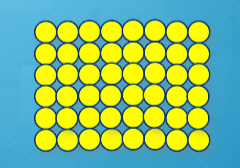
How are particles set up in a solid?
The particles that make up solids are held very closely together
They cannot move freely - but can vibrate
Properties of a liquid
No definite shape
Fixed volume
Cannot be compressed
Can flow
How are particles set up in a liquid
Particles in a liquid are a bit more free than solids and that allows them to change shape and flow

Properties of gases
No definite shape
No definite volume
Can be compressed
Can flow
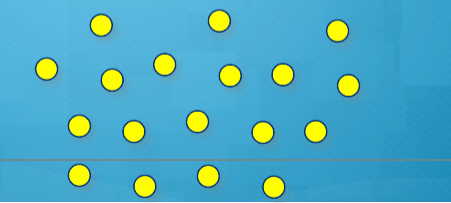
How are the particles in gases set up
Particles in a gas are so spread out that they can be compressed
Diffusion
The movement of molecules from an area of high concentration to an area of low concentration (food colouring mixing in water, air freshener spreading in a room)
Boiling
A rapid, bulk change throughout the liquid at a specific temperature (boiling point), forming visible bubbles, like water cooking on a stove, requiring external heat.
The particles in a liquid get heated up really fast and spread out turning the liquid into a gas
Evaporation
A slow, surface-level liquid-to-gas change at any temperature, like a puddle drying, occurring without bubbles
The particles in a liquid get heated up slowly and spread out turning the liquid into a gas
Melting
Melting is the process from which a solid turns into a liquid as a result of heat. The particles get spread out turning into a liquid
Freezing
The process in which a liquid turns into a solid as a result of a loss of heat. The particles slowly pack back together to form a solid
Condensing
The process in which a gas turns into a liquid as a result of a loss of heat. The particles cool down and go closer together but don’t fully pack together and turns into a liquid
Mixture
Made up of two or more substances mingled together but not chemically combined (saltwater, tea, coffee)
Filtration
Used to separate an insoluble solid and a liquid (such as soil and water)
Evaporation experiment
Used to separate a soluble solid and a liquid using heat (saltwater, tea and sugar)
Distillation
Used to separate substances which have different boiling point
Chromatography
A technique used to separate a mixture of dyes in ink based on their solubilities
Solute
The substance that dissolves
Solvent
The substance that the solute dissolves in
Solution
Solute + Solvent
Soluble
Name given to substances that dissolve in a solvent