03 - sinusoidal quantities
 Call Kai
 Learn
Learn Practice Test
 Spaced Repetition
 Match
Match Flashcards
 Knowt Play
1/17

There's no tags or description
Looks like no tags are added yet.
Name | Mastery | Learn | Test | Matching | Spaced | Call with Kai |
|---|
No analytics yet
Send a link to your students to track their progress
18 Terms
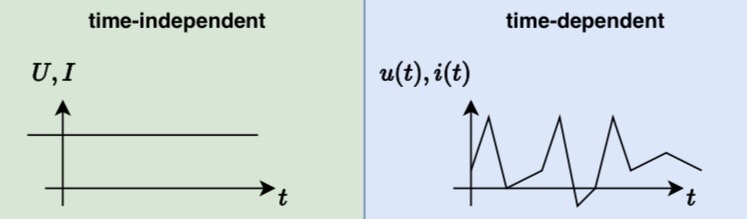
what’s the difference between a time-dependant and a time-independent signal?
time-dependent : the value changes with time
Time-independent : the value stays constant
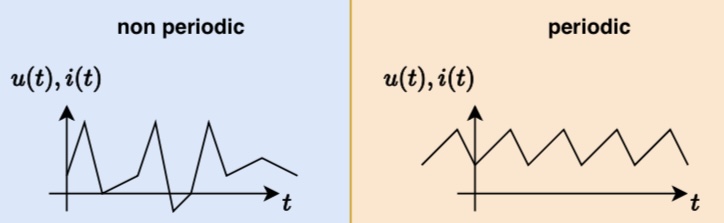
What’s a periodic signal?
a signal that has a path that repeats itself over time
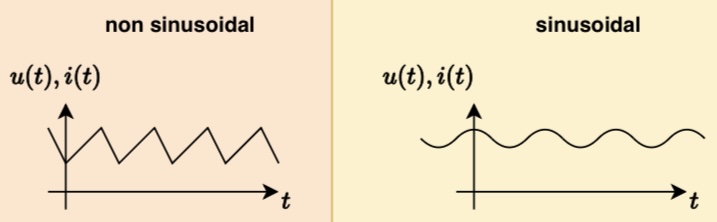
What’s a sinusoidal signal?
A signal that can be mathematically represented by a cosine or a sine function
What does it do when a sinusoidal signal is mixed with a DC signal (DC component)?
It adds an offset to the sinusoidal signal
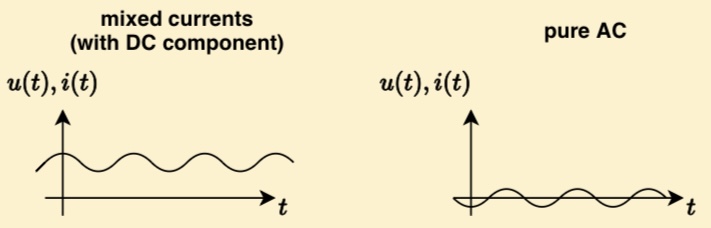
How do we call a sinusoidal signal without any offset (with no DC component)?
A pure AC signal
What is the DC component of a non-pure AC signal?
the value around which the sine wave oscillates
Given by the arithmetic mean of the signal
What’s the peak voltage?
The maximum deviation from the DC value
In which specific case can we the peak voltage the amplitude?
Only for sinusoidal signals
What’s the peak-to-peak voltage?
The difference between the maximum and the minimum deviation from the DC value
What’s the period T?
the shortest time for the signal to achieve a full path
What’s the frequency f?
Formula?
Unit?
How many cycles have been achieved in one second
f=T1
Hertz [Hz]
What’s the angular frequency?
Formula?
Unit?
The angle covered in one second
ω=2πf=T2π
rad/s
What’s the phase angle or initial phase?
Formula?
the time offset between the start of the sine wave and the origin (t=0)
Note: it’s not any zero-crossing point that you can take but the closest to the origin, and the one where the sine wave is normally supposed to start
φ=2π⋅TΔt (In degrees: *360 instead of 2pi)
What’s the phase difference/shift?
What does it show?
What’s the formula for the voltage/current comparison?
What’s the condition to be able to calculate it?
The difference between the phase angles (or initial phases) of 2 signals
shows how a signal is ahead or behind the other
\displaylines{\Delta\varphi=\varphi\left(V\right)-\varphi\left(I\right)}
Only for signals that have the same frequency!
What’s the arithmetic mean of an AC signal?
What value does it have for pure AC signals? How do we get an average value in this case?
the value around which the signal oscillates (DC component/offset)
X=T1⋅∫t0t0+Tx(t)dt
for pure AC signals : = 0 (positive and negative values cancel each other out) —> we use then the rectified value
What’s the rectified value?
What’s its value for pure AC signals?
For square signals?
For triangular signals?
the value around which the absolute signal oscillates
∣X∣=T1⋅∫t0t0+T∣x(t)∣dt
π2⋅X^ (Full rectified)
π1X^ (Half rectified)
square = amplitude
Triangular = amplitude/2
What’s the RMS value?
Formula?
The value for pure AC signals?
For square signals?
Triangular signals?
The DC value for which the dissipated power across a resistor is the same as for the AC signal (current & voltage) —> effective (or DC-equivalent) value
RMS = Root Mean Square
Xrms=T1⋅∫t0t0+Tx2(t)dt
Note: in AC analysis, uppercase letters represent the RMS values
21⋅X^ (Pure AC)
Square = max value
Triangular = max/racine de 3
What’s the general mathematical expression of a sine wave?
What are its components?
What is often written for the amplitude of a sine wave?
Formule u de t avec oméga t + phase
Pareil avec courant
Amplitude sine wave = racine de 2 * rms value (juste U ou I)