RP10b: Preparing a pure organic liquid
 Call Kai
 Learn
Learn Practice Test
 Spaced Repetition
 Match
Match Flashcards
 Knowt Play
1/14

There's no tags or description
Looks like no tags are added yet.
Name | Mastery | Learn | Test | Matching | Spaced | Call with Kai |
|---|
No analytics yet
Send a link to your students to track their progress
15 Terms
Draw and label a diagram of reflux apparatus (5)
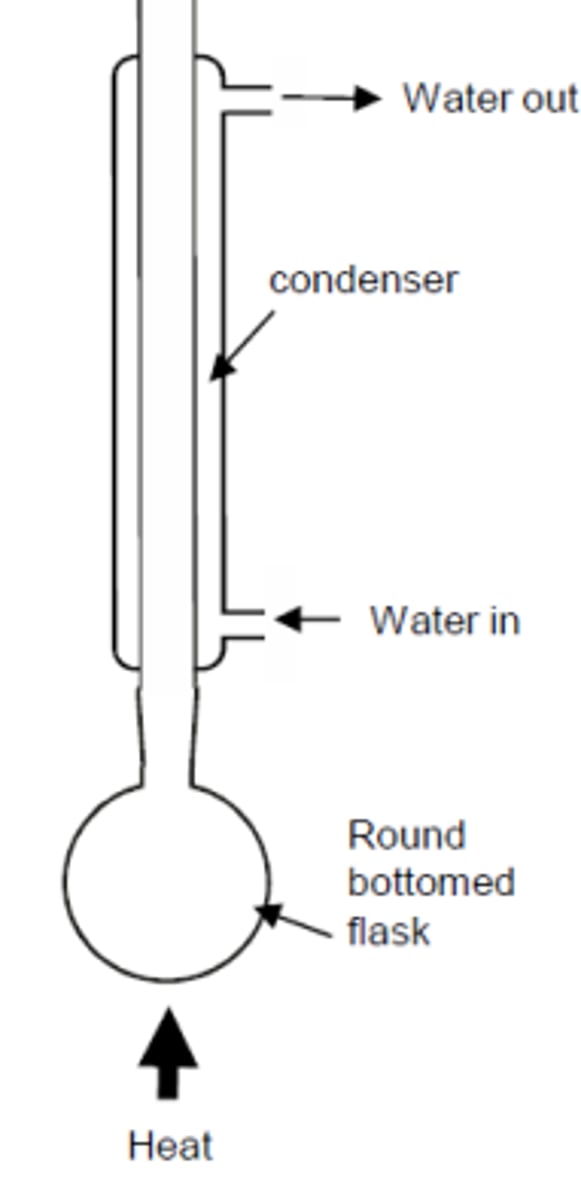
What are the guidelines for drawing the reflux apparatus i.e. common mistakes examiners HATE? (4)
- Don't draw lines between flask and condenser
- Don't seal the top of the condenser.
- Ensure the condenser has an outer tube for water that is sealed at the top and bottom.
- The condenser must have two open openings for water inlet and outlet.
What is the purpose of reflux in an organic reaction? (1)
The condenser prevents organic vapours from escaping by condensing them back to liquids during long heating periods
Why should the end of the condenser never be sealed? (3)
- Can cause gas pressure to build up
- Potentially leading to an explosion,
- Especially when heating volatile liquids
What is the function of anti-bumping granules in reflux and distillation? (1)
Prevent vigorous, uneven boiling by forming small bubbles instead of large ones
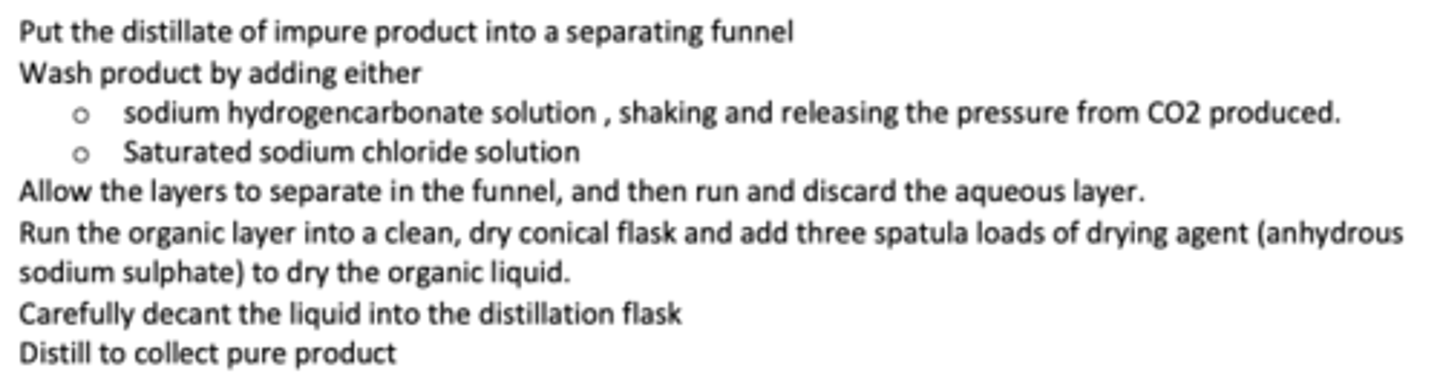
What is the overall method for purifying the organic liquid formed from reflux? (7)
What is the first step in purifying a liquid? (1)
Put the distillate of the impure product into a separating funnel
What two solutions can be used to wash the product in a separating funnel? (2)
- Sodium hydrogencarbonate solution (shaking and releasing pressure from CO₂ produced)
- Saturated sodium chloride solution
What should be done after washing the product in the separating funnel? (1)
Allow the layers to separate and then run and discard the aqueous layer
How is the organic layer dried after separation? (2)
1. The organic layer is transferred into a clean, dry conical flask
2. Three spatula loads of anhydrous sodium sulfate are added to dry the liquid
How should the dry organic liquid be transferred for purification? (1)
Carefully decant the liquid into a distillation flask
What is the final step in purifying a liquid? (1)
Distill the liquid to collect the pure product
What is the role of sodium hydrogencarbonate in purification? (1)
Sodium hydrogencarbonate neutralises any remaining acid
How does sodium chloride help in purification? (1)
Sodium chloride helps separate the organic layer from the aqueous layer.
What are two important properties of a suitable drying agent? (2)
- It should be insoluble in the organic liquid.
- It should not react with the organic liquid.