Lines, Angles, and Triangles
 Call Kai
 Learn
Learn Practice Test
 Spaced Repetition
 Match
Match Flashcards
 Knowt Play
1/20

Earn XP
Description and Tags
types of triangles
Name | Mastery | Learn | Test | Matching | Spaced | Call with Kai |
|---|
No analytics yet
Send a link to your students to track their progress
21 Terms
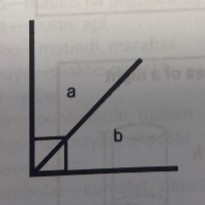
Complementary angles
Two angles whose measures add up to 90 degrees.
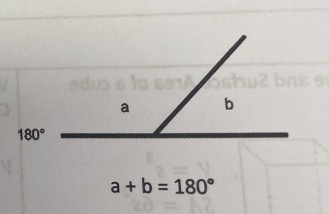
Supplementary angles
Two angles whose measures add up to 180 degrees.
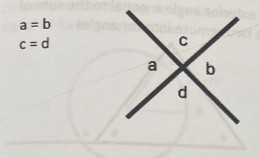
Vertical angles
Opposite angles formed by intersecting lines that are always equal to each other.
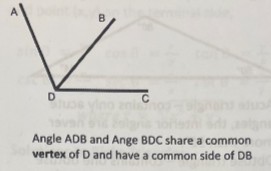
Adjacent angles
Two angles that share a common side and a common vertex.
Line
A straight path of points that has no beginning or end.
Ray
A straight path of points that contains one endpoint and extends forever in one direction.
Segment
A portion of a line that has two distinct endpoints.
Parallel lines
Two or more lines that remain the same distance apart and never meet.
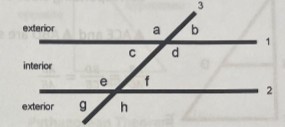
Transversal line
A line that crosses two or more other lines.
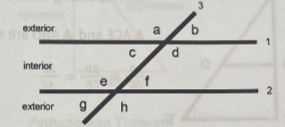
Alternate interior angles
Angles on different sides of the transversal line, inside the two parallel lines.
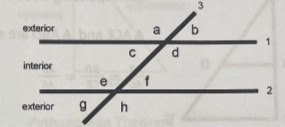
Alternate exterior angles
Angles on different sides of the transversal line, outside the two parallel lines.
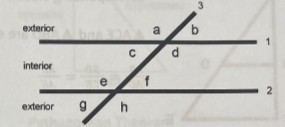
Corresponding angles
Angles that sit on the same side of the transversal line, where one is interior and one is exterior.
Triangle interior angle sum
Exactly 180 degrees for any triangle.
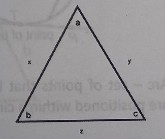
Equilateral triangle
A triangle with three equal sides and three equal angles that measure 60 degrees.
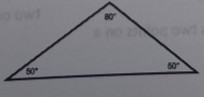
Isosceles triangle
A triangle with two equal sides and two equal angles.
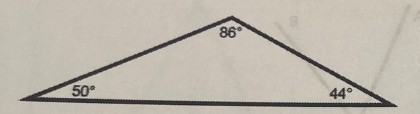
Scalene triangle
A triangle with no equal sides and no equal angles.
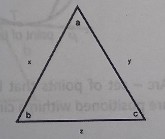
Acute triangle
A triangle that contains only angles that measure less than 90 degrees.
Obtuse triangle
A triangle that contains exactly one angle greater than 90 degrees.
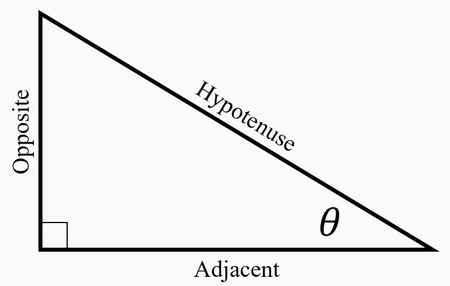
Right triangle
A triangle that contains exactly one right angle (90 degrees).
Triangle Exterior Angle Theorem
The rule stating that an exterior angle is equal to the sum of its two remote interior angles (d = a + c).
Similar triangles property
The rule stating that corresponding sides of similar triangles are proportional.