Lecture 33 - Moons of the Solar System
 Studied by 1 person
 Call Kai
 Learn
Learn Practice Test
 Spaced Repetition
 Match
Match Flashcards
 Knowt Play
1/26

Earn XP
Description and Tags
ASTR 1210 (Exam 3)
Name | Mastery | Learn | Test | Matching | Spaced |
|---|
No study sessions yet.
27 Terms
Jupiter’s Bands
Primary component of Jovian planets is not actually gaseous - we just see the gaseous clouds forming on top of Jupiter
Jupiter has different cloud layers and bands
Earth’s clouds form thru convection in the troposphere
Jupiter water clouds also form thru convection
Jupiter is hotter near its interior, colder near the top
Brighter at infrared wavelengths, the hotter it is in that region - looking deeper into the core
Jupiter’s Great Red Spot
Multi-century old hurricane
Shrinking in size
now 2 times the size of the Earth
Raging for centuries - these winds contribute to Coriolis effect that drives those banded structures very long on Jupiter
Winds are going to interact and change a lot of the appearance because the winds are stronger and faster rotations
Swirling storms at Jupiter’s pole
Energy is getting transferred to the poles - gas to rise near the equator of the Earth and sink near the poles = one large convection cell
Jupiter’s rotation complicates easterly and westerly winds - making it way more banded
Winds are spinning up the hurricane
Places where atmosphere is moving - no mountains to stop it
Great Red Spot is shrinking
Wind Patterns on the Jovian Planets
Three bands in the North and three bands in the South - easterly and westerly
More banded than the Earth is
Uranus and Neptune are a little simpler because sunlight drives a lot of wind
Creates some notable storms
Saturn’s Hexagon
Hexagonal storm in the polar region of Saturn
Seems to be some wind structure to create this hexagonal shape
Has to do with the interactions of different wind features forming it
Need to send a spacecraft to Saturn to see it - picture was taken by the Cassini spacecraft
Storms on Uranus - visible in the infrared
Neptune’s Great Dark Spot
Jovian Planet’s Rings
Saturn’s rings will change
Huygens Drawings of Saturn (1655) — had to conclude this
What Are Saturn’s Rings Like?
Made up of numerous, tiny individual particles
Orbit around Saturn’s equator
Very thin
RIng system forms in what we would call the ecliptic plane of the Sun
made out of millions of tiny particles - none of the bigger than a giant boulder
Saturn’s Changing Ring Appearance
Cassini Gap
Ring Plane Crossing - rings are thin
Gets into a view where rings disappear from us
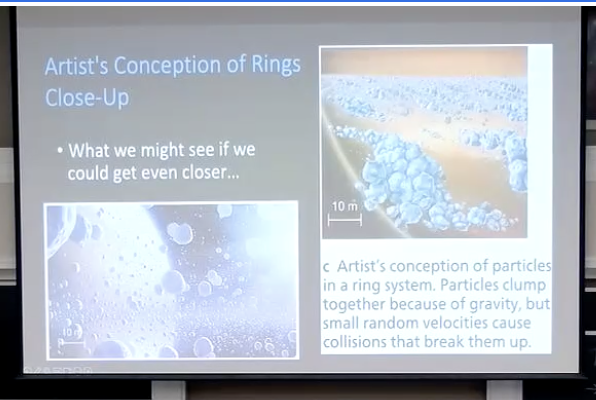
Artist’s Conception of Rings Close-Up
Biggest rocks are about the size of cars
Gap Moons
Some small moons create gaps within the rings - shepherding moons
Daphnis clears a gap of those tiny particles and supplying the ring material
Shepherd Moons
Pair of moons pulling along the rings
Jovian Ring Systems
All four Jovian planets have ring systems
Others have smaller, darker ring particles than Saturn
Origins of the Jovian Rings
Likely formed from dust created by impacts on moons orbiting those planets
Rings aren’t leftover from planet formation because particles are too small to have survived for so long
Must be continuous replacement of tiny particles
Most likely source is impacts with Jovian moons
Which planets has most currently confirmed moons in the Solar System?
Saturn
Jupiter SHOULD have the most moons
What do you define a moon to be?
What is a moon?
Natural satellites which orbit another body - can be orbiting a planet, asteroid, comet, etc
More than 200 observed moons in our solar system
20 of them large enough to be gravitationally spherical
Most massive objets are spherical
Inner planets have almost no moons
Each of the gas giants have > 10 moons currently observed
Phobos and Deimos
Small moons
tiny and lumpy
not spherical
Likely captured asteroids
Perturbed in the asteroid belt and now part of Mars’s orbit
Phobos is getting so close to Mars that it might get pulled apart
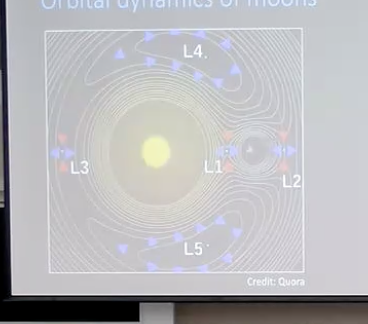
Orbital dynamics of moons
Roche limit
Limit where tidal forces (pull object in one direction and compress it in another direction) are so strong, it can tear Phobos apart
What Kinds of Moons Orbit the Jovian Planets?
Four of the biggest moons -
Ganymede - a little bit bigger than Mercury
Europa
Io
Callisto
Large moons of the solar system - ongoing geological activity
Moons of the Jovian Planets
Small Moons
No geological activity
Medium-sized moons
Geological activity in the past
Large moons
Ongoing geological activity
Medium and Large Moons
Enough self-gravity to be spherical
Have substantial amounts of ice
Formed in orbit around Jovian planets
Circular orbits in same direction as planet rotation
Io’s Volcanoes
Volcanoc eruptions continue to change Io’s surface
Tidal heat from tidal stresses
Receives greatest tidal heating because it is closest to Jupiter
Europa: Waterworld?
Europa, Io, and Ganymede are in resonant orbit
For every two times Io orbits, Europa orbits once. 4:1 for Ganymede
Forces stack up over time - making tidal forces stronger and stronger
Europa is heated very significantly from the inside out
Has a huge amount of water ice
Might have a lot of liquid water beneath the surface
Tidal Stresses Crack Europa’s surface ice
Europa may have more water than Earth
Everywhere we find liquid water, we have life
Maybe there’s life swimming underneath Europa
If Ganymede is larger than Mercury, why isn’t it designated as a planet?
Ganymede primarily orbits Jupiter - not the Sun
sometimes called a satellite planet - large sphere orbiting a planet
Saturn’s Moon - Titan
Only moon in solar system to have a THICK atmosphere, consisting of mostly nitrogen with argon, methane, and ethane
Has a cycle similar to the water cycle we have on Earth
Titan’s Surface
Lake of methane
Found liquid methane and ice made of rocks
Which large-sized moon of a Jovian planet is the most similar to Earth?
Titan
Has erosion, atmospheres, equivalent of liquid