Module 1 - Information Systems Review
 Call Kai
 Learn
Learn Practice Test
 Spaced Repetition
 Match
Match Flashcards
 Knowt Play
1/27

There's no tags or description
Looks like no tags are added yet.
Name | Mastery | Learn | Test | Matching | Spaced | Call with Kai |
|---|
No analytics yet
Send a link to your students to track their progress
28 Terms
system
A set of parts connected to one another, interacting with each other, to achieve a certain goal
shower system
parts: shower head, water tank, human hands, etc.
feedback: adjustment from human hand
delay: travel time of water
stock: water
quality: water temperature
balancing feedback loop
self-correcting feedback loop
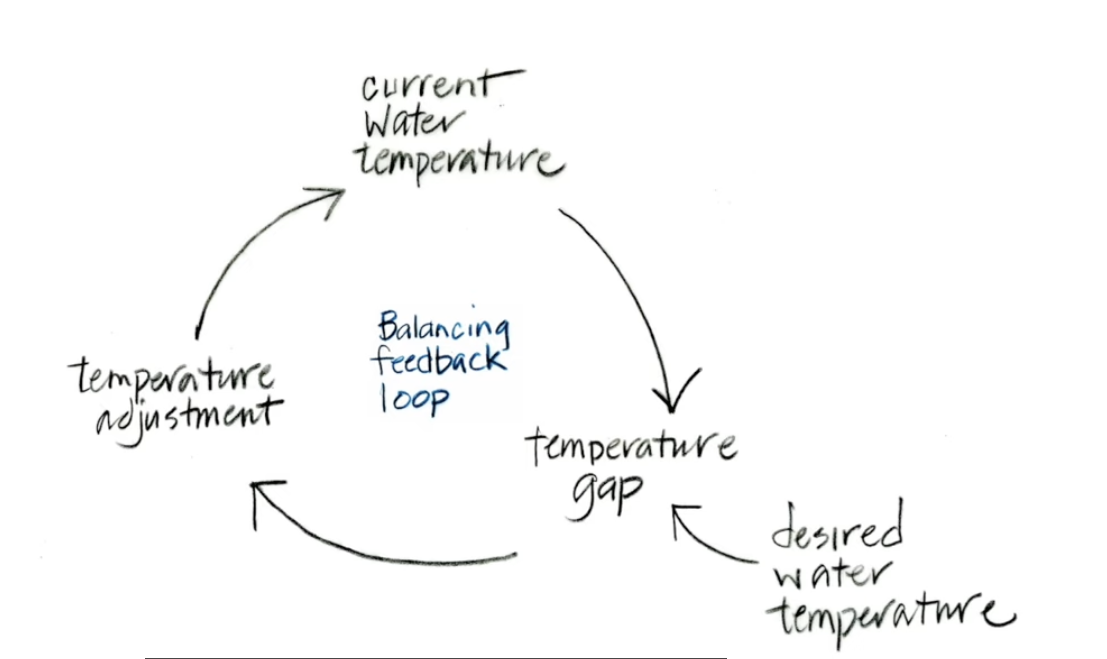
delays
Adjusting to the right level of quality takes some time. That time is called a ___.
Shower system continues from bathroom upstairs to water tank from basement. Travel time of water across floors.
feedback loop
Different components of a system interact with each other and provide feedback in order to reach a certain level of quality. The process is called a feedback loop.
In the shower system, quality would refer to the water temp and the feedback loop would refer to the whole process of adjusting the shower lever until the water is in the right temp. The feedback loops would refer to the whole process of adjusting the shower lever until the water is in the right temp.
stock
quantities that are tracked by systems. These could be literally anything. In the shower example it was water while in the highway example it was cars.
Inflow and Outflow
How stock gets into the system and out.
knowledge
data
lowest form of knowledge.
unstructured facts and figures which lack any kind of organization.
Very specific
example: data on car manufacturing: cost, pricing, income, market research
information
Second form of knowledge
Data that has been organized, condensed, contextualized, and so on.
Data with a direction and purpose!
example: data that answers what was our profit las quarter? which product performs better?
knowledge
deeper level of understanding and knowhow
based on experience and rooted in context
fluid mix of framed experience, values, contextual information, expert insight and grounded intuition that provides an environment and framework for evaluating and incorporating new experiences and information
example: how to fix a machine, how to organize a project, etc.
Knowledge can come in varying degrees.
Data-Information-Knwoledge
Data is the building block, a set of meaningless facts.
Contextualized and organized, it becomes useful information.
Knowing how and when to apply this information is the environment called knowledge.
information system (class)
A system whose goal is to convert data into useful information.
It doesn’t matter whether the system is manual or automated.
A correctly designed one will have a data inflow that collects the necessary data to provide the correct information outflow.
It will also have a feedback mechanism to ensure that the information is of high quality.
information system (video)
a set of interrelated components that collect and disseminate data and information, and provide feedback to meet an objective
technology
people
process
business oriented; focuses on the business domain
business skills & learn enough about technology to make decisions
elements of information system
A. Technology
Hardware
Software
B. People
People
C. Process
Data collection
Information generation
information technology (video)
the hardware, software, database, network that make information systems (IS) possible! (tech out of the tech, people, process of IS)
used to build information systems
focuses on the selection, integration, and deployment of computing technology
needs technical skills such as planning, deploying networking infrastructure or integrates DBs or build websites
information technology (class)
used in building computer based information systems
tech aspect of IS
hardware, software, database, network
technology people process
3 interacting elements of an information system
strong IT
It helps, but doesn’t solve the problem. It can make things, parts more efficient, possible effective, but it doesn’t necessarily entail a solution to all our problems.
Rather, we have systems thinking, the correct mindset.
systems thinking
being aware of how we think and how the world works.
we can get better at it.
to be systems thinkers, we think about thinking.
helps us see underlying patterns, structures, identities, parts, wholes, relationships, POVs
The above then allows us to better understand how things work around us and allow us to create new things or properly solve problems
thinking
the way we handle, organize, and give meaning to information.
Lots of this keeps us smart. information alone isn’t enough to solve problems.
How we build meaning from information
We use this to turn info → knowledge.
mental models
knowledge, what we build from memories, experience
determines how we feel, and thereby act
from the moment we are born, we are building these.
patterns for systems thinking
Distinction: make distinctions between identity and other (things and other things)
Systems: organize things into systems (parts and whole)
Relationships: identify relationships (cause & effect)
Perspective: take perspectives from a point to a view
making distinctions
pattern of systems thinking
everything has identities, it comes from differentiating the others.
we use our senses to do this pattern.
seeing what an object/idea is and isn’t.
organizing things into systems
pattern of systems thinking
systems can be really big, complicated, small, simple
systems are made of parts which have its own parts.
anything we build (Systems) has parts
helps us see how different things (e.g. bodies of water) is all connected
systems gives us a framework to understand the world
identify relationships
pattern of systems thinking
relationships between ideas, objects
relationship = interaction, a cause an effect, an action and reaction
seeing how ideas affect each other is to see things differently.
take perspectives
pattern of systems thinking
e.g. navigating city streets using perspective of space, angle, speed
every perspective has a point and a view.
perspective of other people, ideas helps us understand things from a particular POV
our POV shapes the way we think about something/mental model (eg. homeless = lazy? or underprivileged)
systems thinking approach
provides us a better understanding of the organization
allows IT professional to see the organization as a system of parts with different perspectives and interactions, and understand how the output affects others and the org as a whole
systems thinking is about interconnectedness. It helps the analyst zero in on the different processes or parts of the organization that may be the root cause of some problem or identify opportunities that may be maximized.
This in turn will dictate the whys, hows, and whats of the effective information system to be built.