biology topic 4
 Call Kai
 Learn
Learn Practice Test
 Spaced Repetition
 Match
Match Flashcards
 Knowt Play
1/71

There's no tags or description
Looks like no tags are added yet.
Name | Mastery | Learn | Test | Matching | Spaced | Call with Kai |
|---|
No analytics yet
Send a link to your students to track their progress
72 Terms
types of passive transport
diffusion osmosis facilitated diffusion
water potential
tendency of water to move by osmosis distilled water has the highest water potential
calculate water potential
water potential= turgor pressure + osmotic potential
role of ATP in active transport
ATP binds to carrier protein providing enough energy for protein to change shape
how does ATP release energy
ATP is phosphorylated to form ADP
features of effcient gas exchange surfaces
large surface area
thin or short distance
steep conc gradient
spiracles
openings on bodies surface
tracheae
large tubes in body tissue supported by rings to prevent collapse
tracheoles
smaller branches dividing off the tracheae
how are insects adapted for gas exchange
spiracles can be opened or closed to regulate diffusion
muscles in trachea allow mass movement of air in
tracheoles are highly branched
gills
made of filaments and supported by arches
lamellae
folds that cover the filaments
countercurrent
water and blood flow in opposite directions so water is next to blood of a low O2 conc
how are plant leaves adapted for gas exchange- SA
spongy mesophyll layer provides large surface area
how are plant leaves adapted for gas exchange- W
waxy cuticle is impermeable to pass preventing water loss
how are plant leaves adapted for gas exchange- G
lenticels allow gases to enter and leave
left side of heart
aorta pulmonary vein semilunar vlaves bicuspid valve
right side of heart
pulmonary artery vena cava tricuspid
which side of ventricle is thicker
left side
arteries
thick muscular walls
elastic tissue
narrow lumen
veins
thin walls
valves to prevent backflow
less muscle
capillaries
walls are one cell thick
very narrow
numberous and highly branched
cardiac diastole
heart is relaxed
blood enters atria
atrioventicluar valves open
blood moves into ventricles
atrial systole
atria contract
blood moves into venticles
ventricular systole
ventricles contract
atrioventicular valves close
semilunar valves open
blood moves into arteries
myogenic
hearts contraction is from the muscle itself rather than by nerve impulses
sinoatrial node
wall of right atrium
atrioventricular node
between atria
heart contracts pt 1
SAN initates and spreads impulse across atria so they contract
heart contracts pt 2
AVN receives, delays, and conveys impulse to bundle of his
heart contracts pt 3
impulse moves to purkinje fibres which branch across ventricles so they contract
why does impulse need to be delayed
if impulse spread from atria or venticles there wouldnt be enough time for atrial systole to complete
ECG
graph showing amount of electrical activity in the heart
P-wave
shows atrial systole caused by SAN
QRS complex
shows venticular systole
T-wave
shows systole as the ventricles repolarise
main components of blood
erythrocytes
leucocytes
plasma
structure of erythocytes
biconcave shape no nucleus has haemoglobin
function of leucocytes
help fight disease
why does blood clot
prevent blood loss
prevent entry of bacteria
help in repair
process of blood clotting pt 1
platelets release thromboplastin in response to damage
process of blood clotting pt 2
causes prothrombin to change to thrombin
rocess of blood clotting pt 3
turns souble fibrinogen to insoluble fibrin
causes of atherosclerosis
if endothelium is damaged blood clots causing cells salts cholesterol to build up and form a plaque
how does atherosclerosis affect health
risk of heart attack, stroke
factors increasing risk of atherosclerosis
age genetics smoking alcohol obesity cholesterol
how does partial pressire of O effect binding
partial pressure increases so affinity increases
bohr effect
partial pressure of CO2 increases so more acidic so shape of haemaglobin changes so affinty for O2 decreases
oxyhaemaglobin curve
further left higher affinity for O2
difference between myoglobin and haemaglobin
one haem group
higher affinity for O2
found in muscle cells with high metabolic needs
difference between foetal and adult haemaglobin
foetal has high O2 affinity
tissue fluid
substance containing glucose amino acids O2 supplying to cells and removing waste material
hydrostatic pressure
higher at arterial end of capillary then venous end
oncotic pressure
changing water potential of the capilliares as water moves out
how is tissue fluid formed
blood is pumped through increasingly small vessels hydrostatic pressure is higher than oncotic so fluid moves out of capillaries
excess tissue fluid
removed through vessels into the lymphatic system and returned to blood near heart
function and structure of xylem -length
long continous columns made of dead tissue
function and structure of xlyem -pits
pits allow water to move sideways between vessels
function and structure of xlyem -strength
thickened providing structural support
function and structure of phloem- sieve
sieve tubes transport sugars around plant
function and structure of phloem- companion cells
companion cells for active transport of sugars into tubes
function and structure of phloem- cytoplasm
cytoplasms linked by plasmodesmata allowing flow of substances between cells
apoplastic pathway
water moves through cell walls and intercellular spaces by mass flow
pathway can be used until casparian strip
symplastic pathway
osmosis through root hair cells
water moves through cytoplasm
water must be actively transported to cells to start
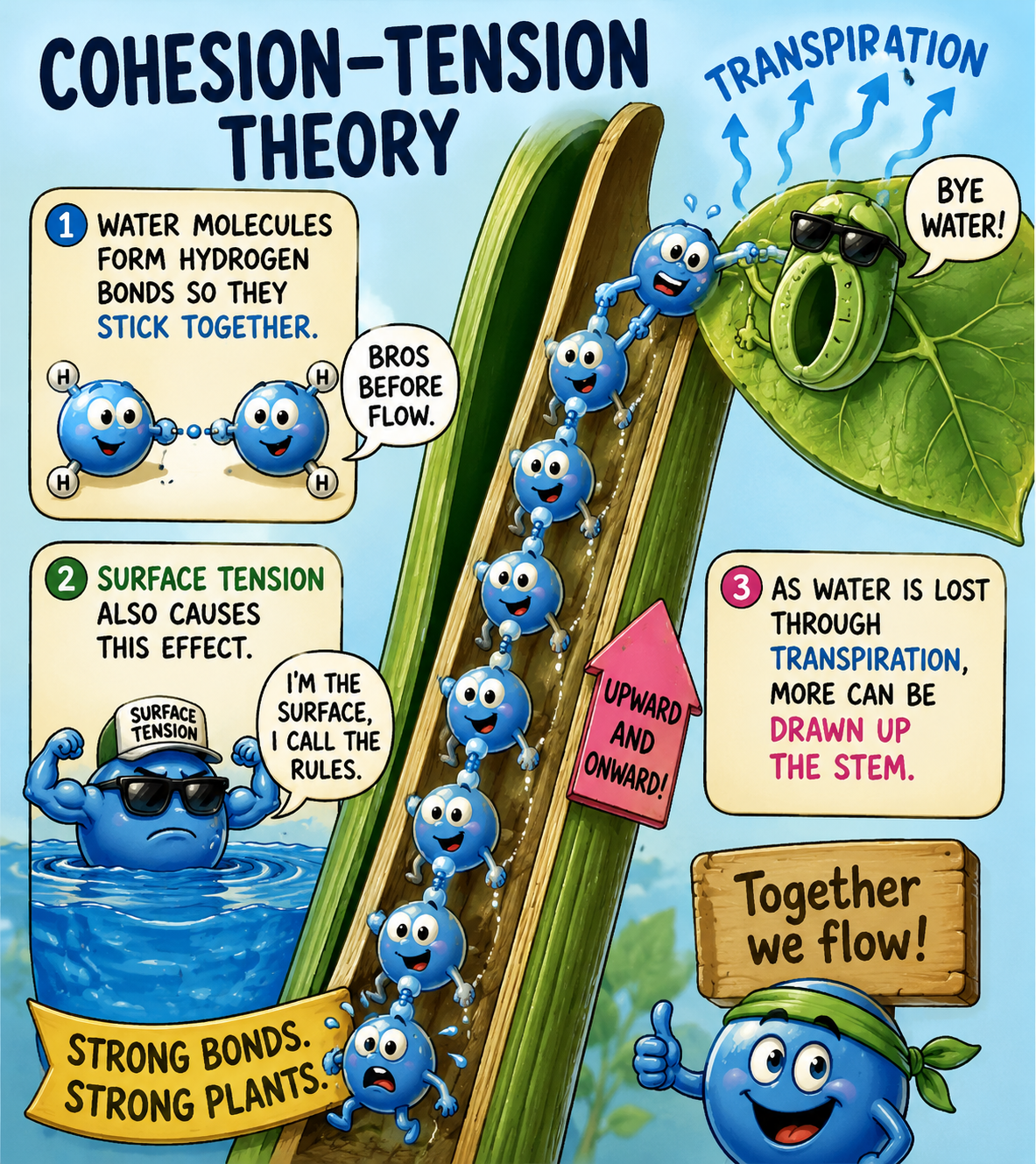
cohesion tension theory
water molecules form hydrogen bonds so they stick together
surface tension also causes this effect
as water is lost through transpiration more can be drawn up the stem
how does root pressure affect water movement
high mineral content gives root low water potential
strong osmotic flow into roots
creates weak push effect moving water from roots to stem
temp effect on rate of transpiration
higher temp increases random motion and evaporation so higher rate of transpiration
light effect rate of transpiration
higher light intensity increases rate of photosynthesis so stomata open increasing rate of transpiration
humidity effect on rate of transpiration
water content is high reducing conc gradient decreasing rate of transpiration
mass flow hypothesis of translocation
sugar loaded into sieve tubes by active transport
lower water potential so water moves in from xylem
hydrostatic pressure causes sugars to move
evidence for mass flow hypothesis
sap released when a stem is cut so must be pressure in phloem
higher sucrose content in leaves then roots
evidence against mass flow hypothesis
not all solutes move at same speed
direction movement in sieve tubes