About the default MCF attribution models
 Studied by 0 people
 Call Kai
 Learn
Learn Practice Test
 Spaced Repetition
 Match
Match Flashcards
 Knowt Play
1/3

There's no tags or description
Looks like no tags are added yet.
Name | Mastery | Learn | Test | Matching | Spaced |
|---|
No study sessions yet.
4 Terms
Overview
Based on the text provided from the Google Analytics support article, here is an in-depth, study-friendly explanation of the Default Multi-Channel Funnel (MCF) Attribution Models.
1. What are Default Attribution Models?
When a customer buys something online, they often interact with multiple marketing channels first (e.g., a Facebook ad, then a Google search, then an email).
Default Attribution Models are the pre-set rules in Google Analytics that decide how much credit each of those interactions gets for the final sale. Choosing the right model changes how you view the success of your marketing.
2. The Specific Models
The article outlines seven distinct models, each with a specific purpose.
A. The "Closer" Models (Focus on the End)
These models prioritize the final steps before a purchase.
Last Interaction
Rule: The very last channel the customer touched gets 100% of the credit.
Best For: Businesses with short sales cycles (no research phase) or ads designed to trigger immediate purchases. It ignores everything that happened earlier.
Last Non-Direct Click
Rule: It ignores "Direct" traffic (when a user types your URL). It gives 100% credit to the last marketing channel clicked.
Best For: This is the default model for most Google Analytics reports. It helps you filter out customers who already knew your brand (Direct traffic) so you can see which marketing effort finally won them over.
Last Google Ads Click
Rule: The most recent click on a Google Search Ad gets 100% credit, even if the customer clicked other things afterward.
Best For: Specifically evaluating the performance of your Google Ads campaigns to see which ads are closing sales.
B. The "Opener" Model (Focus on the Beginning)
This model prioritizes how the customer found you.
First Interaction
Rule: The very first channel the customer interacted with gets 100% credit.
Best For: Brand Awareness. If you are a new brand, this tells you which channels are successfully introducing you to new customers, even if they don't buy immediately.
C. The "balanced" Models (Focus on the Journey)
These models acknowledge that multiple steps played a role.
Linear
Rule: Every single interaction in the journey gets Equal Credit.
Best For: Campaigns designed to maintain contact throughout a long sales cycle. It assumes every touchpoint was equally necessary.
Time Decay
Rule: Interactions closer to the sale get more credit; interactions further back get less. It uses a 7-day half-life (an interaction 7 days ago gets half the credit of one today).
Best For: Short consideration phases or promotional campaigns (e.g., a 2-day sale). It rewards the actions that drove the immediate conversion while giving small credit to the earlier setups.
Position Based
Rule: A hybrid approach. Usually, 40% credit goes to the First interaction, 40% to the Last, and the remaining 20% is split among the Middle interactions.
Best For: Balancing Acquisition (First) and Closing (Last). It values the "introducer" and the "closer" most heavily.
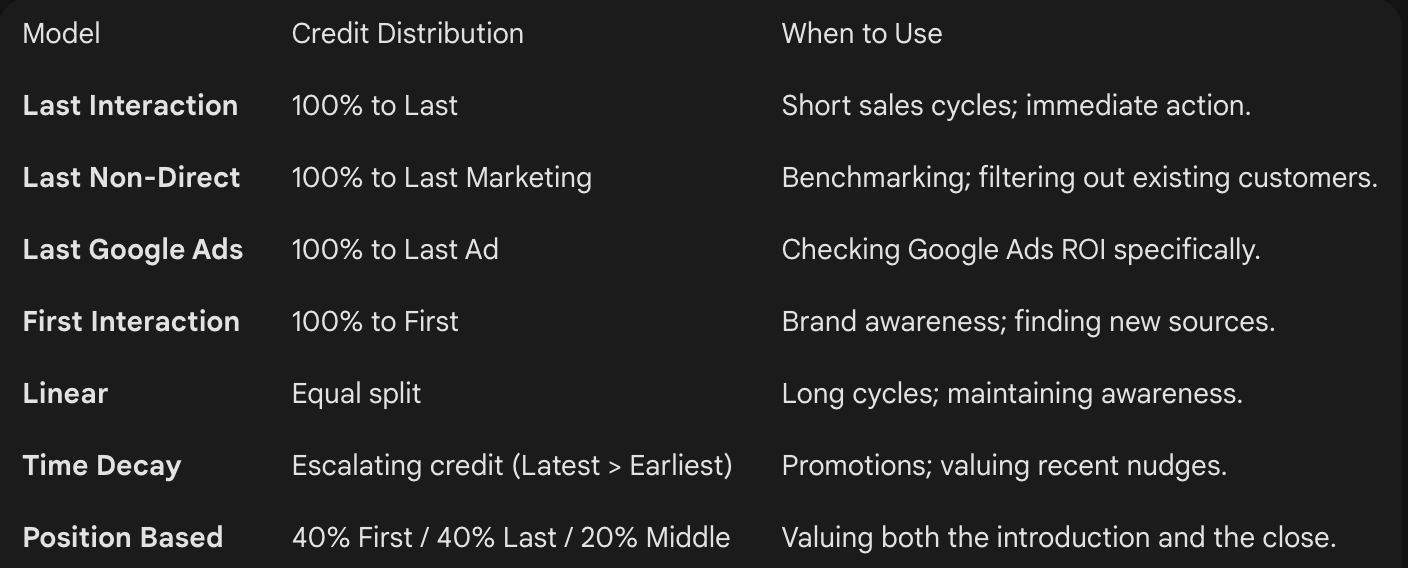
Summary Table for Study
 Note
Note  Flashcards (24)