Pulsed RADAR and RADAR Clutter
 Call Kai
 Learn
Learn Practice Test
 Spaced Repetition
 Match
Match Flashcards
 Knowt Play
1/8

There's no tags or description
Looks like no tags are added yet.
Name | Mastery | Learn | Test | Matching | Spaced | Call with Kai |
|---|
No analytics yet
Send a link to your students to track their progress
9 Terms
Pulsed RADAR
Radar transmits pulsed radio frequency signals
In receiver a clock measures the time for pulse to hit target and return
This time is given by 𝝉𝑫 = 2𝑅c
Hence target range is R = c 𝝉𝑫 / 2
PRF and PRI
Pulse repetition frequency = 1 / (Pulse repetition interval)
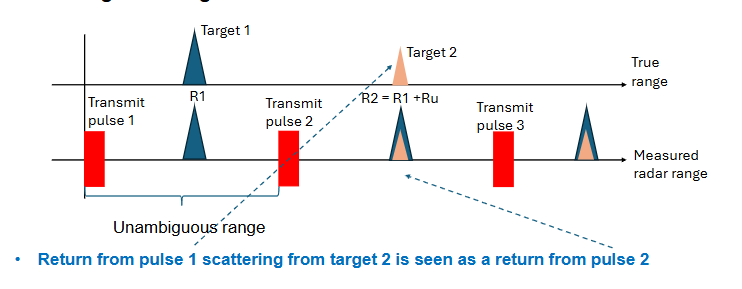
PRF determines the maximum unambiguous range Rmax
If the time taken for an echo pulse to return is greater than the time between transmit pulses (1/PRF) then the return is ambiguous
Pulse Width
Pulse width determines range resolution
RADAR returns from the 2 targets are separated in time by t = 𝟐∆R / 𝒄
Unambiguous range
Can avoid range ambiguities by using:
Multiple PRFs
Pulse coding (e.g. phase coding)
Pulsed Doppler RADAR
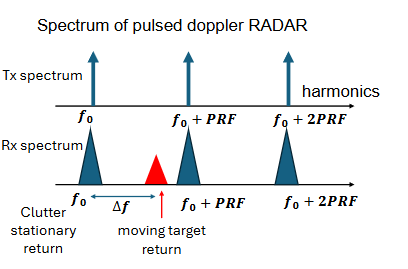
Provides range and speed
Receiver is a sampled system that uses In-Phase and Quadrature detectors
Ratio of I and Q gives phase of received signal
Successive samples gives rate of change of phase which gives speed
Ambiguous pulsed doppler RADAR
For doppler shift to not be ambiguous ∆𝒇 ≤ PRF / 2
Doppler resolution
Synthesise a wider pulse in the time domain so that we have a narrower pulse in the frequency domain
Width of Doppler spectrum from a single pulse of length 𝜏 𝑖𝑠 ≈ 1/𝜏 Hz
But if have N pulses then can integrate N pulses to give a Doppler spectrum pulse width of ≈ 1/𝑁𝜏 Hz
Doppler resolution = 1/ Integration time
RADAR Clutter
All unwanted radar returns
Most common type is ground or surface clutter (including sea)
Best described as RCS per unit area 𝜎0
Typical 𝜎0 for land is -20dbm2m-2
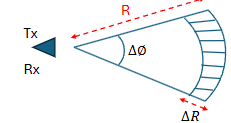
Simplified geometry
Clutter return is often much larger than the target return
Ground area illuminated by radar pulse 𝐴𝐺 = 𝑅∆∅∆𝑅