TSI - Regional Strategies Flashcards
 Studied by 0 people
 Call Kai
 Learn
Learn Practice Test
 Spaced Repetition
 Match
Match Flashcards
 Knowt Play
1/29

There's no tags or description
Looks like no tags are added yet.
Name | Mastery | Learn | Test | Matching | Spaced |
|---|
No study sessions yet.
30 Terms
Magnaghi, 2020 - Territorialist approach to urban bioregions
Place-based, local identity planning promoting ecological protection and self-sufficient economies in natural and historical regional boundaries
Territorial approach 1 (Magnaghi, 2020)
Unique place identity, territorial heritage and local communities shape sustainable development, rejection of top-down planning
Territorial approach 2 (Magnaghi, 2020)
Territory as physical space and living, historical and relational systems between humans and nature
Territorial approach 3 (Magnaghi, 2020)
Strategies involve local self-government, citizen participation, enhancing local resources (autonomy and resilience)
Bioregional sustainability 1 (Magnaghi, 2020)
Bioregions as areas defined by ecological, cultural and historical boundaries, not admin
Bioregional sustainability 2 (Magnaghi, 2020)
Goal to construct ecologically regenerative, socially cohesive and culturally rooted bioregions with specific characteristics
Bioregional sustainability 3 (Magnaghi, 2020)
Universal models do not achieve sustainability; local communities must base models on own ecosystems to create circular economies
Bioregional sustainability 4 (Magnaghi, 2020)
Re-localising production, reducing ecological footprints and fostering economies which respect ecological limits
Albrechts, 2004 - Strategic Planning Renewed
Alternative strategic spatial planning approach suggested
Strategic spatial planning (Albrechts, 2004)
Public process, shared visions, socio-spatial development process; frames decisions and mobilises stakeholders toward agreed regional futures
Regulatory land-use control to integrated regional development (Albrechts, 2004)
Strategic planning as a flexible framework integrating economic, environmental, social and spatial agendas
Strategic planning as a governance-driven, multi- level regional process (Albrechts, 2004)
Governance across local, regional, national, public, private and civil-society; based on negotiation, partnerships and stakeholder alignment
Value rationality (Albrechts, 2004)
What kind of region we want
Regional visions (Albrechts, 2004)
Created futures shaped by social values, political power and place identity
4 track model fof strategic planning (Albrechts, 2004)
Vision making
Stakeholder mobilisation
Define means to reach ends
Building legitimacy and consent
Vision making (Albrechts, 2004)
What future and values are desired?
Stakeholder mobilisation (Albrechts, 2004)
Which actors have interests and resources?
Define means to reach ends (Albrechts, 2004)
Implementation plans, rational
Building legitimacy and consent (Albrechts, 2004)
Strategy to deal with power imbalances
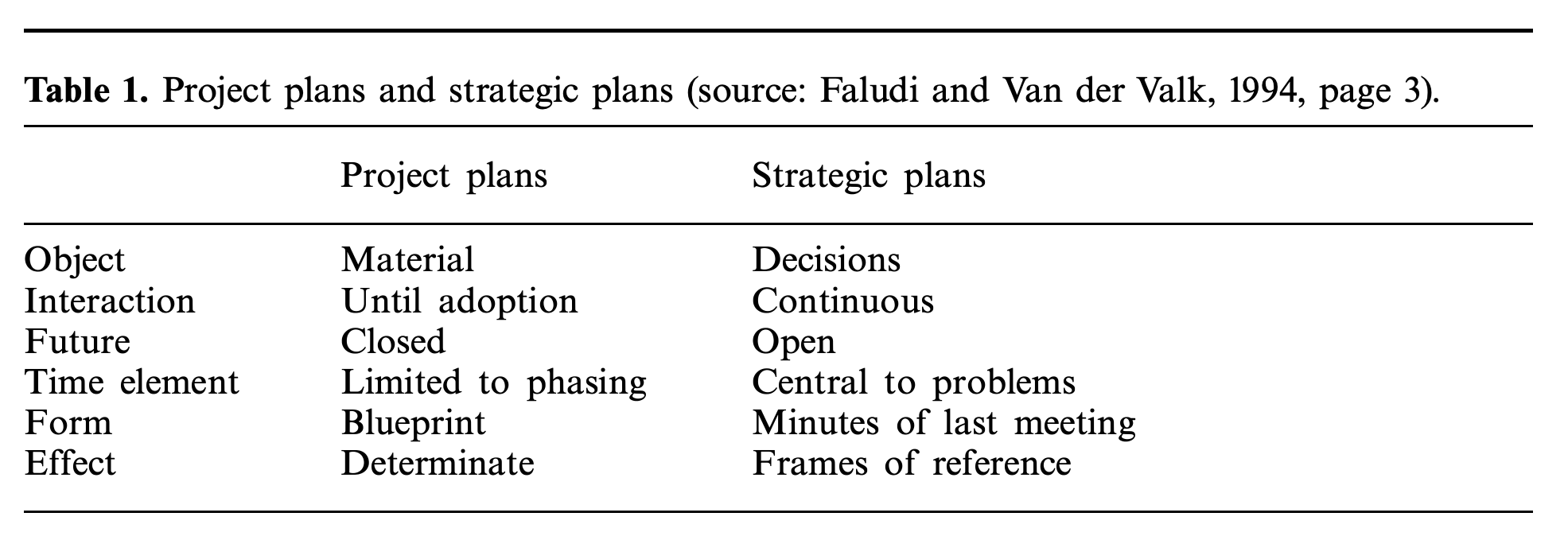
Project plans vs. strategic plans
Critique 1 (Albrechts, 2005)
Divided into sections to deal with disagreement e.g: isolates ecology from economy
Critique 2 (Albrechts, 2005)
Does not change power structures
Critique 3 (Albrechts, 2005)
Prone to lobby non-public experts or influential actors
Critique 4 (Albrechts, 2005)
Rooted in a modern view of positive-sum game which leads to progress and growth
Lindblom, 1995 - The Science of Muddling Through
Approaches of knowledge and the state
Root method (Lindblom, 1995)
Analyse the situation, new course of action, assess, new course of action
Branch method (Lindblom, 1995)
Incremental comparison, continuous adaptation of course of action based on long-term general direction
Critiques to incrementalism 1 (Lindblom, 1995)
Conservative: radical change is not possible, e.g: not suitable for climate change action
Critiques to incrementalism 2 (Lindblom, 1995)
Power: decisions reflecting policy arena interests, not the ‘voiceless’, protects existing power struggles
Critiques to incrementalism 1 (Lindblom, 1995)
Urgency: hard to enable fast change under instable situations; too slow at times
 Note
Note  Flashcards (60)